| Dec 18, 2025 |
Nanostructure control halves core loss in iron-based soft magnetic ribbonsNew processing tunes nanostructure and magnetic domains in iron-based amorphous ribbons, cutting core loss by over 50% for high-frequency power electronics.(Nanowerk News) In power electronics - the technology that converts and supplies electricity - the performance of soft magnetic materials used in transformers, inductors and other components is the key to improving their efficiency. Soft magnetic materials are metallic materials that respond quickly to external magnetic fields. However, as power electronics operate at increasingly higher frequencies, energy losses in these materials have grown, posing a serious efficiency challenge. |
| To face this challenge, a research team from the National Institute for Materials Science (NIMS), Tohoku University, and the National Institute of Advanced Industrial Science and Technology (AIST) has developed a new technique for improving the efficiency of soft magnetic materials (Nature Communications, "Ultra-low core loss in Fe-enriched soft magnetic ribbons enabled by nanostructure and high-frequency domain engineering"). |
| This technique controls the nanostructures and magnetic domain structures of iron-based soft amorphous ribbons, achieving more than a 50% reduction in core loss compared to the initial amorphous material. The developed material exhibits particularly high performance in the high-frequency range of several tens of kilohertz - required for applications in next-generation, high-performance transformers and EV drive power supply circuits. |
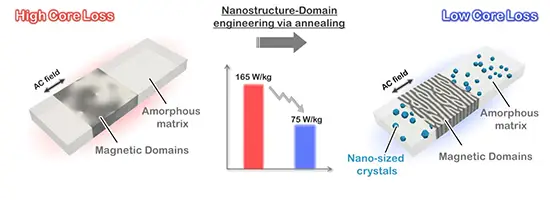 |
| Schematic diagrams of the nanostructure and magnetic domain structure of a conventional amorphous soft magnetic ribbon (left) and the newly developed ribbon (right). The new material exhibits a controlled nanostructure and magnetic domain structure achieved using optimized thermal treatment. The central graph demonstrates that these structural controls reduce core loss by more than 50%. (Image: Ravi Gautam et al.) |
| This breakthrough is expected to contribute to the advancement of these technologies, the development of more energy-efficient electric machines, and progress toward carbon neutrality. In the future, the research team plans to fabricate prototype devices such as transformers using the newly developed material and test its integration into actual power conversion circuits. |
| Source: Tohoku University (Note: Content may be edited for style and length) |