| Mar 16, 2026 |
Hydrogen-controlled AI semiconductor enables learning and memory in two-terminal device
A new neuromorphic device controls hydrogen ions to mimic synaptic learning and memory, achieved for the first time in a vertical two-terminal architecture.
(Nanowerk News) Researchers have developed the first artificial intelligence semiconductor that uses electrically controlled hydrogen migration to perform both computation and data storage. The team, led by Lee Hyun Jun and Noh Hee Yeon from the Division of Nanotechnology at DGIST, created a two-terminal device that precisely injects and discharges hydrogen ions to mimic the learning and memory functions of biological synapses (ACS Applied Materials & Interfaces, "Tunable Hydrogen Dynamics Under Electrical Bias for Neuromorphic Memory Applications").
|
Key Findings
- A novel switching mechanism based on hydrogen ion migration replaces conventional oxygen-vacancy-based approaches, improving device stability and uniformity.
- The technology was implemented in a two-terminal vertical structure for the first time, a configuration well suited to high-density neuromorphic chip manufacturing.
- The device operated reliably through more than 10,000 cycles and retained its stored state over extended periods.
|
|
Modern AI systems process enormous volumes of data, but conventional computer architectures separate computation from memory. This separation creates bottlenecks that slow processing and increase power consumption. Neuromorphic semiconductors offer an alternative by combining both functions in a single device, modeled on the way the human brain works. The core component of such systems is an artificial synapse, a device whose electrical conductivity changes in response to applied signals and holds that changed state over time.
|
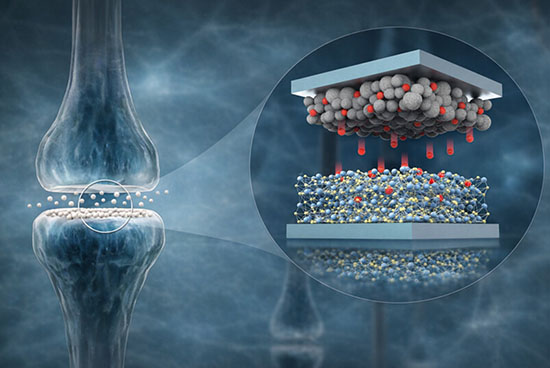 |
| A biological synapse (left) alongside the artificial hydrogen-controlled synapse device (right). In the two-terminal vertical structure, hydrogen ions (red) migrate between stacked oxide layers under an applied electric field, changing the device's conductivity to mimic synaptic learning and memory. (Image: Reproduced from DOI:10.1021/acsami.5c21475, CC BY)
|
|
Most oxide-based memory devices have relied on the movement of oxygen vacancies, which are defects in a material's crystal structure, to store information. While functional, this approach has struggled with long-term stability and consistency from one device to the next. The DGIST team took a different path, developing a method to control hydrogen ions (H⁺) using an electric field. By precisely managing where hydrogen atoms enter and leave the device, the researchers achieved reliable, repeatable switching, meaning the device can be toggled between different resistance states that each represent stored information.
|
|
Senior Researcher Lee Hyun Jun stated, "This research holds significant meaning beyond developing another AI semiconductor. It presents a novel resistive switching mechanism using hydrogen migration, which is entirely different from existing oxygen vacancy–based memory."
|
|
The hydrogen control was achieved within a two-terminal vertical structure, in which current flows through stacked semiconductor layers between just two electrodes. This configuration simplifies fabrication and allows more devices to be packed into a given area. No previous research had demonstrated precise electrical control of hydrogen migration in this type of architecture for AI operations.
|
|
In testing, the device completed over 10,000 switching cycles without degradation and maintained its programmed memory state during long-term storage. It also exhibited analog conductivity changes, meaning its resistance shifted gradually rather than flipping between two fixed states. This property allowed the researchers to demonstrate synaptic learning behaviors, where the connection strength between artificial neurons is tuned incrementally, much like biological synapses in the brain.
|
|
Associate Researcher Noh Hee Yeon emphasized, "This is the first case of precisely controlling the migration of hydrogen atoms between stacked semiconductor layers electrically," adding, "The findings from this study, which elucidated the hydrogen migration mechanism, will fundamentally change the architecture of AI hardware and accelerate the era of next-generation, low-power, high-efficiency neuromorphic semiconductors."
|
|
The study was selected as the cover paper for ACS Applied Materials & Interfaces. The recognition reflects both the novelty of using hydrogen as the active species in a resistive memory and the practical advantages of the vertical two-terminal format for scaling neuromorphic hardware toward lower power consumption and higher device density.
|