| Apr 01, 2026 |
Quantum circuit simulation for chemistry reaches new scale on 1024 GPUs
Researchers used 1,024 GPUs to run one of the world's largest quantum chemistry circuit simulations, surpassing the 40-qubit limit for state-vector methods.
(Nanowerk News) A research team from the Center for Quantum Information and Quantum Biology (QIQB) at The University of Osaka and Fixstars Corporation has carried out one of the world's largest classical simulations of quantum circuits designed for quantum chemistry. Using up to 1,024 NVIDIA H100 GPUs, the researchers pushed past the previous 40-qubit barrier for state-vector-based quantum circuit simulation, expanding the range of molecular systems that can be used to develop and test algorithms for future fault-tolerant quantum computers.
|
Key Findings
- The team simulated a 42-spin-orbital system for a water molecule using qubit reduction techniques, representing the largest problem size achieved.
- A 41-qubit circuit for an iron-sulfur (Fe₂S₂) molecule was executed as a pure circuit-scale benchmark, exceeding the previous 40-qubit limit.
- A new parallel computing method was developed to overcome inter-GPU communication bottlenecks and maximize the performance of large-scale GPU clusters.
|
|
Quantum computers capable of correcting their own errors, known as fault-tolerant quantum computers (FTQC), are expected to unlock calculations in quantum chemistry that remain out of reach for classical machines. These calculations could prove critical in areas such as drug discovery and advanced materials development, where the electronic structure of complex molecules must be modeled with high accuracy. Before such hardware becomes available, however, the quantum algorithms intended for it need to be developed, tested, and validated using classical simulations.
|
|
Quantum phase estimation (QPE) is a core subroutine in many quantum algorithms. In quantum chemistry, it can determine the energy levels of molecular systems, a task that grows exponentially harder for classical computers as the number of electrons and orbitals increases. The research group focused on iterative QPE (IQPE), a variant that achieves the same goal while requiring fewer qubits. They implemented the algorithm within a quantum chemistry circuit simulator called chemqulacs-gpu.
|
|
The team, consisting of Professor Wataru Mizukami, Assistant Technical Staff Shoma Hiraoka, and Assistant Technical Staff Sho Nishida at QIQB, along with Yusuke Teranishi of Fixstars Corporation, ran their simulations on the ABCI-Q system operated by Japan's National Institute of Advanced Industrial Science and Technology (AIST). The system provided up to 1,024 NVIDIA H100 GPUs for the task. Within a limited 48-hour computation window, the researchers encountered and resolved a series of technical challenges to complete the simulations.
|
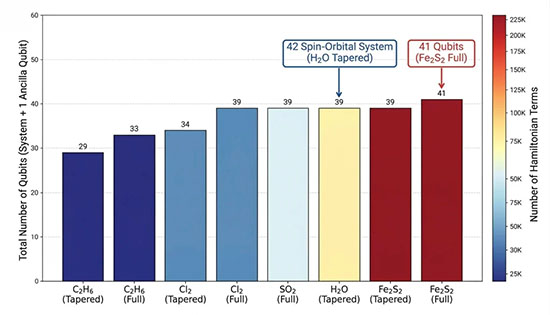 |
| Large-scale classical simulation of IQPE quantum circuits demonstrated in this work. Larger qubit counts and more Hamiltonian terms result in deeper circuits and longer simulation times. (Image: QIQB, The University of Osaka)
|
|
"Large-scale simulation of quantum circuits using 1,024 GPUs in unison is technically demanding, and within the limited 48-hour computation window we repeatedly encountered unexpected issues," said Professor Mizukami. "I am delighted that the team, led by two young researchers, Yusuke Teranishi and Shoma Hiraoka, persevered throughout the effort, and that, with prompt support from the ABCI-Q operations staff, we were able to achieve one of the world's largest results. I hope this accomplishment will help accelerate the development of quantum algorithms."
|
|
A key technical obstacle in distributing quantum circuit simulations across hundreds of GPUs is communication overhead. When a quantum state vector is split across many devices, gate operations that involve non-local qubits require data to be exchanged between GPUs, creating bottlenecks that can negate the benefit of additional hardware. Fixstars Corporation contributed GPU performance profiling and optimization technologies to address this problem. Their work on the simulation code resolved complex inter-GPU communication bottlenecks and enabled efficient circuit execution at scale.
|
|
The two headline results illustrate different aspects of the achievement. The 42-spin-orbital water molecule simulation applied qubit reduction techniques to represent a relatively complex electronic structure problem, demonstrating the practical reach of the platform for realistic quantum chemistry. The 41-qubit Fe₂S₂ circuit, run without such reduction, served as a raw benchmark of circuit simulation capacity and confirmed that the system can operate beyond the previous 40-qubit ceiling for state-vector methods applied to quantum chemistry.
|
|
QIQB led the research and developed the methods for classically simulating IQPE quantum circuits on GPU clusters, including the interface connecting the quantum chemistry layer to the simulation layer. Fixstars Corporation was responsible for optimizing the simulation code and tuning performance on ABCI-Q, resolving the inter-GPU communication bottlenecks that had limited efficiency at large node counts.
|
|
By extending the scale at which quantum chemistry circuits can be classically simulated, this work gives algorithm developers a broader set of molecular benchmarks to work with. As fault-tolerant quantum hardware advances, testing and refining algorithms on systems of increasing complexity will be essential for turning theoretical quantum advantage into practical results in pharmaceutical design and clean energy materials.
|
|
The results were presented at NVIDIA GTC 2026, to be held in San Jose, California, in March 2026 ("P81339 - Efficient Iterative QPE Simulations for Quantum Chemistry using Distributed State-Vector Methods").
|