

| May 21, 2012 |
From lemons to lemonade: Reaction uses carbon dioxide to make carbon-based semiconductor |
| (Nanowerk News) A materials scientist at Michigan Technological University has discovered a chemical reaction that not only eats up the greenhouse gas carbon dioxide, it also creates something useful. And, by the way, it releases energy. |
| Making carbon-based products from CO2 is nothing new, but carbon dioxide molecules are so stable that those reactions usually take up a lot of energy. If that energy were to come from fossil fuels, over time the chemical reactions would ultimately result in more carbon dioxide entering the atmosphere—defeating the purpose of a process that could otherwise help mitigate climate change. |
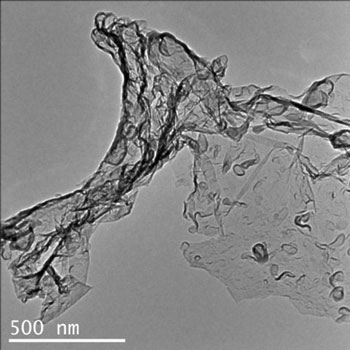 |
| Transmission electron microscopy image of carbon nitride created by the reaction of carbon dioxide and Li3N. |
| Professor Yun Hang Hu's research team developed a heat-releasing reaction between carbon dioxide and Li3N that forms two chemicals: amorphous carbon nitride (C3N4), a semiconductor; and lithium cyanamide (Li2CN2), a precursor to fertilizers. |
| "The reaction converts CO2 to a solid material," said Hu. "That would be good even if it weren't useful, but it is." |
| And how much energy does it release? Plenty. Hu's team added carbon dioxide to less than a gram of Li3N at 330 degrees Celsius, and the surrounding temperature jumped almost immediately to about 1,000 degrees Celsius, or 1,832 degrees Fahrenheit, about the temperature of lava exiting a volcano. |
| Hu's work is funded by the National Science Foundation and detailed in the article "Fast and Exothermic Reaction of CO2 and Li3N into C–N-Containing Solid Materials", authored by Hu and graduate student Yan Huo and published in the Journal of Physical Chemistry. |
| Source: By Marcia Goodrich, Michigan State University |

