| Apr 28, 2022 |
Spinning stars shed new light on strange signal coming from galactic centre |
| (Nanowerk News) Researchers from The Australian National University (ANU) have found an alternative explanation for a mysterious gamma-ray signal coming from the centre of the galaxy, which was long claimed as a signature of dark matter (Nature Astronomy, "Millisecond pulsars from accretion-induced collapse as the origin of the Galactic Centre gamma-ray excess signal"). |
| Gamma-rays are the form of electromagnetic radiation with the shortest wavelength and highest energy. |
| Co-author of the study Associate Professor Roland Crocker said this particular gamma-ray signal – known as the Galactic Centre Excess – may actually come from a specific type of rapidly-rotating neutron star, the super-dense stellar remnants of some stars much more massive than our sun. |
| The Galactic Centre Excess is an unexpected concentration of gamma-rays emerging from the centre of our galaxy that has long puzzled astronomers. |
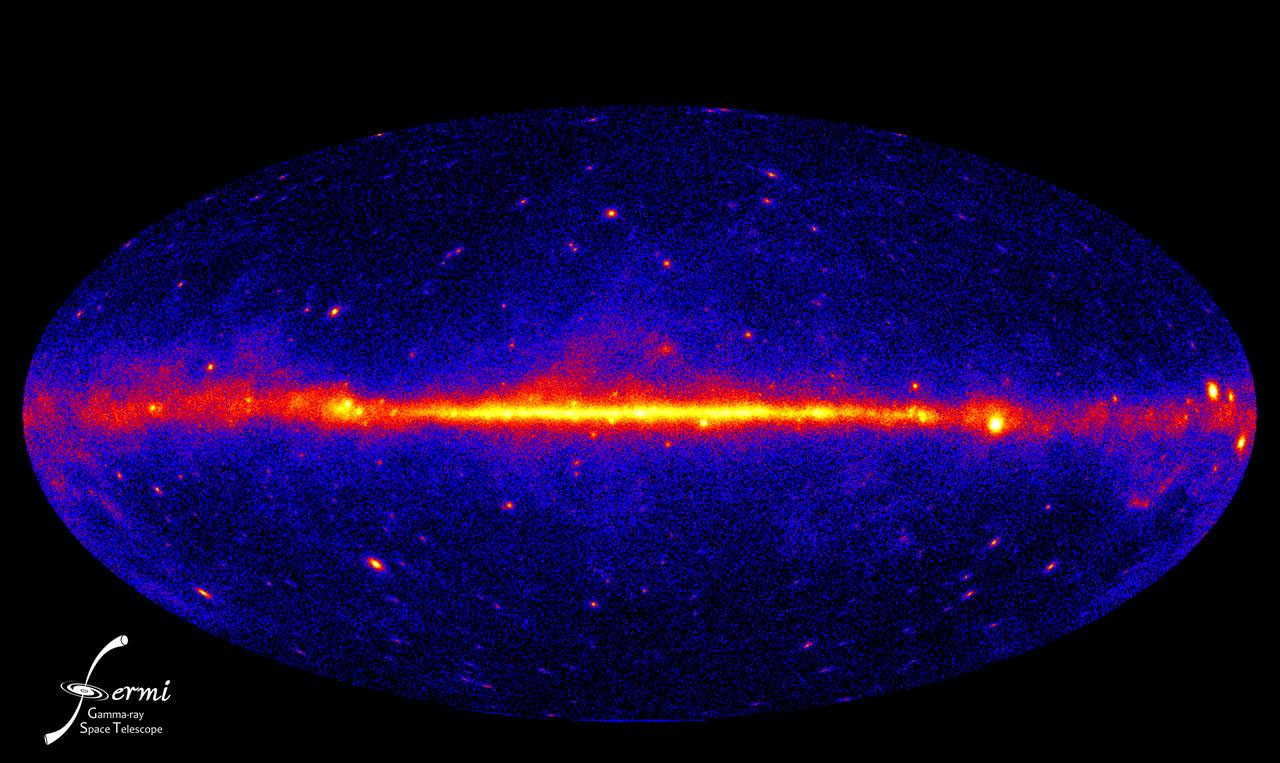 |
| View of the gamma-ray sky. (Image: NASA/DOE/Fermi LAT Collaboration) |
| “Our work does not throw any doubt on the existence of the signal, but offers another potential source,” Associate Professor Crocker said. |
| “It is based on millisecond pulsars -- neutron stars that spin really quickly -- around 100 times a second. |
| “Scientists have previously detected gamma-ray emissions from individual millisecond pulsars in the neighbourhood of the solar system, so we know these objects emit gamma-rays. Our model demonstrates that the integrated emission from a whole population of such stars, around 100,000 in number, would produce a signal entirely compatible with the Galactic Centre Excess.” |
| The discovery may mean scientists have to re-think where they look for clues about dark matter. |
| “The nature of dark matter is entirely unknown, so any potential clues garner a lot of excitement,” Associate Professor Crocker said. |
| “But our results point to another important source of gamma-ray production. |
| “For instance, the gamma-ray signal from Andromeda, the next closest large galaxy to our own may be mostly due to millisecond pulsars.” |
| Source: Australian National University |