| Feb 25, 2025 |
Have we been wrong about why Mars is red?
Mars's rusty dust reveals a wetter planetary history than thought. New lab tests on simulated Mars dust, combined with spacecraft data, show Mars rusted during its ancient aqueous period.
|
|
(Nanowerk News) Mars is easily identifiable in the night sky by its prominent red hue. Thanks to the fleet of spacecraft that have studied the planet over the last decades, we know that this red colour is due to rusted iron minerals in the dust. That is, iron bound up in Mars’s rocks has at some point reacted with liquid water, or water and oxygen in the air, similar to how rust forms on Earth.
|
|
Over billions of years this rusty material – iron oxide – has been broken down into dust and spread all around the planet by winds, a process that continues today.
|
|
But iron oxides come in many flavours, and the exact chemistry of martian rust has been intensely debated because how it formed is a window into the planet’s environmental conditions at the time. And closely linked to that is the question of whether Mars has ever been habitable.
|
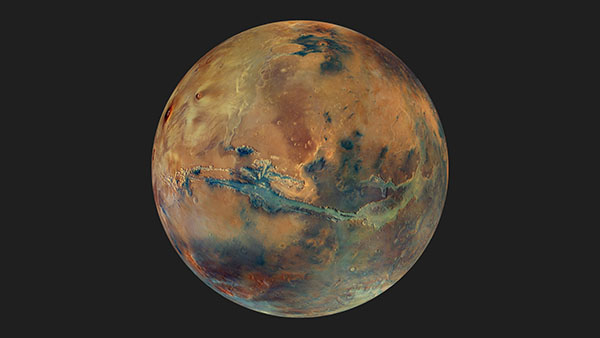 |
| This is a simulated view of Mars from a vantage point 2500 km above the colossal Valles Marineris canyon system, with enhanced colour and contrast (at this relatively low altitude, the planet’s polar caps are not visible). It is a composite of red, green and blue filter mosaics with the colour band values stretched individually, and has a spatial resolution of 2 km per pixel (although higher resolution data products are possible and already in the works). The image does not show the true beige to brown colours of Mars as seen from orbit – the contrast of each colour channel is stretched to highlight variations. Darker grey-toned areas of Mars represent grey-black basaltic sands of volcanic origin; lighter patches show clay and sulphate minerals; and the large scar across the planet's face is Valles Marineris. (Image: ESA / DLR / FU Berlin / G. Michael)
|
|
Previous studies of the iron oxide component of the martian dust based on spacecraft observations alone did not find evidence of water contained within it. Researchers had therefore concluded that this particular type of iron oxide must be hematite, formed under dry surface conditions through reactions with the martian atmosphere over billions of years – after Mars’s early wet period.
|
|
However, new analysis of spacecraft observations in combination with novel laboratory techniques shows that Mars’s red colour is better matched by iron oxides containing water, known as ferrihydrite. Ferrihydrite typically forms quickly in the presence of cool water, and so must have formed when Mars still had water on its surface. The ferrihydrite has kept its watery signature to the present day, despite being ground down and spread around the planet since its formation.
|
|
“We were trying to create a replica martian dust in the laboratory using different types of iron oxide. We found that ferrihydrite mixed with basalt, a volcanic rock, best fits the minerals seen by spacecraft at Mars,” says lead author Adomas Valantinas, a postdoc at Brown University in the US, formerly at the University of Bern in Switzerland where he started his work with ESA’s Trace Gas Orbiter (TGO) data.
|
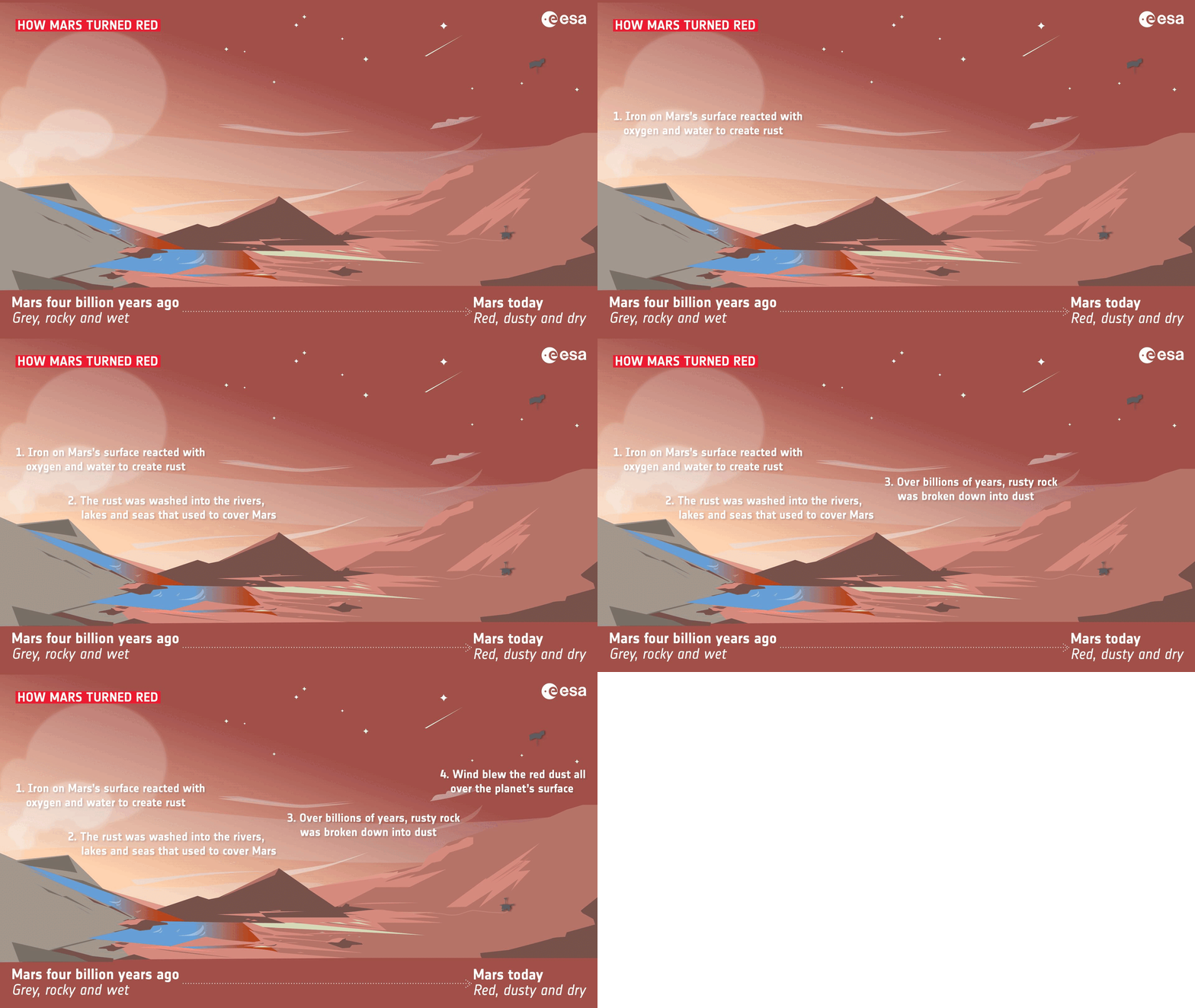 |
| Graphic showing how Mars turned from a grey, wet planet into a dusty red planet. From left to right, four steps are illustrated in a single image. First, iron in the planet’s rocks react with oxygen and water to create rust. Then the rust is washed into rivers, lakes and seas, and becomes incorporated in the underlying rocks. A volcano is also shown to represent a heat source that may have melted ice, further washing the rust into pools. Over billions of years the rusty rock is broken down into dust. Finally, winds blow the dust around the planet. A rover is shown on the surface, representing the direct analyses of this rusty dust. An orbiting spacecraft surveys the scene from above. (Image: ESA)
|
|
“Mars is still the Red Planet. It’s just that our understanding of why Mars is red has been transformed. The major implication is that because ferrihydrite could only have formed when water was still present on the surface, Mars rusted earlier than we previously thought. Moreover, the ferrihydrite remains stable under present-day conditions on Mars.”
|
|
Other studies have also suggested ferrihydrite might be present in martian dust, but Adomas and colleagues have provided the first comprehensive proof through the unique combination of space mission data and novel laboratory experiments.
|
|
They created the replica martian dust using an advanced grinder machine to achieve the realistic dust grain size equivalent to 1/100th of a human hair. They then analysed their samples using the same techniques as orbiting spacecraft in order to make a direct comparison, finally identifying ferrihydrite as the best match.
|
|
“This study is the result of the complementary datasets from the fleet of international missions exploring Mars from orbit and at ground level,” says Colin Wilson, ESA’s TGO and Mars Express project scientist.
|
|
Mars Express’s analysis of the dust’s mineralogy helped show that even highly dusty regions of the planet contain water-rich minerals. And thanks to TGO’s unique orbit that allows it to see the same region under different illumination conditions and angles, the team could disentangle particle size and composition, essential for recreating the correct dust size in the lab.
|
|
Data from NASA’s Mars Reconnaissance Orbiter, together with ground-based measurements from NASA Mars rovers Curiosity, Pathfinder and Opportunity, also helped make the case for ferrihydrite.
|
|
“We eagerly await the results from upcoming missions like ESA’s Rosalind Franklin rover and the NASA-ESA Mars Sample Return, which will allow us to probe deeper into what makes Mars red,” adds Colin.
|
|
“Some of the samples already collected by NASA’s Perseverance rover and awaiting return to Earth include dust; once we get these precious samples into the lab, we’ll be able to measure exactly how much ferrihydrite the dust contains, and what this means for our understanding of the history of water – and the possibility for life – on Mars.”
|
|
The findings have been published in Nature Communications ("Detection of ferrihydrite in Martian red dust records ancient cold and wet conditions on Mars").
|