| May 27, 2025 |
Space-to-ground infrared camouflage with radiative heat dissipation
Researchers propose a novel camouflage strategy for space objects.
|
|
(Nanowerk News) The space industry has seen rapid growth, with satellite launches increasing sharply. By the end of 2023, there were more than 9,850 active spacecraft worldwide, and the annual space economy had grown to $400 billion. As space technologies become more deeply embedded in daily life, protecting high-value space assets like satellites from detection has become an important challenge.
|
|
Most space objects are tracked from Earth using sensors that detect signals in the visible, infrared, and microwave parts of the spectrum. Visible detection is less reliable during the day because of bright sky backgrounds, and microwave detection is limited by power constraints, making it more suitable for spotting objects in low Earth orbit. Infrared detection, however, poses a greater risk because it benefits from lower background interference, allowing clearer signals with better contrast.
|
|
Although infrared camouflage technologies have improved, they still fall short in space’s harsh and unusual environment. One issue is that camouflage often overlooks solar radiation in the infrared range. Another is that the materials used for cooling by radiating heat don’t perform well enough to keep spacecraft in a safe temperature range (typically –20°C to 70°C). Since conduction and convection don’t work in space, radiative cooling is the only way to manage heat. Camouflage materials also need to be lightweight and durable to withstand space conditions.
|
|
To address these challenges, researchers led by Professor Qiang Li at Zhejiang University’s State Key Laboratory of Extreme Photonics and Instrumentation have developed a new camouflage strategy. In a paper published in Light: Science & Applications ("Space-to-ground infrared camouflage with radiative heat dissipation"), the team describes a multilayer thin-film device designed to provide both stealth and heat management for spacecraft.
|
|
Their approach targets several key infrared bands—H (1.5–1.8 μm), K (2–2.4 μm), mid-wave infrared (MWIR, 3–5 μm), long-wave infrared (LWIR, 8–13 μm), and very-long-wave infrared (VLWIR, 13–25 μm). The device reflects and absorbs radiation to reduce visibility in key detection bands while using the VLWIR band for efficient heat release.
|
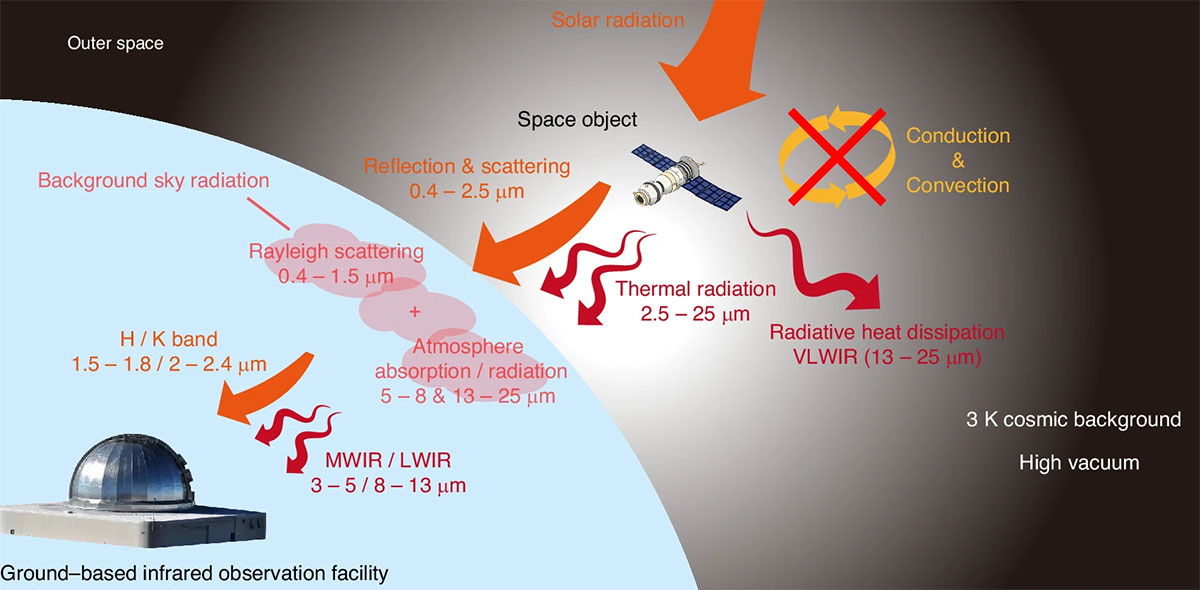 |
| Principle for space-to-ground infrared camouflage with radiative heat dissipation. (Image: Qin, B., Zhu, H., Zhu, R. et al.) (click on image to enlarge)
|
|
The multilayer structure consists of ZnS, GST, HfO₂, Ge, and Ni, with each material contributing to specific optical or thermal properties. In the H and K bands, the device strongly absorbs solar radiation (with absorptivity values of 0.839 and 0.633), reducing reflected signals. In the MWIR and LWIR bands, it emits very little thermal radiation (emissivity values of 0.132 and 0.142), helping to mask the object’s heat signature. At the same time, it has high emissivity (0.798) in the VLWIR band, allowing it to release heat efficiently.
|
|
To test the device, the researchers attached it to a satellite model and observed it outdoors using infrared cameras to simulate Earth-based detection. In the MWIR and LWIR bands, parts of the satellite without the camouflage reached 42.2°C and 45.5°C. In contrast, the camouflaged areas showed much cooler temperatures of 30.5°C and 21.0°C—close to the sky’s background temperature. The device also reduced infrared signal intensity by 36.9% in the H band and 24.2% in the K band compared to uncoated metal surfaces, proving its effectiveness in hiding both heat and reflected light.
|
|
To further test its cooling performance, the team recreated space-like conditions in a vacuum chamber set at 0.15 Pa, where heat can only escape by radiation. Liquid nitrogen simulated the cold of deep space (about 3 K), while an electric heater mimicked the heat generated during satellite operations. Under a heat input of 1,200 W/m², the device stayed 39.8°C cooler than a conventional metal film, demonstrating its strong heat management capabilities.
|
|
The success of this design lies in its ability to control light and heat across multiple infrared bands with a very thin structure—just 4.25 micrometers thick. It combines stealth, efficient cooling, and thermal stability in one device. The researchers believe this work has strong potential to improve the survivability of spacecraft and support future space missions.
|