| Jun 03, 2025 |
Cosmic Himalayas quasar cluster defies explanationA cluster of eleven quasars on a galactic boundary challenges existing models, prompting a rethink of quasar formation in large-scale cosmic structures. |
| (Nanowerk News) A newly discovered cluster of eleven quasars has shattered the previous record of five. Rather than being associated with a dense group of galaxies, these quasars sit on the boundary between two groups of galaxies. This structure, dubbed the “Cosmic Himalayas,” cannot be explained by conventional theories, forcing astronomers to rethink the formation scenarios for quasars. |
| Quasars are some of the brightest objects in the Universe. A quasar is powered by large amounts of matter falling into the supermassive black hole at the center of a galaxy. Collisions and mergers between galaxies can cause quasar activity by feeding addition matter into the center of a galaxy. Quasar activity peaked in the early Universe, but even then they were relatively rare. |
| So an international research team led by Yongming Liang at the National Astronomical Observatory of Japan was surprised when they found a group of elven quasars in an area of space where you would normally expect to see maybe one, while analyzing data from the Sloan Digital Sky Survey. The previous record holder for quasar over-density had been five. |
| Follow-up observations with the Subaru Telescope revealed another mystery. The quasars do not coincide with a dense group of galaxies. Instead, they sit on the boundary between two groups. If galaxy collisions and mergers are responsible for quasar activity, then the densest groups of quasars should be found in the densest group of galaxies. A new formation scenario is needed to explain this group of quasars, which could change the way we think about the evolution of other structures in the Universe. |
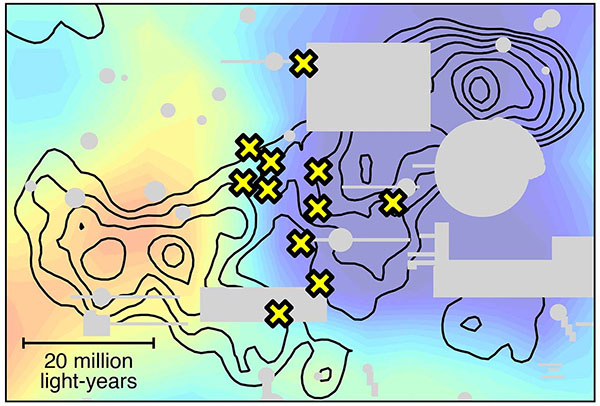 |
| The "Cosmic Himalayas": a towering cluster of energetic quasars shaping the cosmic landscape. Yellow X marks indicate the positions of quasars. The color scale represents the density of neutral hydrogen gas, with red indicating high density and blue indicating low density, or in other words, the blue region is rich in ionized gas. Therefore, the neutral gas concentrates in the left cluster of galaxies, while the ionized gas preferentially appears around the right galaxy clump. Black contour lines show the galaxy density. Gray regions are masked areas due to poor image mosaic or saturation near bright stars. (Image: Subaru Telescope / SDSS, Liang et al.) |
| The team hopes that new data from next-generation instruments like the Prime Focus Spectrograph on the Subaru Telescope will help to solve the mysteries of the Cosmic Himalayas. |
| The research team named this formation the Cosmic Himalayas in reference to how the towering Himalayas on Earth form a boundary between plains and plateaus. The Cosmic Himalayas sit 10.8 light years away from Earth in the direction of the constellation Cetus. |
| A preprint of the findings to be published in The Astrophysical Journal is availabe ("Cosmic Himalayas: The Highest Quasar Density Peak Identified in a 10,000 deg2 Sky with Spatial Discrepancies between Galaxies, Quasars, and IGM HI"). |
| Source: National Astronomical Observatory of Japan (Note: Content may be edited for style and length) |