| Jul 16, 2025 |
The most massive black hole merger ever observed through gravitational waves
Merger creates black holes weighing 240 times the mass of our Sun.
|
|
(Nanowerk News) The event, designated GW231123, was detected by the LIGO-Virgo-KAGRA (LVK) Collaboration during its fourth observing run (O4) on 23 November 2023 – using the US National Science Foundation-funded LIGO Hanford and Livingston Observatories.
|
|
The merger involved two black holes weighing approximately 100 and 140 times the mass of our Sun. Their collision produced a final black hole more than 240 times the mass of our Sun — making it the heaviest binary black hole system ever confirmed through gravitational-wave observations.
|
|
The detection of this intermediate-mass black hole marks a landmark achievement in gravitational-wave science. It opens a new frontier in our understanding of black hole formation and underlines the urge to accelerate innovation towards the next generation of gravitational-wave detectors, promising even more spectacular discoveries, says Dr Amit Singh Ubhi, University of Birmingham.
|
|
The discovery was made possible by the coincident observation across multiple detectors, and the continuous cutting-edge upgrades to their instrumentation. Dr Amit Singh Ubhi, a Research Fellow who contributed to the design and production of new hardware developed in Birmingham for the LIGO detectors, commented: "The detection of this intermediate-mass black hole marks a landmark achievement in gravitational-wave science. It opens a new frontier in our understanding of black hole formation and underlines the urge to accelerate innovation towards the next generation of gravitational-wave detectors, promising even more spectacular discoveries.”
|
|
Dr Debnandini Mukherjee, Research Fellow at the University’s Institute for Gravitational Wave Astronomy, was a member of the team which analysed the data. She commented: “This event is the heaviest binary ever detected with such high confidence. It is a powerful example of the outstanding technological improvements achieved by the detector network, how much we can learn from gravitational-wave astronomy, and how much more there is to uncover.”
|
|
The black holes involved in GW231123 are so massive that they challenge existing models of stellar evolution, which predict an upper mass limit for black holes formed from collapsing stars.
|
|
Moreover, the black holes were spinning at speeds approaching the theoretical limit set by Einstein’s general relativity, suggesting a complex formation history, possibly involving earlier mergers of smaller black holes.
|
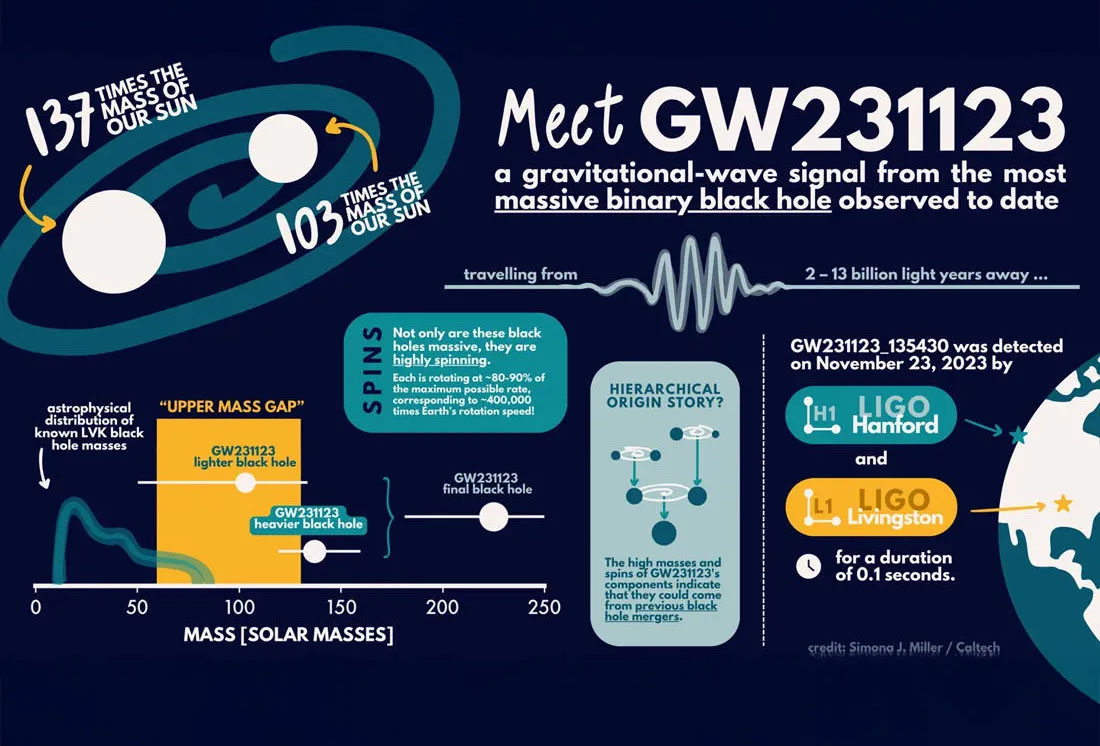 |
| GW231123_135430 was detected on 23 November 2023 by H1 LIGO Hanford and L1 LIGO Livingston for a duration of 0.1 seconds. The merger involved two black holes, weighing approximately 100 and 140 times the mass of our Sun. Not only are these black holes massive, they are highly spinning. Each is rotating at ~80-90% of the maximum possible rate, corresponding to ~400,000 times Earth's rotation speed! Hierarchical origin story? The high masses and spins of GW231123's components indicate that they could come from previous black hole mergers. (Infographic: University of Birmingham) (click on image to enlarge)
|
|
Dr Panagiota Kolitsidou, Research Fellow at the Institute, contributed to the validation of the theoretical models used. She commented: “Black holes this massive cannot be explained by stellar collapse alone. GW231123 stands out as an exceptional puzzle for current astrophysical models. It is a treasure trove for new insights on the astrophysics of binary systems, insights that can only be achieved through gravitational waves.”
|
|
Extracting accurate information from the signal required advanced modelling to account for the complex dynamics of highly spinning black holes. The University of Birmingham team was instrumental in analysing the data and validating the theoretical models used to interpret the event.
|
|
It will take years for the community to fully unravel this intricate signal pattern and all its implications. Despite the most likely explanation remaining a black hole merger from a circular orbit, more complex scenarios could be the key to deciphering its unexpected features – there are exciting times ahead! says Dr Gregorio Carullo, University of Birmingham.
|
|
Dr Gregorio Carullo, Assistant Professor at the Institute, was a member of the analysis team. He commented: “It will take years for the community to fully unravel this intricate signal pattern and all its implications. Despite the most likely explanation remaining a black hole merger from a circular orbit, more complex scenarios could be the key to deciphering its unexpected features – there are exciting times ahead!”
|
|
Approximately 100 black-hole mergers have previously been observed through gravitational waves. Until now the most massive binary was the source of GW190521, with a much smaller total mass of ‘only’ 140 times that of the Sun.
|