| Aug 06, 2025 |
Satellite Internet of Things promises smarter global connectivityResearchers are building better satellite IoT systems to improve global coverage, reduce delays, and meet the growing demand from connected devices. |
| (Nanowerk News) Researchers in China are working on smarter ways to connect devices in space. A team from Zhejiang University and the Chinese Academy of Sciences has developed new communication technologies aimed at improving how Internet of Things (IoT) devices connect via satellite. Their study highlights both the challenges of building such systems and the potential solutions that could make global satellite IoT a practical reality. |
| The review, published in the journal Frontiers of Information Technology & Electronic Engineering ("Satellite Internet of Things: challenges, solutions, and development trends"), outlines how satellite-based IoT networks differ from traditional networks. Unlike systems designed for human use—like mobile phones—satellite IoT supports devices that transmit small bursts of data intermittently. This includes sensors in remote areas, such as weather monitors, cargo trackers, or agricultural equipment. |
| The architecture of a satellite IoT network involves devices, gateways, and access points—typically low Earth orbit (LEO) satellites. These satellites use beams to send signals to devices, but issues like interference between beams and rapid movement of satellites make signal stability and data transfer difficult. Geosynchronous satellites (GEO), which stay in fixed positions, can transmit faster using lasers or millimeter waves, but they can’t serve every part of the globe equally. |
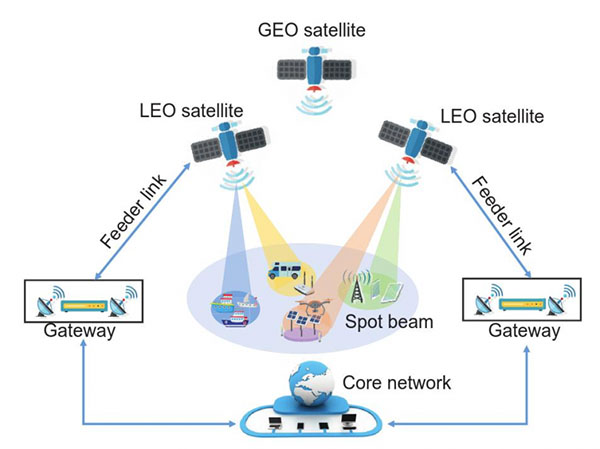 |
| A typical network architecture of satellite Internet of Things (IoT) (LEO: low Earth orbit; GEO: geosynchronous orbit). (Image: Xiaoming CHEN et al.) |
Several key problems stand in the way of efficient satellite IoT:
|
| To overcome these, the researchers recommend moving away from older communication methods. Instead of relying on permission-based systems, they propose “grant-free” protocols, which let devices send data more freely and reduce delays. They also explore the use of advanced detection algorithms and new multiple access techniques to improve signal quality and reduce interference. |
| Looking ahead, the study suggests combining LEO and GEO satellites, integrating terrestrial and satellite networks, and even linking satellite IoT with deep-space networks. These steps could expand the reach of IoT from Earth to the Moon and beyond, enabling continuous global coverage and more reliable service. |
| Source: Chinese Academy of Sciences (Note: Content may be edited for style and length) |