An exploding star reveals what old stars look like before they go supernova (w/video)
A rare supernova let scientists glimpse a star's interior, revealing a dense silicon-sulphur shell and unexpected helium that should have vanished earlier.
(Nanowerk News) An exploding star has given researchers a rare chance to find out what the inside of old stars looks like, according to an international study. Usually, when a star explodes in a supernova, the internal layers of the star get mixed up, making it hard to determine its structure.
In 2021, a star called 2021yfj exploded after having already lost most of its outer layers, giving the researchers a chance to see just what it looks like on the inside. They found a thick, massive silicon- and sulphur-rich shell which was expelled by the star shortly before the supernova explosion.
However, they also detect helium, which was surprising as it was assumed that this lighter element would have been lost during earlier stages of the supernova.
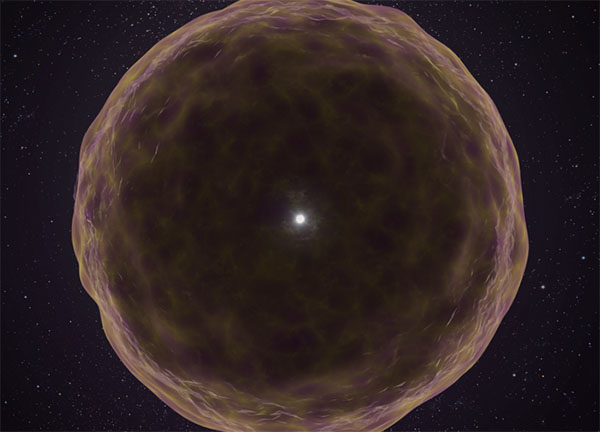
Its progenitor star lost its outer shells well before the supernova happened and only consisted of its oxygen/silicon core – unlike any known star in the Milky Way. Yet, the dying, stripped-to-the-bone star experienced extreme mass loss episodes that led to the ejecting of material rich in silicon (grey), sulfur (yellow), and argon (purple), shown in this figure. Exposing such an inner stellar layer challenges existing theories about mass-loss and stripping in massive stars and suggests that a rare mechanism may have been involved. (Image: Keck Observatory, Adam Makarenko)
Such a rare cosmic event, in which a star reveals its inner structure as it explodes as a supernova, is reported in Nature ("Extremely stripped supernova reveals a silicon and sulfur formation site"). The observations offer insights into the evolution of stars and may confirm predictions about the structure of stars nearing the end of their lives.
Massive stars at the end of their lives are predicted to be organized into a structure of shells made up of different elements, with heavier elements expected closer to the core. However, it has been hard to observe these layers as the supernova explosion usually mixes the layers.
Steve Schulze and colleagues report the observation of supernova (SN) 2021yfj in September 2021. The progenitor star appears to have been stripped of most of its outer layers, with the supernova explosion revealing the inner stellar layers. The authors observe a thick, massive silicon- and sulfur-rich shell, expelled by the progenitor shortly before the supernova explosion.
However, they also detect helium, which was surprising as it was assumed that this lighter element would have been lost during earlier stages of the supernova. Exposing such an inner stellar layer challenges existing theories about mass-loss and stripping in massive stars, the progenitors of supernova explosions, and suggests that a rare mechanism may have been involved, the authors propose.
Writing in an accompanying News & Views, Anya Nugent and Peter Nugent say that the discovery “…provides direct confirmation that stars have the theoretically predicted shell structure all the way down to their silicon- and sulfur-rich layers.” They add that the findings uncover “…mysteries about how massive stars end their lives.”
Source: Springer (Note: Content may be edited for style and length)