| Sep 22, 2025 |
Heartbeat of a newborn magnetar spotted in a cosmic explosion
Astronomers detected millisecond pulsations in a gamma-ray burst, confirming that newborn magnetars can power the universe's most extreme explosions.
|
|
(Nanowerk News) Astronomers have uncovered millisecond pulsations inside one of the most powerful gamma-ray bursts ever recorded, offering the clearest proof yet that newborn magnetars can drive these colossal explosions (Nature Astronomy, "Evidence for a brief appearance of gamma-ray periodicity after a compact star merger").
|
|
The burst, catalogued as GRB 230307A, erupted on March 7, 2023, and briefly outshone the entire gamma-ray sky. Satellites detected the event, while optical follow-ups confirmed it originated from the merger of compact stars. But instead of lasting the expected two seconds or less, the blast burned for a full minute, challenging standard models.
|
|
Hidden in that bright glow, researchers discovered an oscillation spinning nearly a thousand times per second. The brief pulse, lasting just 160 milliseconds, marks the first direct observation of a “heartbeat” from a millisecond magnetar—a rapidly rotating neutron star wrapped in an intense magnetic field.
|
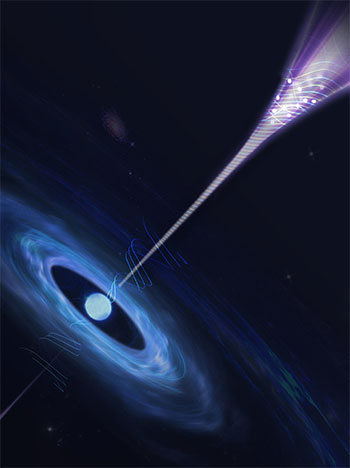 |
| An artistic illustration of the magnetar and the gamma-ray burst jet in this work. (Illustration: Yuja Tian and Yuting Wu, Nanjing Zhijiao Cloud Intelligent Technology Co., Ltd.; Scientific concept guidance: Runchao Chen and Binbin Zhang,Nanjing University)
|
|
The team sifted through more than 600,000 datasets before spotting the pattern, which was independently confirmed by multiple space observatories. The signal stood out at 909 hertz, a frequency so precise that scientists described it as hearing the first heartbeat of a newborn star.
|
|
The fleeting nature of the signal hints at the dynamics of the explosion itself. The magnetar’s rapid spin likely imprinted the oscillation onto the gamma-ray jet through its magnetic field. But as the jet quickly evolved, the symmetry of the blast concealed the heartbeat almost as soon as it appeared.
|
|
This rare glimpse suggests the burst was powered by a magnetically dominated jet rather than one driven mainly by matter. For theorists, the detection closes a long-standing gap between models and observation, providing strong evidence that magnetars can survive star mergers and act as central engines for the brightest known explosions.
|
|
Until now, scientists could only infer the nature of these cosmic engines through afterglow analysis and theoretical modeling. The new finding provides direct proof, reshaping how astronomers view the extreme aftermath of stellar collisions.
|
|
Researchers are now combing through other gamma-ray bursts for similar signals. Each detection could help map the life and death of compact stars, explain the role of magnetars in cosmic evolution, and connect these bursts to gravitational waves and other cosmic messengers.
|
|
Future observatories may reveal more of these brief pulses. Each would serve as another heartbeat from the depths of space, carrying vital clues about the universe under its most extreme conditions.
|