| Nov 04, 2025 |
Researchers develop ion beam technology for removing space debris
Ion beam to stop uncontrolled movement of objects and enable them to be moved.
|
|
(Nanowerk News) Space debris is one of the biggest challenges to the safe operation of satellites and future rocket launches, which can be damaged by it. The amount of debris in space is constantly growing—estimates show that there are more than 36,000 objects larger than 10 centimeters and more than 130 million pieces smaller than 1 centimeter.
|
|
Various methods for removing debris are therefore being researched worldwide – from contact-based systems to non-contact approaches. Contact solutions are considered particularly complex because the fragments move unpredictably and the systems can be easily damaged during direct access.
|
Researchers focus on a contactless approach
|
|
In the EU project ALBATOR, five partners, including Kiel University (CAU), Justus Liebig University Giessen, Universidad Carlos III de Madrid (Spain), and the companies NorthStar Earth & Space (Luxembourg) and OsmosX (France), are pursuing a non-contact approach: the so-called ion-beam shepherd method.
|
|
The ion-beam shepherd method is based on momentum transfer by a plasma beam of particles with high energy. The beam is not intended to “vaporize” the debris, but to change its orbit and attitude in a controlled way. Debris objects typically tumble, i.e. rotate uncontrollably. Using the ion beam, this rotation must first be stopped before the object can be captured and towed, for example with a robotic arm or a net.
|
|
Alternatively, the entire maneuver can be performed without contact by pushing the object exclusively with the ion beam. The goal is either to push the debris into a controlled re-entry so that it burns up in the atmosphere, or to transfer it to a so-called graveyard orbit.
|
Plasma-beam can transfer thrust to debris fragments
|
|
Within ALBATOR, the researchers are developing a novel plasma-beam system that can be precisely targeted at space debris. In addition to building and optimizing the system, they are creating models to simulate the plasma discharge and the interaction of the beam with different surfaces, so that thrust can be transferred to debris fragments as efficiently as possible.
|
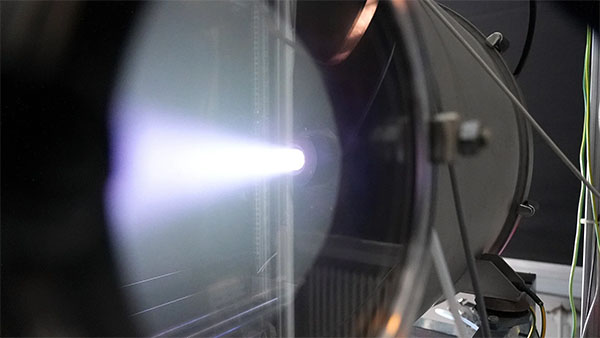 |
| The ion beam shepherd method is based on momentum transfer via a plasma beam of high-energy particles. The beam is not intended to “destroy” space debris, but rather to specifically alter its trajectory and intrinsic motion. (Image: Rafael Vester, Kiel University)
|
|
The Kiel team contributes its expertise in beam–surface interactions. Using a patented force probe developed in Kiel, they measure how strongly ion beams act on various materials, such as solar panels, gold-coated Kapton foils, or protective coatings. Complementary high-fidelity computer simulations provide further data to improve understanding of the complex processes. Both approaches feed into a materials database that is crucial for efficiently directing the ion beam at space debris and controlling its motion.
|
|
Project lead Dr. Thomas Trottenberg from the Plasma Technology group in Kiel emphasizes: “If we want to use space safely and in a sustainable way, we have to avoid creating debris -- or actively remove it. That is exactly what we are working toward.”
|
|
ALBATOR (ecr-bAsed muLticharged ion Beam for Active debris removal and oTher remediatiOn stRategies) is funded under the HORIZON–EIC Pathfinder Challenge for 42 months with a total budget of around 4 million EUR. Of this, approximately 639,000 EUR goes to Kiel University. With the European Innovation Council (EIC) Pathfinder program, the EU supports visionary, high-risk projects at an early stage of development that have the potential to create radically new technologies and markets.
|