

Nanotechnology News – Latest Headlines
Tailored sequences of DNA lead to breakthrough in the campaign to sort and separate carbon nanotubes
A team of researchers from DuPont and Lehigh University has reported a breakthrough in the quest to produce carbon nanotubes that are suitable for use in electronics, medicine and other applications.
July 8, 2009 Read more
Simple, fast process to make extremely pure metal-oxide nanoparticles for gas sensors
Ohio State University researchers have developed a new method for making extremely pure, very small metal-oxide nanoparticles.
July 8, 2009 Read more
Dye-doped DNA nanofibers emit white light
A team of researchers at the University of Connecticut and the US Air Force Research Laboratory has now successfully used the electrospinning of DNA complexes to produce nanofibers that incorporate two different fluorescing dyes in such a way that energy can efficiently be transferred from one dye to the other. The color of the resulting fluorescence can be controlled by means of the ratio of the two dyes.
July 8, 2009 Read more
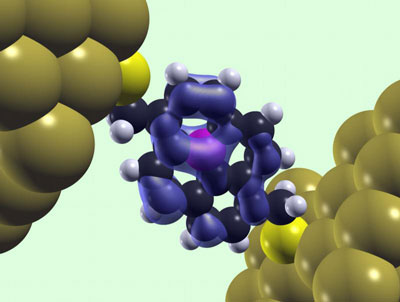
Nanoelektronik mit molekularen Stromleitern
Einem internationalen Forscherteam ist ein Durchbruch in der Nanoelektronik gelungen: Mit einer ungeraden Anzahl an Elektronen sind Moleküle, die mit Metallelektroden im Kontakt sind, nämlich schon im niedrigen Spannungsbereich extrem leitfähig.
July 8, 2009 Read more
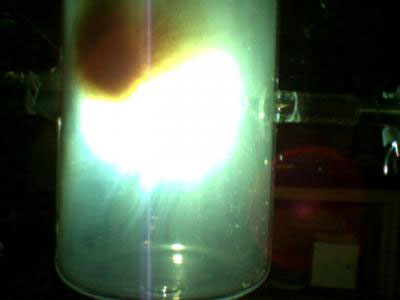
Filling fullerenes with radio-active material for radiation therapy
Virginia Tech chemistry Professor Harry C. Dorn, Emory and Henry College chemistry Professor James Duchamp, and Panos Fatouros, professor and chair of the Division of Radiation Physics and Biology at the Virginia Commonwealth University School of Medicine have co-invented a hands-off process for filling fullerenes with radio-active material.
July 7, 2009 Read more
Normal cells far from cancer give nanosignals of trouble
A new Northwestern University-led study of human colon, pancreatic and lung cells is the first to report that cancer cells and their non-cancerous cell neighbors, although quite different under the microscope, share very similar structural abnormalities on the nanoscale level.
July 7, 2009 Read more
Low-cost solution processing method developed for CIGS-based solar cells
Researchers at the UCLA Henry Samueli School of Engineering and Applied Science have developed a low-cost solution processing method for CIGS-based solar cells that could provide an answer to the manufacturing issue.
July 7, 2009 Read more
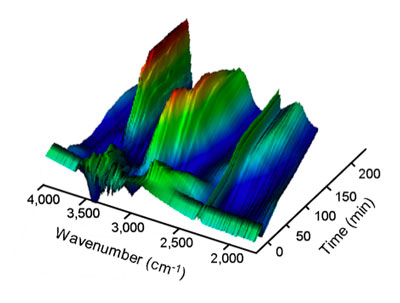
Scientists track chemical changes in cells as they endure extreme conditions
One of nature's most gripping feats of survival is now better understood. For the first time, scientists from the U.S. Department of Energy's Lawrence Berkeley National Laboratory observed the chemical changes in individual cells that enable them to survive conditions that should kill them.
July 7, 2009 Read more
One step closer to an artificial nerve cell
Scientists at the Swedish medical university Karolinska Institutet and Linköping University are well on the way to creating the first artificial nerve cell that can communicate specifically with nerve cells in the body using neurotransmitters.
July 7, 2009 Read more
New metamaterial brings us nearer to the dream of invisibility
A group of researchers from the Department of Physics at UAB have designed a device, called a dc metamaterial, which makes objects invisible under certain light by making the inside of the magnetic field zero but not altering the exterior field. The device, which up to date has only been studied in theoretical works, thus acts as an invisibility cloak, making the object completely undetectable to these waves.
July 7, 2009 Read more
Up to $10m funding for new materials and devices for integrated energy harnessing and storage
Three proposals from Nanyang Technological University (NTU) have won up to S$30 million in research fund from the National Research Foundation following its fourth call for proposals under its Competitive Research Programme Funding Scheme.
July 7, 2009 Read more
Q is for quantum and "Q-life"
Features in the July issue of Physics World include a close look at how physics is informing our understanding of cells and of the brain, while Paul Davies, a physicist, astrobiologist and director of BEYOND: Center for Fundamental Concepts in Science at Arizona State University, suggests there are tentative signs that life itself may have arisen as a result of physicists' long-cherished theory of quantum mechanics.
July 7, 2009 Read more
Verbesserte Methode zur Fluoreszenzmikroskopie
Fortschritt bei der bildgebenden Beobachtung von Zellen und Gewebe.
July 7, 2009 Read more
Environmental Working Group releases their 2009 Sunscreen Report
The Environmental Working Group (EWG), a United States-based non-governmental organization that works to expose threats to health and the environment, has released their 2009 Sunscreen Report. The investigators expected to recommend against the use of micronized and nano-sized zinc oxide and titanium dioxide sunscreen, but after months of research and analysis of nearly 400 peer-reviewed studies, they found themselves recommending some sunscreens that may contain nanoparticles.
July 7, 2009 Read more
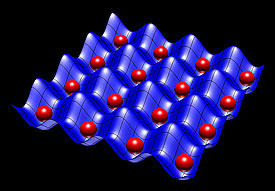
Physicists control individual bits in quantum computers
Physicists at the National Institute of Standards and Technology (NIST) have overcome a hurdle in quantum computer development, having devised a viable way to manipulate a single 'bit' in a quantum processor without disturbing the information stored in its neighbors
July 7, 2009 Read more
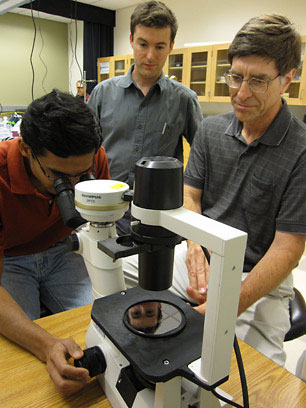
Tiny sensor measures real-time water stress in living plants
The device is an embedded microsensor capable of measuring real-time water stress in living plants. In theory, the sensor will help vintners strike the precise balance between drought and overwatering - both of which diminish the quality of wine grapes.
July 7, 2009 Read more
 Subscribe to our Nanotechnology News feed