

Nanotechnology News – Latest Headlines
Tying up loose ends for a quantum leap
Quantum technologies have become the Holy Grail of the IT industry with research projects springing up all over Europe. Now a major effort is being made to spur development by adopting a coordinated, structured approach.
July 9, 2009 Read more

Nanoscientist receives highest honor U.S. government bestows on young scientists or engineers
UC Riverside's Chun Ning (Jeanie) Lau has received a national honor that few outstanding researchers who are beginning their independent research careers are given. Lau, an associate professor of physics, is one of the recipients of the Presidential Early Career Awards for Scientists and Engineers (PECASE) for the 2008 competition. PECASE represents the highest honor a beginning scientist or engineer can receive in the United States.
July 9, 2009 Read more
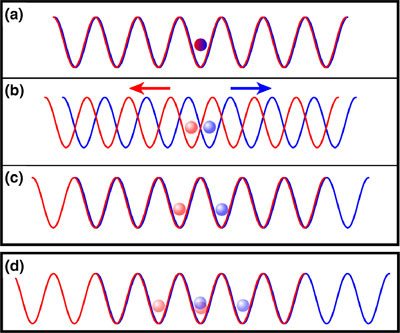
Physicists take first step towards super-fast search algorithms for quantum computers
Physicists at the University of Bonn carry out a 'quantum walk' with caesium atoms.
July 9, 2009 Read more
DNA sorts out carbon nanotubes
DNA could be the answer to sorting different kinds of carbon nanotubes, say US researchers. Short strings of synthetic DNA wind onto nanotubes in a very sequence-dependent way, which has allowed researchers to separate 12 of the most common types of tubes from the inevitable mixtures that form when nanotubes are synthesised.
July 9, 2009 Read more
Virginia county working on nanotechnology park
A regional economic development body with a vacant, nearly 1,000-acre business park in Pulaski County endorsed Wednesday the concept of committing a small piece of it to a $20 million home for nanotechnology businesses and education.
July 9, 2009 Read more
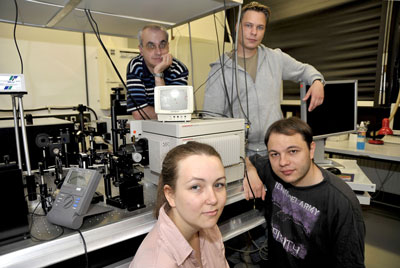
Miniaturized lasers can emit quantum light
The discovery of this quantization of the light field has opened up a new field of physics - quantum optics. In modern lasers the light emission can take place within a picosecond, a 1000 times faster than has ever been detected before in photon sequence measurements. A team in Germany made a major breakthrough: in several years of work the worldwide first detector has been developed which has the necessary temporal resolution.
July 9, 2009 Read more
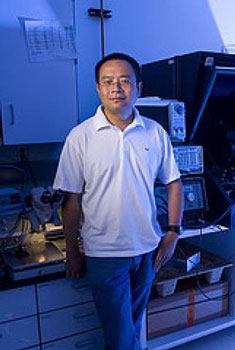
First direct measurement of quantum capacitance of graphene
New research findings describe the first direct measurement of a fundamental property of graphene, known as quantum capacitance, using an electrochemical gate method.
July 9, 2009 Read more
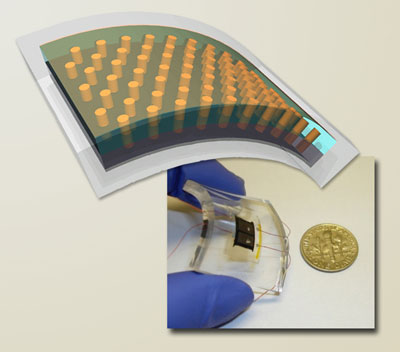
Semiconductor nanopillars promise cheap and efficient solar panels
Researchers at the Lawrence Berkeley National Laboratory and the University of California at Berkeley have demonstrated a way to fabricate efficient solar cells from low-cost and flexible materials.
July 9, 2009 Read more
Single molecules as electric conductors
An international research team has shown that molecules containing an odd number of electrons are much more conductive at low bias voltages.
July 9, 2009 Read more
New York organizations partner to provide clean energy and environmental technology business support services
CNSE of the University at Albany and the New York State Foundation for Science, Technology, and Innovation (NYSTAR) have entered into agreements with NYSERDA to provide support for the growth of clean energy and environmental technology companies at the Saratoga Technology and Energy Park (STEP) and throughout New York State.
July 9, 2009 Read more
Talks at SEMICON West to focus on advanced processes, materials and manufacturing for nanoelectronics devices
Recognized academic and technical experts in nanoelectronics from the College of Nanoscale Science and Engineering of the University at Albany have been selected to deliver presentations at SEMICON West 2009, a leading industry conference and trade show to be held July 13 through 17 in San Francisco, CA.
July 9, 2009 Read more
Nanomedizin gegen Hirnkrankheiten im neuen Forschungslabor Clinatec in Grenoble
Mit dem kürzlich im Herzen Grenobles eröffneten biomedizinischen Forschungslabor Clinatec, will das CEA neue auf den Mikro- und Nanotechnologien basierende therapeutische Ansätze entwickeln, um Hirnkrankheiten zu bekämpfen, bei denen klassische Therapien bislang versagt haben.
July 9, 2009 Read more
Stevens Assistant Professor recognized for exceptional contributions to mechanics education
Dr. Frank Fisher, an Assistant Professor of Mechanical Engineering, Director of the Nanomechanics and Nanomaterials Lab, and Co-Director of the Graduate Nantoechnology Program at Stevens Institute of Technology, was recently awarded one of the two 2009 Ferdinand P. Beer and E. Russell Johnston Jr. Outstanding New Educator Awards by the American Society of Engineering Education.
July 8, 2009 Read more
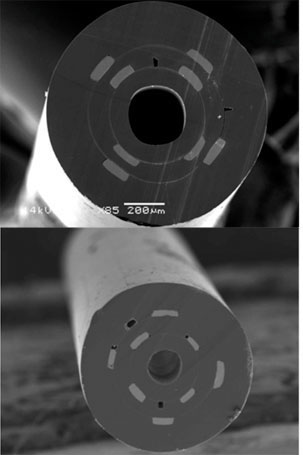
A fabric that acts as a camera
MIT researchers have developed light-detecting fibers that, when weaved into a web, act as a flexible camera.
July 8, 2009 Read more
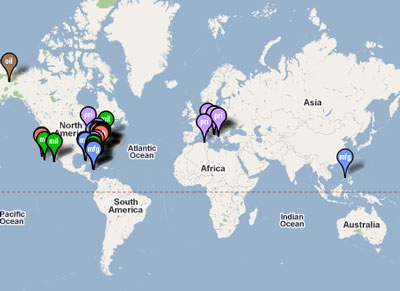
New online map shows environmental cleanup sites that use nanomaterials
The map shows which nanomaterials have been used where and includes detailed information on the contaminants treated and the nature of the treatment. It provides a unique source of information on the intentional release of nanomaterials into the environment to treat contaminated ground and water.
July 8, 2009 Read more
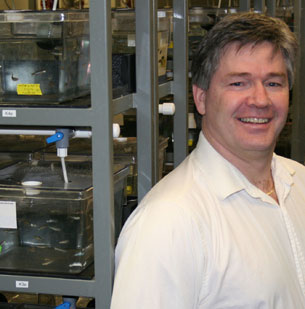
New effort to monitor the effects of nanomaterials on the environment
University of Alberta biological sciences professor Gregg Goss is on the front line of a new effort to monitor the effects of nanomaterials on the environment. Goss will help lead a team of 19 researchers from across the country in a three-year study of the toxicity of nanomaterials in aquatic environments.
July 8, 2009 Read more
 Subscribe to our Nanotechnology News feed