

Nanotechnology News – Latest Headlines
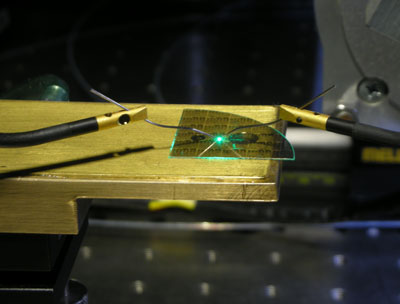
IMEC launches new industrial affiliation program on GaN-on-Si technology
IMEC today announces the launch of a new industrial affiliation program (IIAP) that will focus on the development of GaN technology for both power conversion and solid state lighting applications. An important goal of the program is to lower GaN technology cost by using large-diameter GaN-on-Si and hence by leveraging on the Si scale of economics.
July 14, 2009 Read more
Researchers image crucial anthrax protein - crystal structure could offer new therapies
Anthrax, long feared for its potential as a biological weapon, has lost some of its mystery. Researchers at the U.S. Department of Energy's Argonne National Laboratory, in collaboration with scientists at the University of Chicago, have determined the structure of a protein crucial to the virulence of anthrax bacteria.
July 14, 2009 Read more
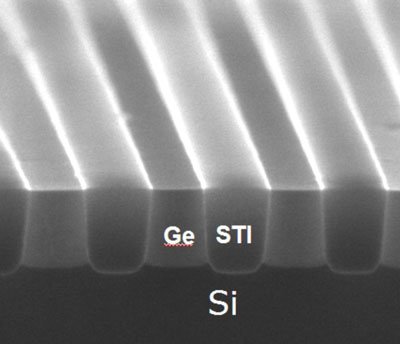
Promising results in the race to scale CMOS to 22nm and below
IMEC has achieved promising results in the race to scale CMOS to 22nm and below. The breakthroughs from its transistor scaling programs include a successful integration of the laser-anneal technique in a high-K/metal-gate first process and a step forward towards fabricating aggressively scaled germanium-pFET transistors.
July 14, 2009 Read more
Brookhaven and Stanford physicists share Onnes Prize for superconductivity experiments
J.C. Seamus Davis and John Tranquada, physicists at the U.S. Department of Energy's Brookhaven National Laboratory, along with Aharon Kapitulnik of Stanford University, have been named the recipients of the 2009 Heike Kamerlingh Onnes Prize for outstanding superconductivity experiments.
July 14, 2009 Read more
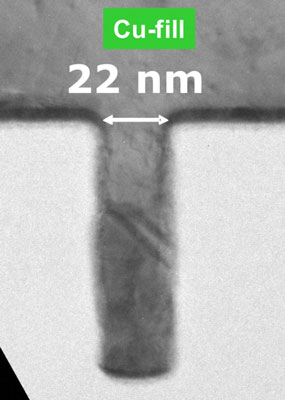
22nm interconnect technology takes a significant step forward
IMEC presents innovations in dielectrics and metallization technologies as well as in their integration approaches. Great progress has been obtained in the metallization of 22nm interconnects, in Cu/low-k reliability assessment and in the suppression of low-k integration damage. The results contribute to deliver the interconnect performance and reliability beyond the 32nm node.
July 14, 2009 Read more
New partnerships and pilot line for IMEC's solar cell research program
IMEC today announced that it has established new partnerships with solar cell material and equipment suppliers. These companies, including MEMC Electronic Materials Inc., Leybold Optics Dresden GmbH, Roth & Rau AG, and Mallinckrodt Baker B.V., have concluded joint-development agreements with IMEC in the frame of IMEC?s newly launched wafer-based silicon photovoltaics industrial affiliation program.
July 14, 2009 Read more
IMEC launches dedicated EUV mask cleaning program
IMEC today announced that it is extending its EUV (extreme ultra-violet) lithography research program with a parallel dedicated EUV mask cleaning research program. The program will build on a new collaboration between IMEC and HamaTech APE GmbH.
July 14, 2009 Read more

Molekularbiologie in 3D-Welten
Forscher des Geschäftsbereichs Visual Computing von Fraunhofer Austria in Graz haben in einem Projekt der DFG die Software BioBrowser entwickelt. Sie errechnet voll-automatisch aus den Forschungsdaten der Molekularbiologen die 3D-Modelle von kompliziert aufgebauten Proteinen und stellt sie auf Knopfdruck hochqualitativ und interaktiv dar.
July 14, 2009 Read more
Meeting the challenges of nanotechnology
Whether in the fields of medicine, sustainable energy supply or environmental protection, without making use of nanotechnology we will not be capable of overcoming the challenges which the future presents. In parallel with these efforts, though, it is essential that we examine the new technology very carefully for potential risks, such as those presented by free nanoparticles. This is the conclusion drawn at the close of Empa's 3rd NanoConvention, held on July 6th in Zurich.
July 14, 2009 Read more
Microfluidic fuel cells as possible power source for portable electronic devices
Microfluidic fuel cells could provide the necessary energy to provide continuous power to remote sensors, mobile phones and laptops.
July 14, 2009 Read more
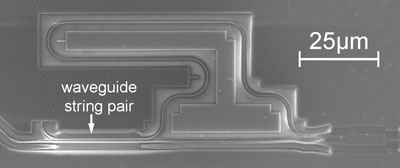
Groundbreaking research demonstrates new nanophotonic forces
The University of Ghent (UGent) and the nanoelectronics research center IMEC demonstrated repulsive and attractive nanophotonic forces, depending on the spatial distribution of the light used.
July 14, 2009 Read more

Swine flu vaccinations with nanopatch technology
In response to the growing threat of swine flu, a University of Queensland team is applying nanopatch technology to potentially solve the problems associated with vaccinating millions of Australians.
July 14, 2009 Read more
New environmentally friendly method to synthesize a wide variety of nanoparticles inexpensively
Metals that dissolve in water successfully extracted, transferred into layer of organic solvent that floats on water.
July 13, 2009 Read more

Scientists discover repulsive side to light force
A team of Yale University researchers has discovered a "repulsive" light force that can be used to control components on silicon microchips, meaning future nanodevices could be controlled by light rather than electricity.
July 13, 2009 Read more
'Materials and Processes for Medical Devices' event brings together clinicians, engineers, designers
The only medical devices event that brings together materials scientists and engineers, metallurgists, product designers, researchers, and clinicians is coming to Minneapolis, Aug. 10-12.
July 13, 2009 Read more
Symposium offers new thinking on light weight materials
The materials showing the way to future vehicles may be light in terms of weight, but they are far from 'lightweight' in importance.
July 13, 2009 Read more
 Subscribe to our Nanotechnology News feed