

Nanotechnology News – Latest Headlines

Scientists use platelet-inspired nanoparticles as 'Trojan horse' drug-delivery system
Scientists boosted brain-computer interface performance by 2x using nanoparticles to deliver anti-inflammatory drugs directly to implanted electrodes.
December 9, 2025 Read more

Simple ion beam method creates highly sensitive magnetic nanostrips
New ion beam fabrication uses low cost materials to form vertical nanomagnets whose nanostrip geometry boosts sensitivity to magnetic fields and current pulses.
December 9, 2025 Read more
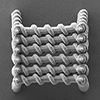
The twisted nanotubes that tell a story
Researchers have demonstrated that the spiral geometry of tiny, twisted magnetic tubes can be leveraged to transmit data based on quasiparticles called magnons, rather than electrons.
December 9, 2025 Read more

Research reveals new hybrid state of matter where solids meet liquids
Some atoms in a liquid stay fixed even at high temperatures, reshaping how solidification starts and enabling an unusual corralled supercooled liquid state.
December 9, 2025 Read more

Study reveals limitations of AI-based material prediction
Computer simulations and artificial intelligence often make significant errors when predicting the properties of new, high-performance materials. This is the finding of an international study where the authors also provide tools to address this issue.
December 9, 2025 Read more

Faster charging thanks to invisible mini-vortices
Tiny cavities in energy storage devices form small vortices that help with charging. This previously unknown phenomenon could advance the development of faster storage devices.
December 9, 2025 Read more

Electrically controlled hydrogels switch metal friction from grip to glide
Electrically tunable ionic hydrogels use small voltages to switch friction at metal contacts between high-friction and ultra-low-friction states, enabling voltage-programmed grip, release and motion in soft-robotic and mechanical systems.
December 9, 2025 Read more
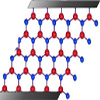
From light to logic: Ultrafast quantum switching in 2D materials
Scientists have found a way to use light to control and read tiny quantum states inside atom-thin materials. The simple technique could pave the way for computers that are dramatically faster and consume far less power than today's electronics.
December 9, 2025 Read more

AI transforms metasurface design from pixels to optical systems
Artificial intelligence speeds metasurface design from unit cells to full optical systems, enabling compact imaging, AR and VR displays and advanced LiDAR.
December 9, 2025 Read more

Quantum rule links terahertz light electrons and crystals in everyday matter
Listening to the 'whispers' of electrons and crystals has lead to a quantum discovery with terahertz light that could help us advance technological innovations and life science research.
December 9, 2025 Read more

Researchers harness plant-virus proteins to create nanomaterials
Researchers develop a cheaper, safer material for use in solar panels, sensors and optical devices.
December 8, 2025 Read more

From fullerenes to 2D structures: A unified design principle for boron nanostructures
New model explains stability and electronic behavior of boron nanostructures from hollow clusters to ultrathin 2D layers, linking them to atomic coordination.
December 8, 2025 Read more

Magnetically doped quantum dots promise brighter lights and smarter future tech
With the successful introduction of manganese into perovskite nanoparticles, researchers have 'doped the undopable'.
December 8, 2025 Read more

Expanding the search for quantum-ready 2D materials
Scientists have created a high-throughput computational strategy, creating a new, data-driven approach to finding ideal 2D materials and substrates.
December 8, 2025 Read more
New filterless air purifier uses nano water spray to capture ultrafine dust
New quiet, filterless air purifier sprays nano-sized water droplets to trap ultrafine dust, slashing power use and avoiding harmful ozone.
December 8, 2025 Read more

New microscope can image an invisible 2D material
have found a new way to image layers of boron nitride that are only a single atom thick. This material is usually nearly invisible in optical microscopes because it has no optical resonances. To resolve this issue, the team uses nonlinear microscopy with infrared light, making the material shine very brightly and even reveal its crystal orientation. The work has important implications for the vibrant field of designing new (opto-)electronic devices from stacking 2D materials.
December 8, 2025 Read more
 Subscribe to our Nanotechnology News feed