

Space Exploration News – Latest Headlines
 Subscribe to our Space Exploration News feed
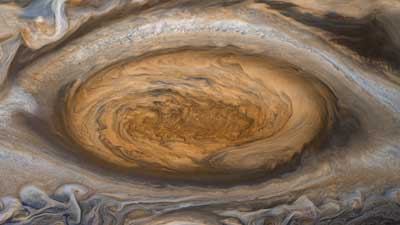
Six mysteries of Jupiter's Great Red Spot
Despite the fact that the spot is so familiar to most of us, there's a lot that astronomers still don't understand about it. The new Juno observations may finally begin to unravel its mysteries.
July 13, 2017 Read more
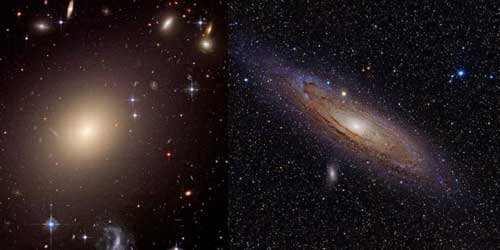
Shedding light on galaxies' rotation secrets
Spiral galaxies are strongly rotating whereas the rotation velocity of ellipticals is much lower. A new study investigates the reasons of such a dichotomy revealing that it is imprinted at formation.
July 13, 2017 Read more
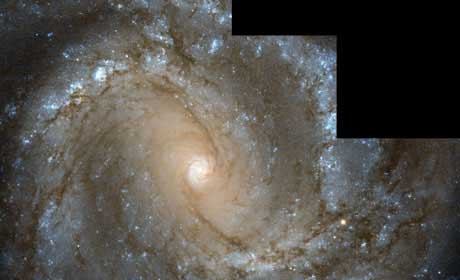
Complex gas motion in the centre of the Milky Way
The comprehensive new model finally makes it possible to conclusively explain this complex gas motion.
July 13, 2017 Read more
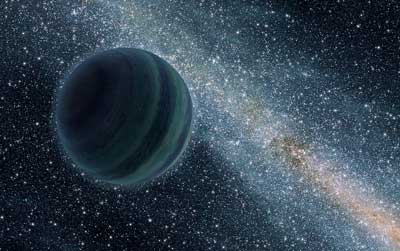
New evidence in support of the Planet Nine hypothesis
Astronomers have used a novel technique to analyse the orbits of the so-called extreme trans-Neptunian objects and, once again, they point out that there is something perturbing them: a planet located at a distance between 300 to 400 times the Earth-Sun separation.
July 12, 2017 Read more

Spiky ferrofluid thrusters can move satellites
Researchers have created a new computational model of an electrospray thruster using ionic liquid ferrofluid - a promising technology for propelling small satellites through space.
July 11, 2017 Read more
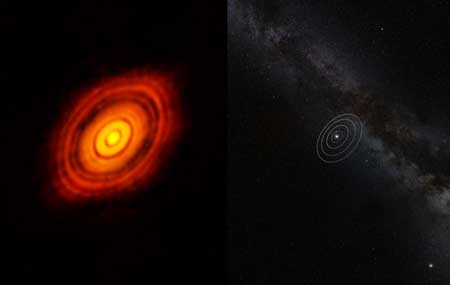
Astronomers track the birth of a 'super-earth'
'Synthetic observations' simulating nascent planetary systems could help explain a puzzle that has vexed astronomers for a long time.
July 11, 2017 Read more
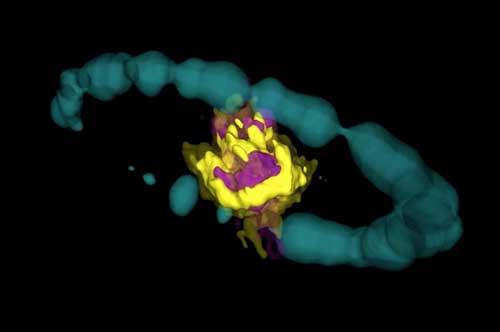
Heart of an exploded star observed in 3-D
Supernova forges billowing, tangled knots of new molecules.
July 10, 2017 Read more
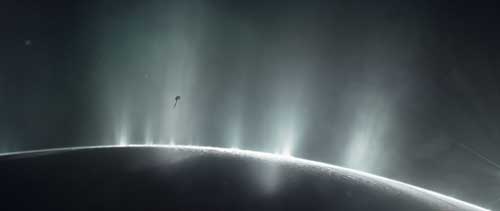
Hidden lake discovery sheds light on alien hunt
Evidence of new strains of bacteria in a lake hidden under an Icelandic glacier far from the sun has revealed how life might thrive in sub-surface oceans on the icy moons around Saturn and Jupiter.
July 7, 2017 Read more
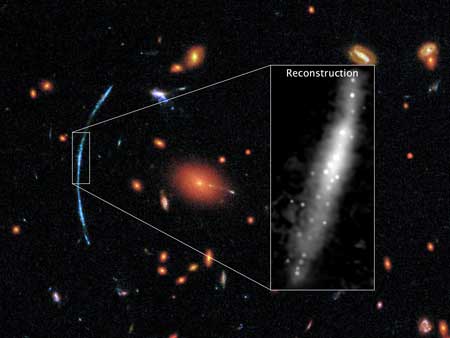
Hubble pushed beyond limits to spot clumps of new stars in distant galaxy
By applying a new computational analysis to a galaxy magnified by a gravitational lens, astronomers have obtained images 10 times sharper than what Hubble could achieve on its own. The results show an edge-on disk galaxy studded with brilliant patches of newly formed stars.
July 6, 2017 Read more

Intelligent life may guide the evolution of the cosmos - here's how
Does humanity exist to serve some ultimate, transcendent purpose? Conventional scientific wisdom says no. One scientists believes otherwise.
July 6, 2017 Read more
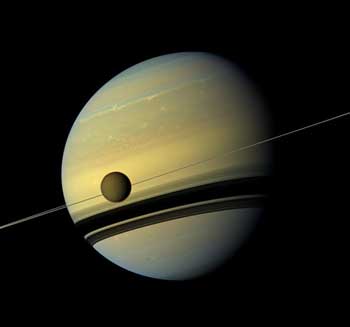
Calm lakes on Titan could mean smooth landing for future space probes
New research has found that most waves on Titan's lakes reach only about 1 centimeter high, a finding that indicates a serene environment that could be good news for future probes sent to the surface of that moon.
July 5, 2017 Read more
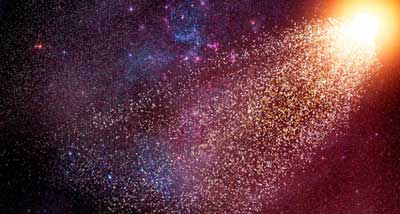
Fastest stars in the Milky Way are 'runaways' from another galaxy
A group of astronomers have shown that the fastest-moving stars in our galaxy - which are travelling so fast that they can escape the Milky Way - are in fact runaways from a much smaller galaxy in orbit around our own.
July 5, 2017 Read more
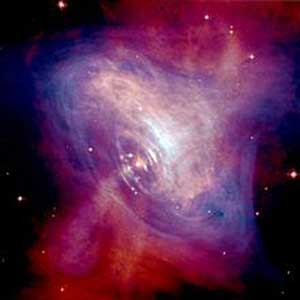
Study calls into question theories on pulsar phenomena
Researchers have cast doubt over established explanations for certain behaviours in pulsars - highly magnetised rotating neutron stars, formed from the remains of supernovae.
July 3, 2017 Read more
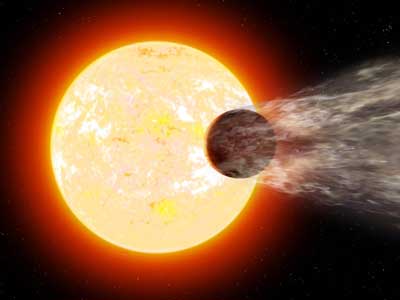
Under pressure - Extreme atmosphere stripping may limit exoplanets' habitability
New models of massive stellar eruptions hint at an extra layer of complexity when considering whether an exoplanet may be habitable or not. Models developed for our own Sun have now been applied to cool stars favoured by exoplanet hunters.
July 3, 2017 Read more
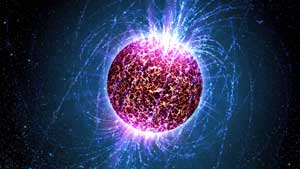
Neutron stars could be our GPS for deep space travel
NASA's Neutron Star Interior Composition Explorer, or NICER will study the exotic astrophysical objects known as neutron stars and examine whether they could be used as deep-space navigation beacons for future generations of spacecraft.
June 30, 2017 Read more
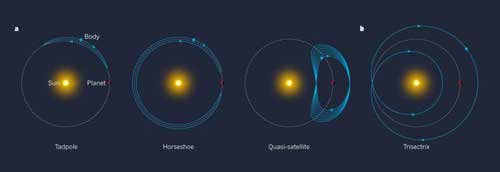
The Bee-Zed asteroid orbits in the opposite direction to planets
The asteroid makes a complete circuit around the Sun every 12 years, corresponding with the orbital period of Jupiter, which shares its orbit but travels in the opposite direction.
June 28, 2017 Read more
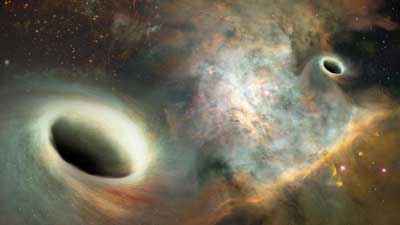
Groundbreaking discovery confirms existence of orbiting supermassive black holes
For the first time ever, astronomers say they've been able to observe and measure the orbital motion between two supermassive black holes hundreds of millions of light years from Earth - a discovery more than a decade in the making.
June 27, 2017 Read more
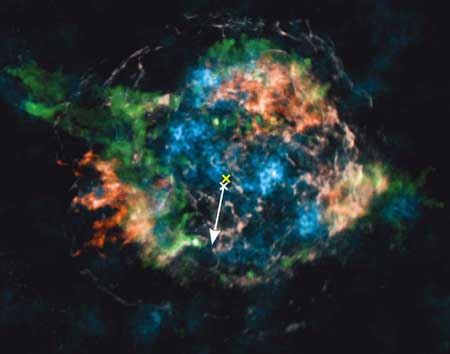
Neutrinos as drivers of supernovae
Radioactive elements in gaseous supernova remnant Cassiopeia A provide glimpses into the explosion of massive stars.
June 26, 2017 Read more