

Space Exploration News – Latest Headlines
 Subscribe to our Space Exploration News feed
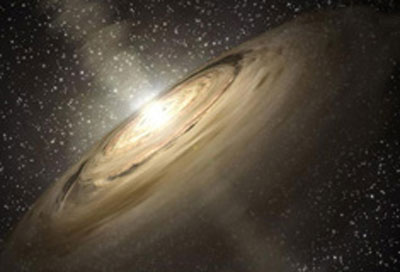
Solar system's birth record revised
Some 4.567 billion years ago, our solar system?s planets spawned from an expansive disc of gas and dust rotating around the sun. While similar processes are witnessed in younger solar systems throughout the Milky Way, the formative stages of our own solar system were believed to have taken twice as long to occur. Now, new research lead by the Centre for Star and Planet Formation at the Natural History Museum of Denmark, University of Copenhagen, suggests otherwise. Indeed, our solar system is not quite as special as once believed.
November 2, 2012 Read more
NASA'S Curiosity Rover provides clues to changes in martian atmosphere
NASA's car-sized rover, Curiosity, has taken significant steps toward understanding how Mars may have lost much of its original atmosphere. Learning what happened to the Martian atmosphere will help scientists assess whether the planet ever was habitable. The present atmosphere of Mars is 100 times thinner than Earth's.
November 2, 2012 Read more
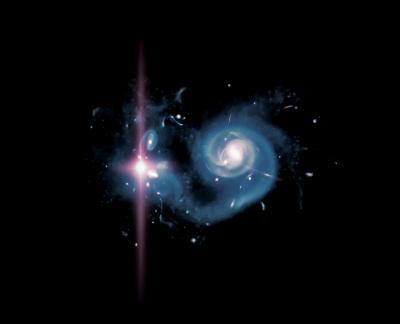
Super-rare, super-luminous supernovae are likely explosion of universe's earliest stars
The most-distant, super-luminous supernovae found to date have been observed by an international team, including Raymond Carlberg of the University of Toronto's Department of Astronomy & Astrophysics. The stellar explosions would have occurred at a time when the universe was much younger and probably soon after the Big Bang.
November 1, 2012 Read more
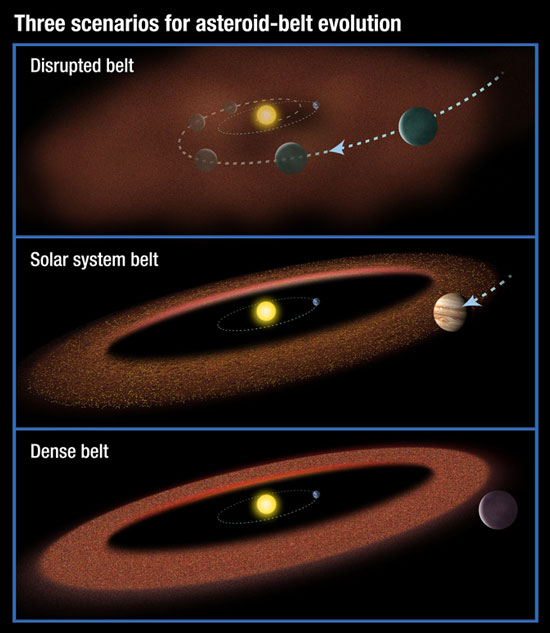
Asteroid belts of just the right size are friendly to life
Solar systems with life-bearing planets may be rare if they are dependent on the presence of asteroid belts of just the right mass, according to a study by Rebecca Martin, a NASA Sagan Fellow from the University of Colorado in Boulder, and astronomer Mario Livio of the Space Telescope Science Institute in Baltimore, Md.
November 1, 2012 Read more
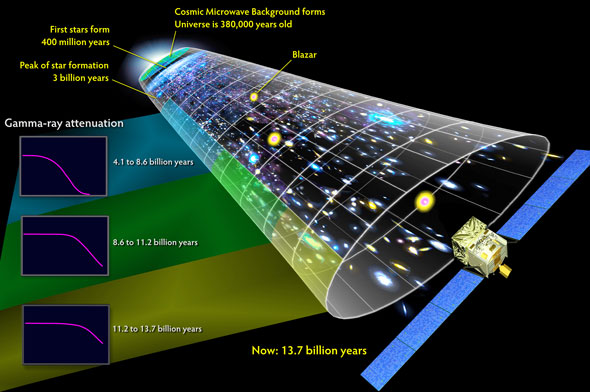
NASA'S Fermi measures cosmic 'fog' produced by ancient starlight
Astronomers using data from NASA's Fermi Gamma-ray Space Telescope have made the most accurate measurement of starlight in the universe and used it to establish the total amount of light from all the stars that have ever shone, accomplishing a primary mission goal.
November 1, 2012 Read more
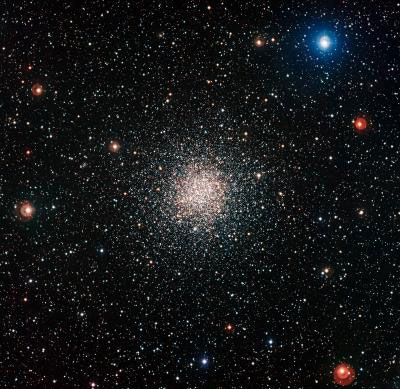
Stars ancient and modern?
Globular star clusters are among the oldest objects in the Universe, and NGC 6362 cannot hide its age in this picture. The many yellowish stars in the cluster have already run through much of their lives and become red giant stars. But globular clusters are not static relics from the past - some curious stellar activities are still going on in these dense star cities.
October 31, 2012 Read more
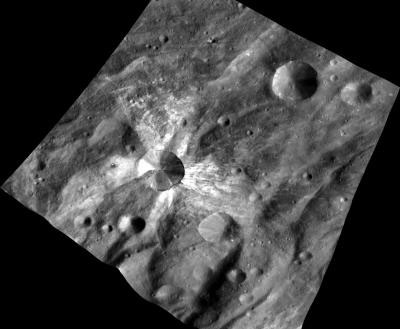
New type of 'space weathering' observed on asteroid Vesta
The surface of the giant asteroid Vesta is weathering in a way that appears to be completely different from any other asteroid yet visited, according to new data recorded by NASA's Dawn spacecraft. This new type of space weathering suggests that there's something about Vesta - perhaps its mineral composition or its position in the solar system - that makes its surface environment fundamentally different from other asteroids studied thus far.
October 31, 2012 Read more
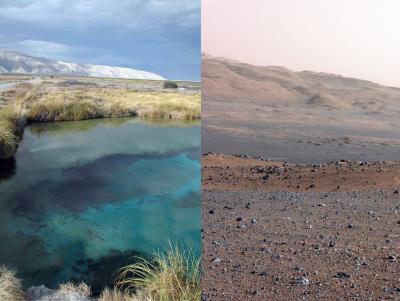
Curiosity on Mars sits on rocks similar to those found in marshes in Mexico
Millions of years ago fire and water forged the gypsum rocks locked in at Cuatro Ciénegas, a Mexican valley similar to the Martian crater where NASA's Rover Curiosity roams. A team of researchers have now analysed the bacterial communities that have survived in these inhospitable springs since the beginning of life on Earth.
October 29, 2012 Read more
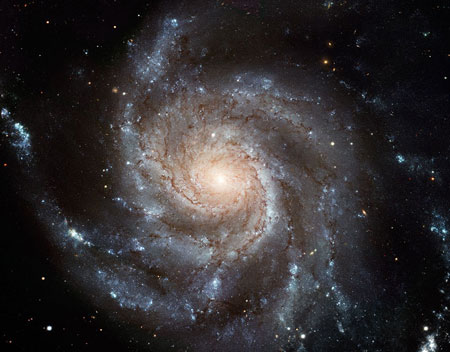
Rocker experiment will observe spiral galaxy near big dipper's handle
In the pre-dawn hours of Nov. 10, astrophysicist Timothy Cook and his research team will be at the Army?s White Sands Missile Range in New Mexico, ready to launch a NASA-funded science experiment, called IMAGER, which has been five years in the making. They will use a Black Brant IX, an 18-foot-long two-stage sounding rocket capable of carrying up to 1,200 pounds of payload into suborbital flight.
October 25, 2012 Read more
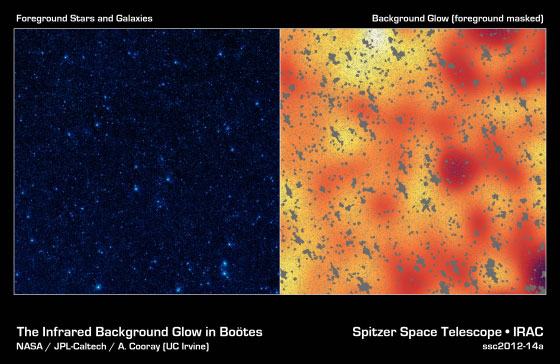
Astronomers report dark matter 'halos' may contain stars, disprove other theories
Could it be that dark matter "halos" - the huge, invisible cocoons of mass that envelop entire galaxies and account for most of the matter in the universe ? aren't completely dark after all but contain a small number of stars? Astronomers from UCLA, UC Irvine and elsewhere make a case for that.
October 24, 2012 Read more
Cosmic filaments make up half the mass of the universe
An international team of astronomers has carried out the first three-dimensional study of a cosmic filament of dark matter. Using data from the Hubble Space Telescope, the team discovered that the filament, which is part of the Cosmic Web, is fuelling one of the most massive galaxy clusters in the universe, and has a length of over 60 million light years.
October 18, 2012 Read more
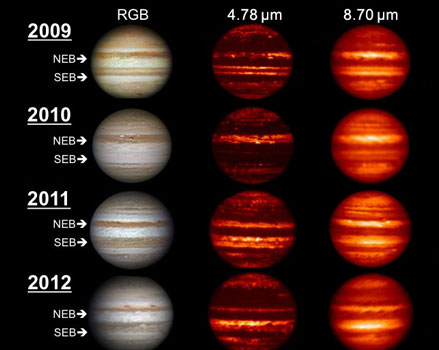
Jupiter: Turmoil from below, battering from above
Jupiter, the mythical god of sky and thunder, would certainly be pleased at all the changes afoot at his namesake planet. As the planet gets peppered continually with small space rocks, wide belts of the atmosphere are changing color, hotspots are vanishing and reappearing, and clouds are gathering over one part of Jupiter, while dissipating over another.
October 17, 2012 Read more
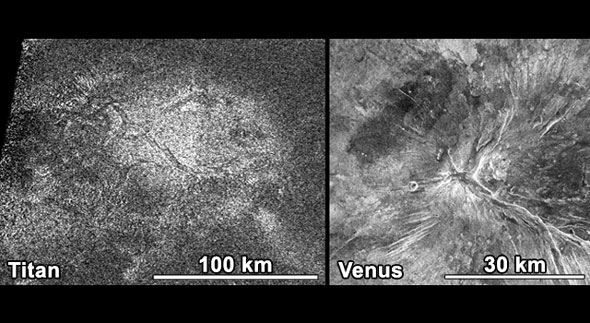
What's baking on Titan?
Radar images from NASA's Cassini spacecraft reveal some new curiosities on the surface of Saturn's mysterious moon Titan, including a nearly circular feature that resembles a giant hot cross bun and shorelines of ancient seas.
October 16, 2012 Read more
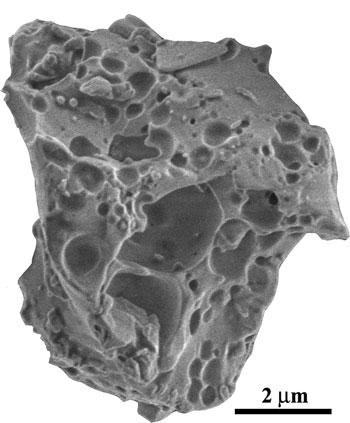
Solar wind particles likely source of water locked inside lunar soils
The most likely source of the water locked inside soils on the moon's surface is the constant stream of charged particles from the sun known as the solar wind, a University of Michigan researcher and his colleagues have concluded.
October 15, 2012 Read more
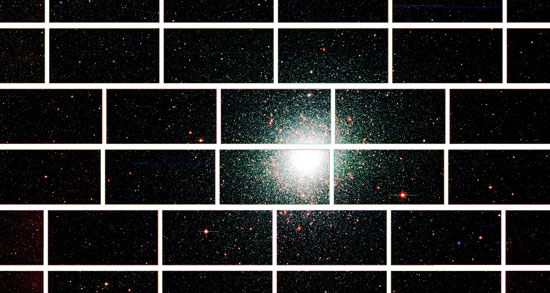
Dark energy camera to probe universe?s biggest mysteries
Eight billion years ago, rays of light from distant galaxies began their long journey to Earth. On Sept. 12, that ancient starlight found its way to a mountaintop in Chile, where the newly-constructed Dark Energy Camera - the most powerful sky-mapping machine ever created - captured and recorded it for the first time.
September 20, 2012 Read more
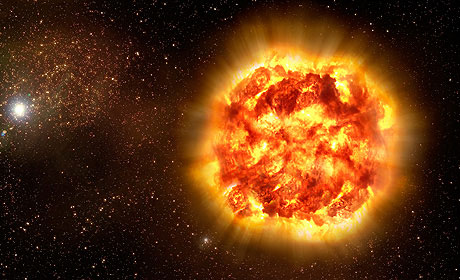
In quest of the cosmic origins of silver
Heidelberg scientist shows that silver and gold materialised in different stellar explosions
September 6, 2012 Read more
Space-age food served up with seeds of success
An eggplant the size of a basketball, and a cucumber half a meter long seem, at first glance, out of this world. They are, literally. Chinese scientists have created more than 120 varieties of plants by sending seeds into space over the past 25 years.
September 3, 2012 Read more
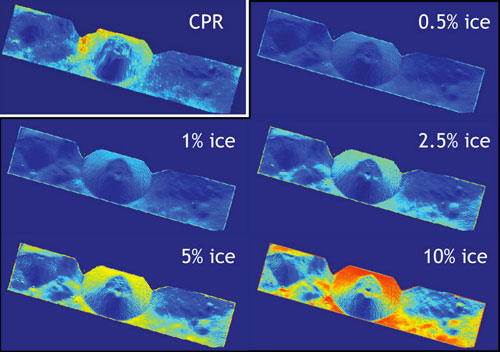
Walls of lunar crater may hold patchy ice, LRO radar finds
Small patches of ice could make up at most five to ten percent of material in walls of Shackleton crater.
August 30, 2012 Read more