

Space Exploration News – Latest Headlines
 Subscribe to our Space Exploration News feed
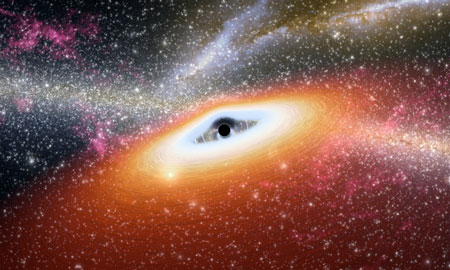
Missing hydrogen problem solved
The mystery of why scientists cannot detect hydrogen in the most distant regions of the universe has been addressed by University of Sydney research.
November 13, 2012 Read more
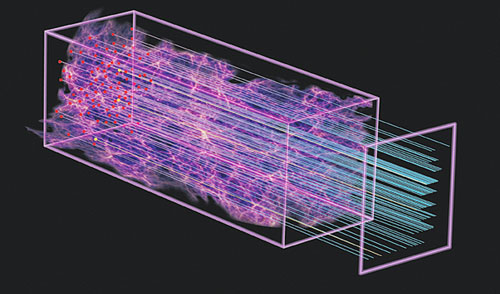
The great space coaster: Astronomers measure the deceleration of the universe before dark energy
For the past five billion years, the expansion of the Universe has been speeding up, powered by the mysterious repulsive force known as 'dark energy'. But thanks to a new technique for measuring the three-dimensional structure of the distant Universe, astronomers from the Sloan Digital Sky Survey (SDSS-III) have made the first measurement of the cosmic expansion rate just three billion years after the Big Bang.
November 13, 2012 Read more
China to launch manned spaceship in June
Like in the Shenzhou-9 mission, the crew might include two men astronauts and a woman, who are scheduled to enter the Tiangong-1 space lab module, Niu Hongguang, deputy commander-in-chief of China's manned space program, said on the sidelines of the 18th National Congress of the Communist Party of China.
November 12, 2012 Read more
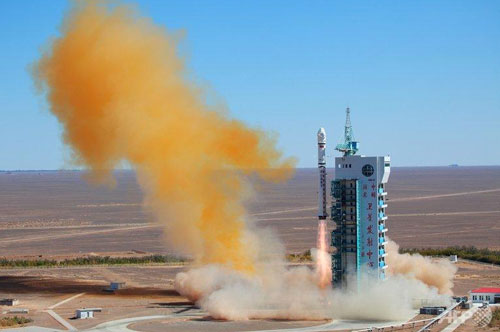
China plans manned space launch in 2013
China is aiming to launch its next manned space mission as early as June 2013, state media reported Saturday, as the country steps up its ambitious exploration programme.
November 10, 2012 Read more
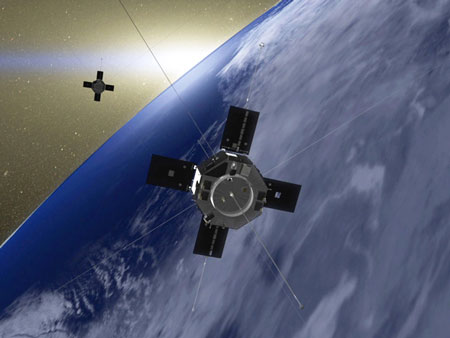
The Van Allen probes: Honoring the origins of magnetospheric science
In 1958, the first US rocket - known as Explorer 1 and led by James Van Allen at the University of Iowa - was launched. By providing observations of a giant swath of magnetized radiation trapped around Earth, now known as the Van Allen Belts, Explorer 1 confirmed that Earth's magnetic environment, the magnetosphere, was not a simple place.
November 9, 2012 Read more
DARPA unveils SpaceView program to engage amateur astronomers in helping to protect satellites
DARPA has created SpaceView, a space debris tracking project that provides amateur astronomers with the means to make a difference. Amateur astronomers will have their first opportunity to sign up in person for the program at the Arizona Science and Astronomy Expo in Tucson, November 10-11, 2012.
November 9, 2012 Read more
Comet collisions every six seconds explain 17-year-old stellar mystery
Every six seconds, for millions of years, comets have been colliding with one another near a star in the constellation Cetus called 49 CETI, which is visible to the naked eye.
November 9, 2012 Read more
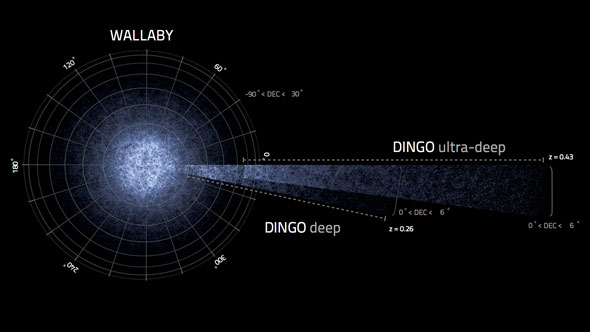
New Australian telescope set to find 700,000 galaxies
Australia?s newest radio telescope is predicted to find an unprecedented 700,000 new galaxies, say scientists planning for CSIRO?s next-generation Australian Square Kilometre Array Pathfinder (ASKAP).
November 9, 2012 Read more
On the hunt for dark matter
Ceremonial dedication of the PRISMA Cluster of Excellence / EUR 35 million to promote top-level research in particle and hadron physics.
November 9, 2012 Read more
A clean-up for space
Space is becoming increasingly polluted by man-made debris. New EU guidelines and standards will help mitigate the problem and make the space industry cleaner.
November 9, 2012 Read more
Propulsion chips for miniature satellites
Miniature satellites weighing under 100 kilograms (kg) are a less expensive and easier-to-launch alternative to large spacecraft. EU-funded scientists are developing a "thruster-on-a-chip" to provide the necessary boost.
November 9, 2012 Read more
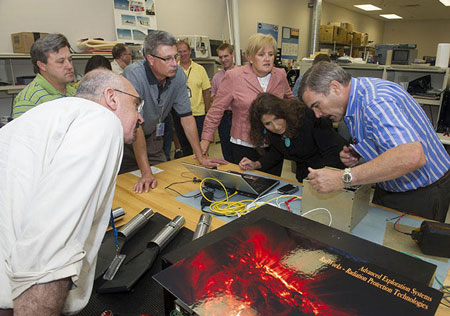
New technique to protect astronauts from space radiation
The complexities of traveling to and working in space present challenges to astronauts that NASA scientists and engineers have been working on since Neil Armstrong and Buzz Aldrin first stepped on the moon more than 43 years ago.
November 8, 2012 Read more
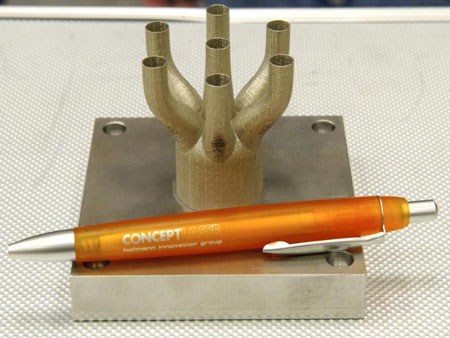
NASA's space launch system using futuristic technology to build the next generation of rockets (w/video)
NASA's Marshall Space Flight Center in Huntsville, Ala. is using a method called selective laser melting, or SLM, to create intricate metal parts for America's next heavy-lift rocket. Using this state-of-the-art technique will benefit the agency by saving millions in manufacturing costs.
November 8, 2012 Read more
New habitable zone super-Earth found in exosolar system
Astronomers have discovered a new super-Earth in the habitable zone, where liquid water and a stable atmosphere could reside, around the nearby star HD 40307. It is one of three new super-Earths found around the star that has three other low-mass planets orbiting it.
November 8, 2012 Read more
New cosmic ray discovered
European astronomers have discovered a new source of cosmic rays emanating from the vicinity of the Arches cluster, near the centre of the Milky Way. According to the researchers, these particles are accelerated in the shock wave generated by tens of thousands of young stars moving at a speed of around 700 000 km/h.
November 8, 2012 Read more
NASA holds Innovative Advanced Concepts Symposium Nov. 14-15
The NASA Innovative Advanced Concepts (NIAC) Program's 2012 Fall Symposium will be held Nov. 14-15, 2012 at the Crowne Plaza Hotel in Hampton, Va. NIAC examines early stage concepts that may lead to advanced and innovative space technologies critical for NASA to enable missions in the next 10 to 100 years.
November 7, 2012 Read more
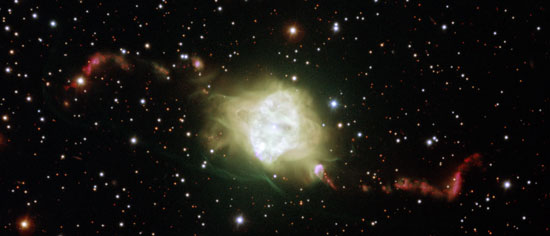
Astronomer's model helps identify binary star inside curved-jet-shooting nebula
University of Tübingen astronomer Dr. Thomas Rauch has helped an international team of astronomers with their discovery of a pair of stars circling inside one of the strangest known planetary nebulae. The researchers used his new model to confirm a long-debated theory on the spectacular and symmetrical appearance of matter hurled into space by binary stars.
November 7, 2012 Read more
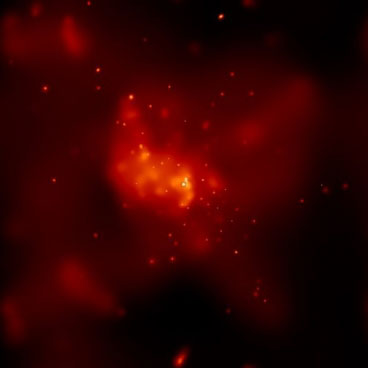
A burst of activity in the middle of the Milky Way
Researchers detect the brightest flare ever observed in our galaxy?s black hole.
November 6, 2012 Read more