

Space Exploration News – Latest Headlines
 Subscribe to our Space Exploration News feed
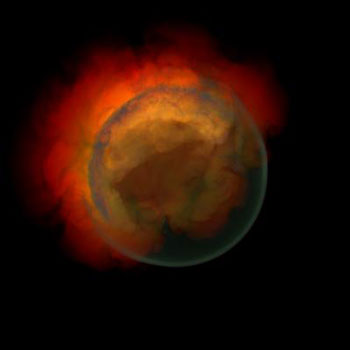
Failed explosions explain most peculiar supernovae
Supercomputer simulations have revealed that a type of oddly dim, exploding star is probably a class of duds - one that could nonetheless throw new light on the mysterious nature of dark energy.
November 20, 2012 Read more
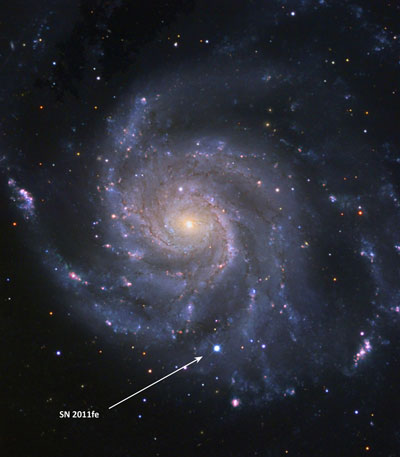
Astronomers pin down origins of "mile markers" for expansion of universe
A study using a unique new instrument on the world's largest optical telescope has revealed the likely origins of especially bright supernovae that astronomers use as easy-to-spot "mile markers" to measure the expansion and acceleration of the universe.
November 20, 2012 Read more
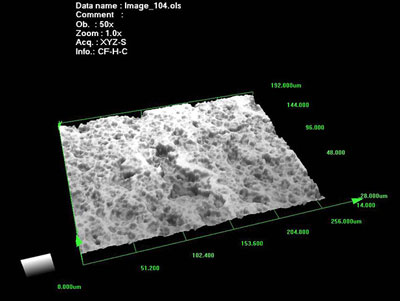
Ah, that new car smell: NASA technology protects spacecraft from outgassed molecular contaminants
Outgassing - the physical process that creates that oh-so-alluring new car smell - isn't healthy for humans and, as it turns out, not particularly wholesome for sensitive satellite instruments, either. But a team of NASA engineers has created a new way to protect those instruments from its ill effects.
November 20, 2012 Read more
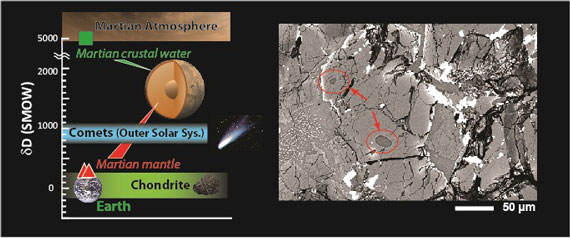
Meteorite samples provide definitive evidence of water and rock types on Mars
Researchers at the Tokyo Institute of Technology, NASA's Johnson Space Center, Lunar Planetary Institute, and Carnegie Institute of Washington report on geochemical studies that help towards settling the controversy that surrounds the origin, abundance, and history of water on Mars.
November 20, 2012 Read more
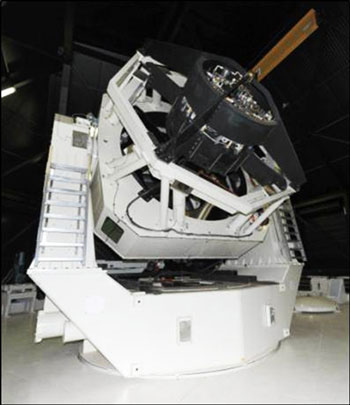
DARPA telescope headed to Australia to help track space debris
DARPA's ground-based Space Surveillance Telescope may soon head to Australia. An agreement reached this week with Australia's Department of Defense will allow DARPA to take the 180,000 lb. three-mirror Mersenne-Schmidt telescope to Australia to track and catalogues space debris and objects unique to the space above that region of the world that could threaten DoD satellites.
November 19, 2012 Read more
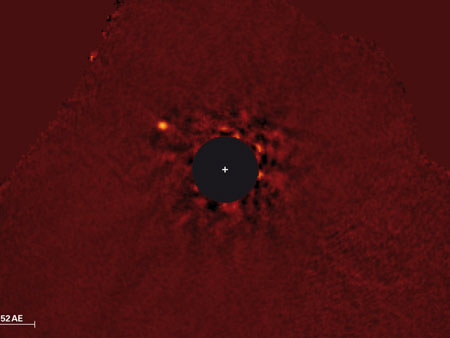
Portrait of a super-Jupiter
A discovery in the Andromeda constellation sheds new light on the birth of planets. The gas giant has roughly 13 times the mass of Jupiter, while the parent star has 2.5 times the mass of the Sun. This planet probably formed in a similar way to ordinary, lower-mass planets: in a 'protoplanetary disk' of gas and dust. This makes the planet an important test case for current models of how planets are born.
November 19, 2012 Read more
Thirty million hours of supercomputer time for space simulation
In space research, the Finnish Meteorological Institute specialises in large-scale computer simulations modelling the behaviour of particles and electromagnetic fields in the vicinity of Earth and other bodies in the solar system. Simulation models are used, for example, to study processes involved in the origin of auroras.
November 19, 2012 Read more
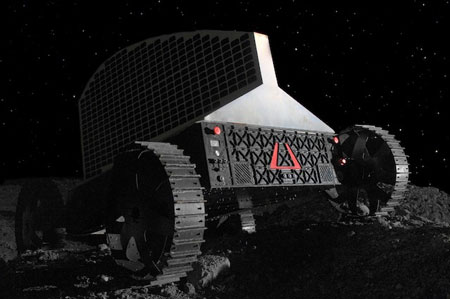
Robotic explorers may usher in lunar 'water rush'
The American space program stands at the cusp of a "water rush" to the moon by several companies developing robotic prospectors for launch in the near future, according to a NASA scientist considering how to acquire and use water ice believed to be at the poles of the moon.
November 18, 2012 Read more
Melt water on Mars could sustain life
Near surface water has shaped the landscape of Mars. Areas of the planet's northern and southern hemispheres have alternately thawed and frozen in recent geologic history and comprise striking similarities to the landscape of Svalbard. This suggests that water has played a more extensive role than previously envisioned, and that environments capable of sustaining life could exist.
November 16, 2012 Read more
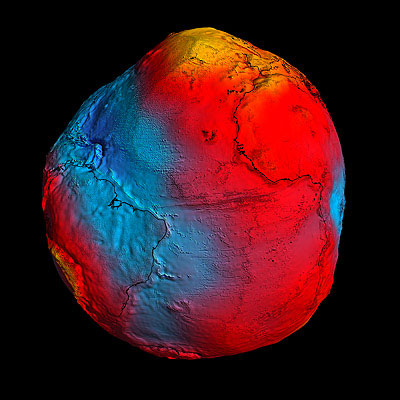
GOCE's second mission improving gravity map
ESA's GOCE gravity satellite has already delivered the most accurate gravity map of Earth, but its orbit is now being lowered in order to obtain even better results.
November 16, 2012 Read more
Crescent moon sets stage for brilliant Leonids meteor shower
The 2012 Leonid meteor shower peaks on the night/morning of Nov. 16-17. If forecasters are correct, the shower should produce a mild but pretty sprinkling of meteors over North America, followed by a more intense outburst over Asia. The new moon will set the stage for what could be one of the best Leonid showers in years.
November 15, 2012 Read more
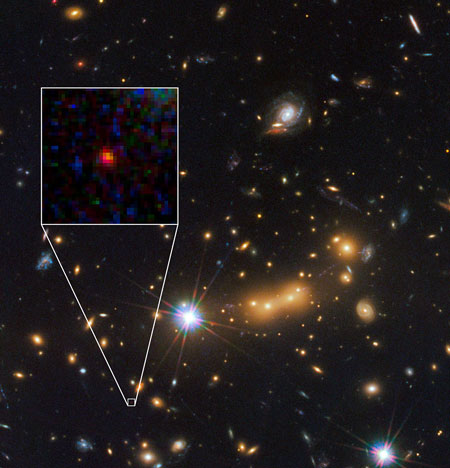
Hubble helps find candidate for most distant object in the Universe yet observed
By combining the power of the NASA/ESA Hubble Space Telescope, NASA's Spitzer Space Telescope and one of nature's zoom lenses, astronomers have found what is probably the most distant galaxy yet seen in the Universe. The object offers a peek back into a time when the Universe was only 3 percent of its present age of 13.7 billion years.
November 15, 2012 Read more
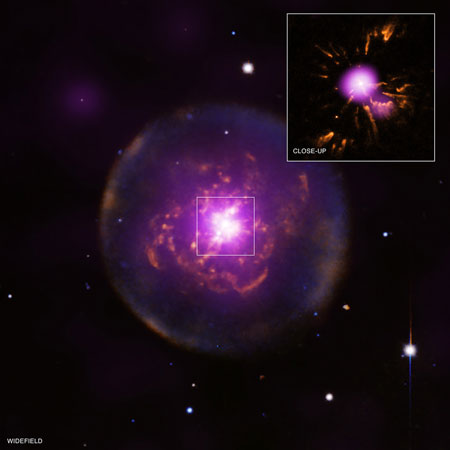
Born-again star foreshadows fate of Solar System
Astronomers have found evidence for a dying Sun-like star coming briefly back to life after casting its gassy shells out into space, mimicking the possible fate our own Solar System faces in a few billion years.
November 15, 2012 Read more
Meteorites reveal warm water existed on Mars
Hydrothermal fractures around Martian impact craters may have been a habitable environment for microbial life.
November 15, 2012 Read more
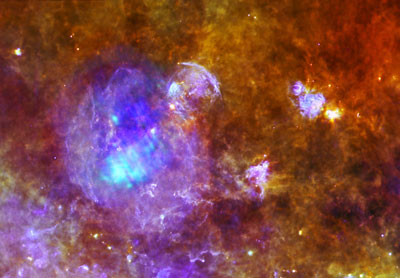
Life and death in a star-forming cloud
The aftershock of a stellar explosion rippling through space is captured in this new view of supernova remnant W44, which combines far-infrared and X-ray data from ESA's Herschel and XMM-Newton space observatories.
November 14, 2012 Read more
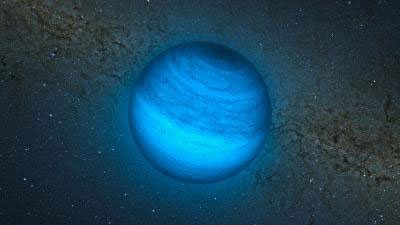
Lost in space: Rogue planet spotted?
Astronomers using ESO's Very Large Telescope and the Canada-France-Hawaii Telescope have identified a body that is very probably a planet wandering through space without a parent star. This is the most exciting free-floating planet candidate so far and the closest such object to the Solar System at a distance of about 100 light-years.
November 14, 2012 Read more
Student teams to build and fly rockets with onboard payloads for NASA rocketry challenge
Organizers of the NASA Student Launch Projects have announced the 57 student teams whose inventive creations will soar skyward in April during the space agency's 2012-13 rocketry challenge.
November 13, 2012 Read more
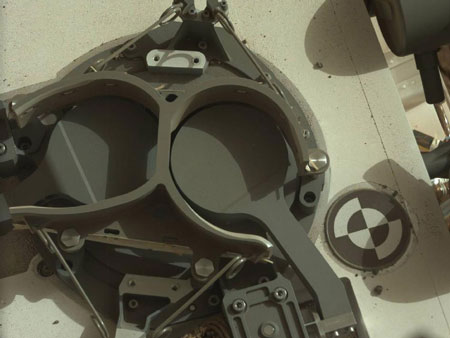
Mars Rover's 'SAM' lab instrument suite tastes soil
A pinch of fine sand and dust became the first solid Martian sample deposited into the biggest instrument on NASA's Mars rover Curiosity: the Sample Analysis at Mars, or SAM.
November 13, 2012 Read more