| Aug 08, 2025 |
When flaws become features: Turning defects into brighter perovskite emission
Engineered atomic faults in perovskites boost light emission by nearly 80 percent and improve stability, offering new design strategies for brighter, more durable optoelectronic devices.
(Nanowerk News) In the world of materials science, “defects” are usually the bad guys, tiny imperfections in a material’s structure that sabotage performance, drain efficiency, or shorten a device’s life span. But a new study published in Advanced Materials ("Atomically Precise Ruddlesden–Popper Faults Induced Enhanced Emission in Ligand Stabilized Mixed Halide Perovskites") flips this idea on its head. It reveals how a long-misunderstood defect in crystals, known as the Ruddlesden-Popper (RP) fault, could be the secret ingredient to unlocking brighter and more stable light-emitting materials.
|
|
At the heart of this discovery are perovskites, a family of materials making waves for their use in solar panels, LEDs, lasers, and even quantum technologies. Perovskites are prized for their unique atomic structures, which allow electrons and other charge carriers to move efficiently, making them highly effective at converting or emitting energy.
|
|
But like all crystals, perovskites are not perfect. One common imperfection is the RP fault, a type of layer-stacking mistake at the atomic level. Historically, these RP faults were seen as nuisances, sites that trapped charge and reduced performance. But this new research takes a bold new perspective: what if these so-called flaws are actually features?
|
|
Using cutting-edge electron microscopy, the team behind the study peered deep into the atomic world of perovskites. What they found was surprising. When RP faults are carefully engineered, rather than randomly occurring, they can actually enhance the ability of material to emit light. In other words, with a little manipulation, a defect becomes a performance booster.
|
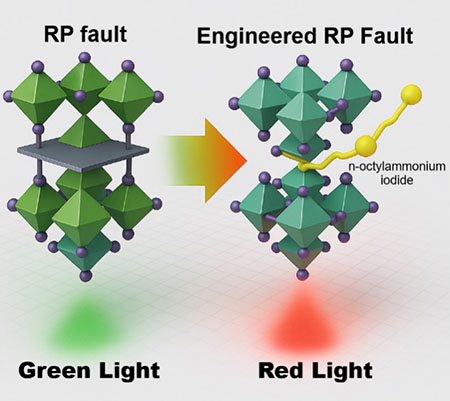 |
| Researchers engineered a specific type of crystal defect in perovskite nanocrystals, known as a Ruddlesden–Popper fault, by adding n-octylammonium iodide. This modification changes the material’s composition from bromine-rich to iodine-rich, shifting its light emission from green to red and boosting brightness for use in flexible LEDs. (Image: courtesy of the researchers)
|
|
To do this, Somnath Mahato and colleagues from Lukasiewicz PORT and Indian Institute of Technology introduced a special iodine-containing molecule, n-octylammonium iodide, into the crystal formation process. This fine-tuned the structure of a mixed-halide perovskite called CsPbBr₃I, resulting in a new phase of the material that emitted light not just more brightly, but in a new color, shifting from green to a deep, vivid red. Incredibly, the intensity of the emitted light increased by almost 80%.
|
|
Why does this matter? One reason is flexible electronics, especially flexible LEDs, which are used in next-gen displays and wearable tech. These devices often face physical stress and bending, which can damage the material at the atomic level. But the RP faults, once thought to be weaknesses, act like tiny shock absorbers, helping the crystal relieve stress and stay intact.
|
|
It’s a little like turning structural cracks in a bridge into smart hinges that absorb traffic vibrations.
|
|
Even more exciting, this approach hints at a broader strategy called strain engineering, where internal stresses in materials are deliberately manipulated to improve performance. In other perovskite systems, this technique has been shown to enhance magnetism, superconductivity, and even catalysis for clean energy applications.
|
|
This breakthrough opens the door to a whole new way of thinking about materials design. Rather than trying to eliminate all defects, researchers could learn to embrace and control them, transforming problems into possibilities.
|