

| Sep 03, 2025 |
Clear solar windows turn glass into hidden power generatorsResearchers created transparent solar windows that capture sunlight at the edges, cutting PV cell needs while keeping buildings visually unchanged.(Nanowerk News) Windows that look ordinary could soon double as solar panels. A team at Nanjing University has developed a transparent, colorless solar concentrator that can be coated directly onto standard glass, offering a way to generate clean energy without changing how windows look. The research was published in PhotoniX ("Colorless and unidirectional diffractive-type solar concentrators compatible with existing windows"). |
| The device, called a cholesteric unidirectional solar concentrator (CUSC), uses specially engineered liquid crystal films to redirect sunlight. Unlike older concentrators that scatter or absorb light—often distorting the view or lowering efficiency—this design relies on polarization-selective diffraction. It channels specific wavelengths of light into the glass edge, where photovoltaic cells convert it into electricity, while leaving the window clear. |
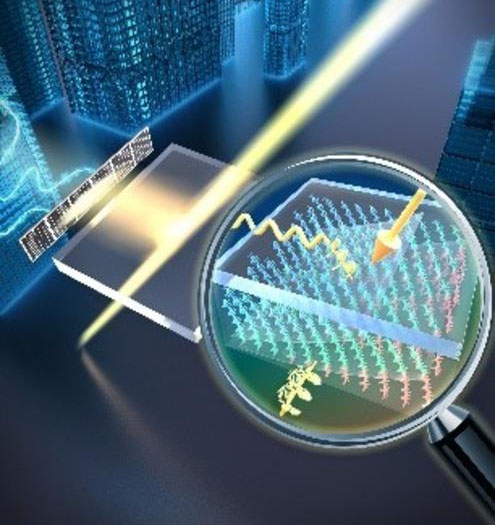 |
| This semi-transparent solar concentrator uses liquid crystal films to reflect and guide circularly polarized sunlight, enabling colorless energy harvesting for next-generation green buildings. (Image: Center for Liquid Crystal and Photonics/ Nanjing University) |
| Tests showed the system transmits more than 64 percent of visible light while maintaining a high color rendering index, meaning the window remains visually neutral. At the same time, it captures significant solar energy. A one-inch prototype was able to power a small fan under natural sunlight. Larger models could multiply the sunlight intensity 50-fold, cutting the number of solar cells needed by three-quarters. |
| The films are made using photoalignment and polymerization techniques, and can be manufactured at scale with roll-to-roll processes. They remain stable under long exposure and could be retrofitted onto existing buildings. |
| By pairing the concentrator with advanced solar cells such as gallium arsenide, researchers estimate even higher efficiency. Beyond city buildings, the technology could also benefit greenhouses and transparent displays, making glass surfaces productive rather than passive. |
| Professor Wei Hu of Nanjing University called the development “a practical and scalable strategy for carbon reduction and energy self-sufficiency,” highlighting its potential role in sustainable urban design. |
| Source: Chinese Society for Optical Engineering (Note: Content may be edited for style and length) |

