| Sep 15, 2025 |
Tiny metasurface sensor detects magnetic fields billions of times weaker than Earth'sResearchers built a fingernail-sized magnetometer using metasurfaces that measures fields billions of times weaker than Earth's, opening new paths for quantum sensing.(Nanowerk News) A team of researchers has built a magnetic sensor small enough to fit on the tip of a finger yet powerful enough to register magnetic fields billions of times weaker than Earth’s. The device relies on a nanoscale optical structure called a metasurface, which reshapes light in ways ordinary materials cannot (PhotoniX, "Phase-gradient metasurface enables atomic spin chirality detection for elliptically polarized laser-pumped atomic magnetometer"). |
| At the heart of the sensor is an atomic magnetometer, an instrument that uses the behavior of atoms to measure magnetic fields with extraordinary precision. Conventional versions of these devices often require bulky optical setups, but the new design replaces that complexity with a metasurface only 3 millimeters across and less than a millimeter thick. |
| When laser light passes through the metasurface, it emerges in a twisted form that interacts with rubidium atoms in a vapor cell. These atoms respond to even the slightest magnetic disturbances. Using this method, the researchers achieved a sensitivity of 2.67 picotesla per square root hertz while working in a background field of about 10,000 nanotesla. That level of precision allows the sensor to pick up signals that are unimaginably faint compared with Earth’s magnetic field. |
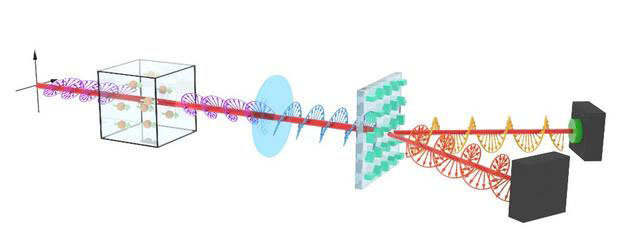 |
| Design principle of the compact single-beam elliptically polarized atomic magnetometer enabled by the phase-gradient metasurface. (Image: Jin Li, Beihang University) |
| The design also simplifies how the magnetometer operates. Traditional setups often need two separate beams of light: one to prepare the atoms and another to read out the measurements. The new system accomplishes both with a single beam, reducing size and complexity without sacrificing accuracy. The researchers call this approach atomic spin chirality detection, a method that sharpens the instrument’s ability to resolve weak signals. |
| Miniaturization at this scale opens the way to a wide range of applications. In medicine, portable scanners could track the faint magnetic fields produced by neurons in the brain. In navigation, handheld devices could guide users through environments where GPS signals fail. Geologists could use compact sensors to map underground structures, while physicists could apply them to explore questions about dark matter or gravity. |
| By merging light-shaping metasurfaces with atomic sensing, the work demonstrates how quantum technology can move from specialized laboratories into practical devices. The combination of sensitivity, compact design, and integration potential marks a step toward making atomic magnetometers tools for everyday science and technology. |
| Source: Chinese Society for Optical Engineering (Note: Content may be edited for style and length) |