| Nov 05, 2025 |
Atomically thin magnetic memory films work without insulating bufferA new study reveals that insulating buffer layers are no longer needed for ultrathin magnetic racetrack devices, unlocking new paths for seamless integration with functional substrates.(Nanowerk News) Insulating layers once considered essential for ultrathin magnetic memory devices may no longer be required. Researchers at the Max Planck Institute of Microstructure Physics have found that Platinum-Cobalt-Nickel (Pt/Co/Ni/Co) membranes can preserve their magnetic performance without the commonly used magnesium oxide (MgO) buffer layer. The finding allows these films to be directly integrated with functional or flexible substrates, simplifying design and expanding application potential. |
| The study, led by Prof. Stuart Parkin from the NISE Department and published in Advanced Materials ("Atomically-Thin Freestanding Racetrack Memory Devices"), shows that a sacrificial Sr₃Al₂O₆ (SAO) layer can replace MgO during fabrication. This oxide supports the growth of high-quality magnetic films that are less than 4 nm thick. Once the SAO is dissolved, the freestanding films can be transferred onto pre-patterned surfaces—including those with built-in circuits—while preserving their magnetic integrity. |
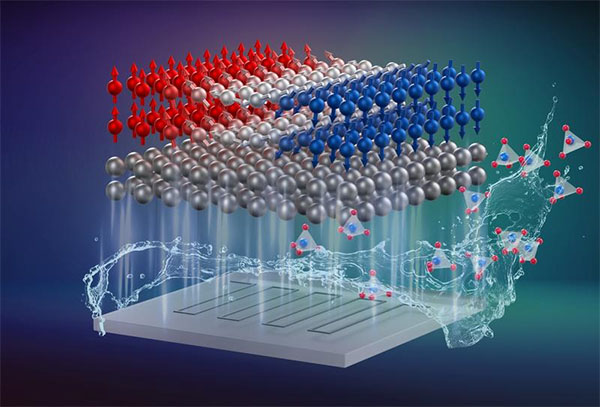 |
| Ultrathin Freestanding Racetrack Membranes Couple with Transfer Bases. (Image: Masha Formenko, Max Planck Institute of Microstructure Physics) |
| Racetrack memory (RTM) devices store information as magnetic domain walls that travel along nanowire-like “tracks.” These spintronic devices offer fast, low-power, non-volatile memory with potential to combine logic and storage on a single chip. |
| Previous attempts to broaden RTM design involved freestanding membranes that could be placed onto 3D-patterned bases (Nature Nanotechnology, "Three-dimensional racetrack memory devices designed from freestanding magnetic heterostructures"). But the insulating MgO buffer typically used in these membranes blocked electrical or magnetic interaction with the underlying layers. |
| The new research eliminates that bottleneck. “Eliminating the insulating MgO buffer layer, ultrathin Platinum-Cobalt-Nickel membranes directly interface with pre-patterned substrates while retaining their magnetic properties,” the authors report. The buffer-free membranes even show higher domain wall mobility than buffered versions. |
| The team demonstrated further functionality by transferring the films onto pre-patterned platinum layers, showing that domain wall behavior could be controlled locally, a key feature for future racetrack-based computing architectures. The membranes also proved robust, maintaining performance after bending, thermal treatment, electrical stress, and extended exposure to air. |
| This result moves magnetic racetrack devices closer to integration within compact, flexible, or layered systems. It provides a new path for high-density, energy-efficient spintronic technologies. |
| Source: Max Planck Institute of Microstructure Physics (Note: Content may be edited for style and length) |