| Mar 16, 2026 |
Dislocations induce ordered polar topologies in antiferroelectric thin films
Researchers discovered that crystal dislocations in antiferroelectric PbZrO3 thin films generate ordered polar antihedgehog lattices, creating a new defect-engineering approach for polar topologies.
(Nanowerk News) A team of researchers has identified a strong coupling between crystal dislocations and polar topological structures in antiferroelectric lead zirconate (PbZrO3) thin films. Published in Nature Communications ("Strong interplay between polar and structural topologies"), the study shows that dislocation cores at film interfaces act as convergence points for electric polarization, spontaneously generating an ordered lattice of polar domains. The discovery reframes dislocations, long regarded as crystal imperfections, as a means of engineering topological polar states in antiferroelectric materials.
|
Key Findings
- Dislocation arrays at interfaces in PbZrO3 thin films spontaneously produce ordered "antihedgehog" polar domain lattices through coupled electrostrictive and flexoelectric effects.
- Polarization vectors converge at dislocation cores and diverge between them, forming a checkerboard-like topological pattern observed at atomic resolution.
- Phase-field simulations confirm that local effective electric fields near dislocation cores are strong enough to overcome the antiparallel dipole coupling that normally prevents polarization rotation in antiferroelectrics.
|
|
Antiferroelectric materials are characterized by electric dipoles that align in opposite directions in adjacent crystal unit cells. This antiparallel arrangement creates large energy barriers that resist continuous rotation of polarization, a prerequisite for forming topological polar structures such as vortices, skyrmions, and merons. Ferroelectric materials have yielded a variety of such structures, but the energy barriers inherent to antiferroelectrics have kept them out of reach.
|
 |
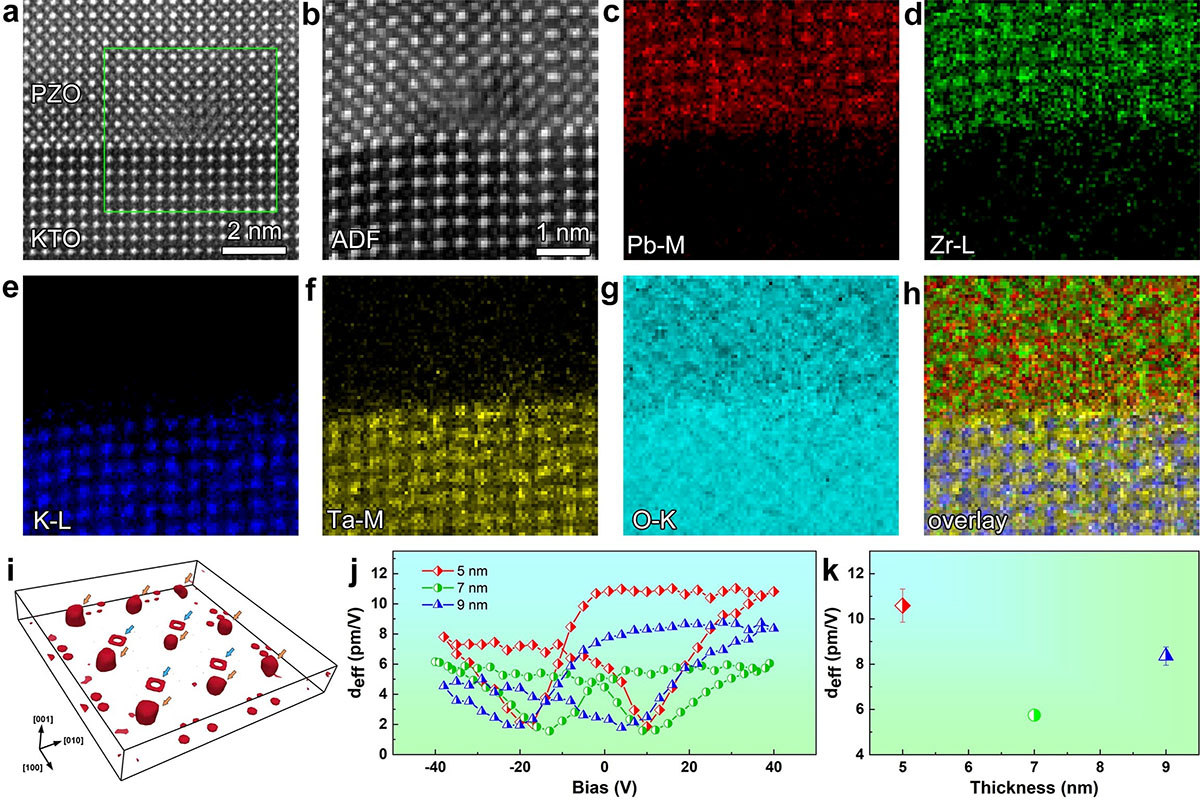
| Characterization of atomic composition at interfacial dislocation cores and piezoelectric properties of the antiferroelectric PbZrO3 thin film. (Image: IMR) (click on image to enlarge)
|
|
The collaborative team, led by scientists at the Institute of Metal Research of the Chinese Academy of Sciences and the Songshan Lake Materials Laboratory, took a different approach by targeting dislocations, the most common one-dimensional topological defects found in crystalline solids. Using atomic-resolution transmission electron microscopy, the researchers mapped polarization distributions at dislocation cores located along the interfaces of high-quality PbZrO3 epitaxial thin films.
|
|
Their imaging revealed that polarization vectors converge toward each dislocation core and diverge in the regions between adjacent dislocations. The periodic strain fields produced by these dislocation arrays couple strongly with local electric dipoles, triggering the spontaneous formation of an antihedgehog polar domain lattice. This checkerboard-like arrangement of converging and diverging polarization constitutes an entirely new type of polar topology in antiferroelectric materials.
|
|
To clarify the physical mechanism, the team carried out phase-field simulations. The modeling showed that two effects operating near dislocation cores, electrostriction and flexoelectricity, jointly generate local effective electric fields. These fields are intense enough to override the antiparallel coupling between neighboring dipoles, forcing the polarization to rotate and reorganize into the observed topological pattern.
|
|
"This work demonstrates that dislocations, traditionally viewed as crystal defects, can serve as a new tool for engineering polar topological states," said Prof. Tang Yunlong, corresponding author of the study.
|
|
The research involved contributors from the Institute of Metal Research, the Songshan Lake Materials Laboratory, Cornell University, the Institute of Physics of the Chinese Academy of Sciences, the University of Scranton, Hunan University of Science and Technology, and Lanzhou University of Technology.
|
|
The results establish a defect-engineering strategy for creating polar topologies in antiferroelectric systems. The authors propose that this approach could provide a material platform for developing high-density memory and novel logic devices based on topological polar states.
|