| Apr 13, 2026 |
How nanoscale catalyst design could improve hydrogen peroxide production
A review paper examines how precise nanoscale construction of graphitic carbon nitride catalysts can advance sustainable photocatalytic hydrogen peroxide production.
(Nanowerk News) A new review from researchers at Tohoku University examines how precise nanoscale construction of graphitic carbon nitride photocatalysts can improve the sustainable production of hydrogen peroxide.
|
|
The study (Coordination Chemistry Reviews, "Recent advances in g-C3N4 nanoarchitectonics for efficient photocatalytic H2O2 evolution"), published by the university's Advanced Institute for Materials Research, offers one of the first comprehensive assessments of how organizing this metal-free catalyst's building blocks at the atomic and molecular level could unlock performance gains needed for real-world applications.
|
Key Findings
- The review is among the first to focus specifically on the nanoarchitectonics of layered graphitic carbon nitride for photocatalytic hydrogen peroxide generation.
- Strategies such as defect engineering, metal doping, and semiconductor heterostructure construction can significantly improve the catalyst's efficiency.
- Scaling up from laboratory research to industrial production remains a central challenge that requires better control of the catalyst's nanoscale structure.
|
|
Hydrogen peroxide is a versatile oxidizing agent used across a wide range of industrial and household applications. Conventional production methods carry significant environmental costs, which has driven interest in photocatalytic approaches that rely on sunlight, water, and oxygen as the only inputs. A light-activated catalyst known as graphitic carbon nitride, a layered, metal-free semiconductor composed primarily of carbon and nitrogen, plays a key role in these reactions.
|
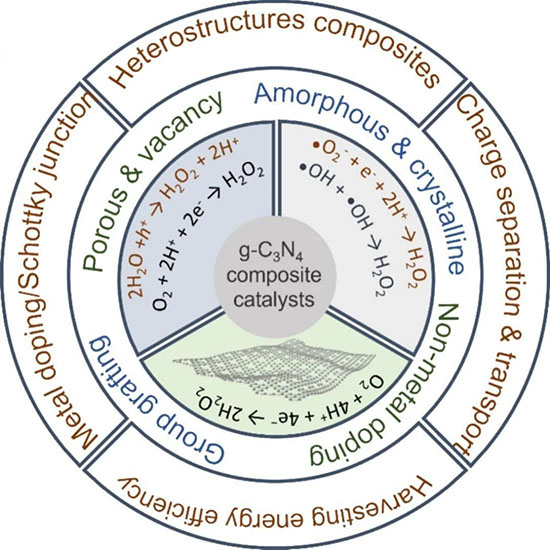 |
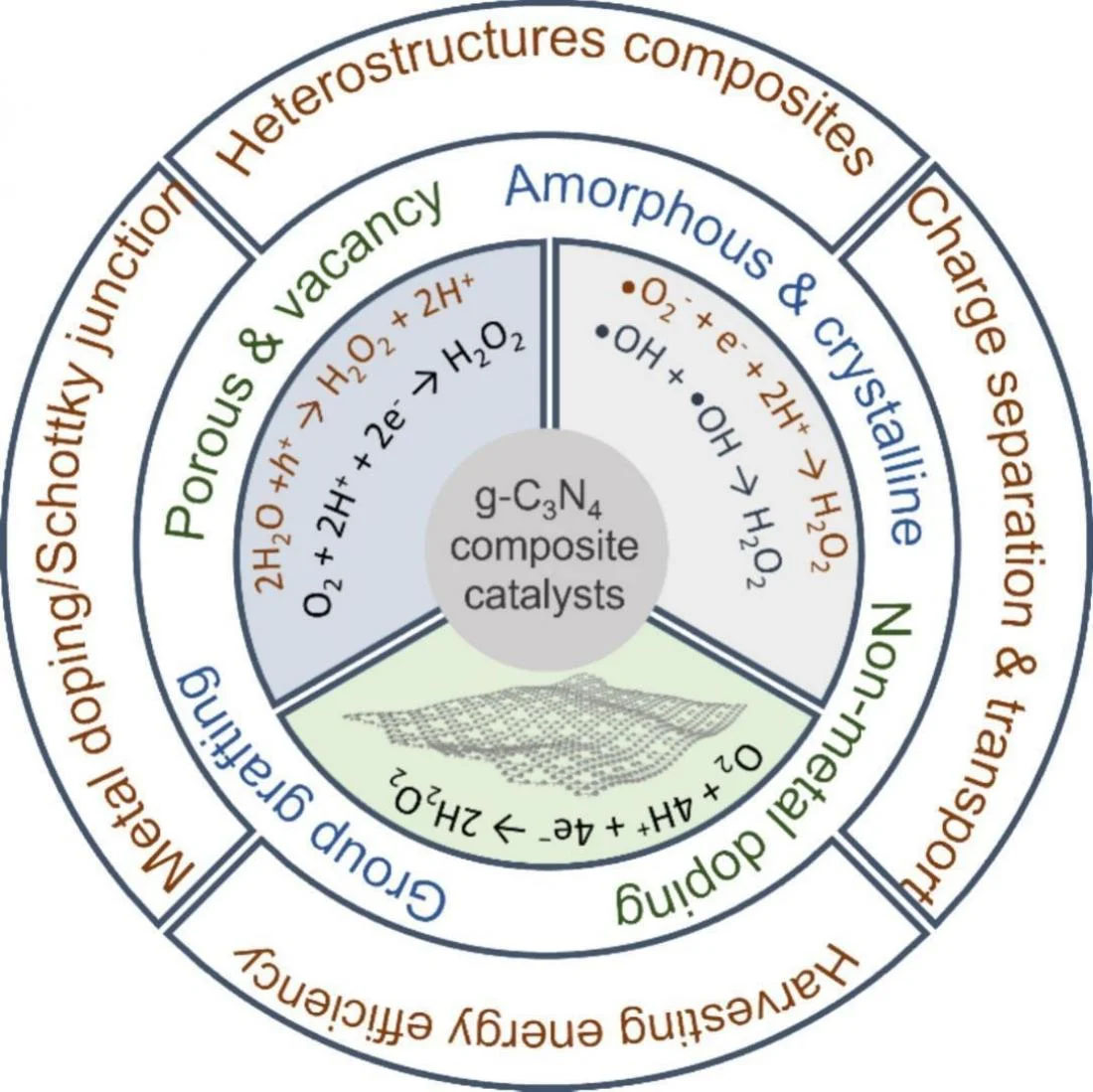
| Outline illustration of this review on g-C3N4 nanosheets nanoarchitectonics in photocatalytic H2O2 production. (Image: Xiao Zhang, San Ping Jiang)
(click on image to enlarge)
|
|
The Tohoku University team focused their review on what they call the "nanoarchitectonics" of this catalyst. The term refers to constructing a material by deliberately positioning its building blocks at the nanoscale, much like planning the placement of every brick in a building's architecture. This degree of structural control determines the catalyst's physical and chemical properties and is essential for moving the technology beyond the laboratory.
|
|
"Recent reviews have discussed fabrication methods, challenges, and perspectives for g-C3N4 materials used in H2O2 generation, but a comprehensive review specifically addressing the recent advancements in nanoarchitectonics of layered g-C3N4 for photocatalytic H2O2 generation was still needed," says Xiao Zhang (Advanced Institute for Materials Research (WPI-AIMR), Tohoku University).
|
|
Beyond structural design, the review evaluates several complementary strategies for enhancing catalyst performance. Defect engineering, which involves introducing controlled imperfections into the material's crystal structure, can create additional active sites for chemical reactions. Metal doping, where small amounts of metal atoms are incorporated into the carbon nitride framework, alters its electronic properties. The construction of semiconductor heterostructures, where graphitic carbon nitride is paired with a second semiconductor material, has the potential to produce hydrogen peroxide cleanly and efficiently.
|
|
The review identifies important bottlenecks that must be overcome before photocatalytic hydrogen peroxide production using this class of catalysts can operate at industrial and commercial scale. Achieving the necessary precision in nanoscale fabrication at volume remains the core obstacle, and the nanoarchitectonics framework outlined here provides a roadmap for addressing it.
|