Nanoarchitectonics: Building Functional Materials from Atomic and Molecular Units
What is Nanoarchitectonics?
Nanoarchitectonics is a concept in materials science that aims to construct functional materials and systems by organizing atoms, molecules, and nanomaterials as building blocks. Proposed at the beginning of the 21st century, the concept represents a post-nanotechnology paradigm: while nanotechnology revealed the science of the nanoscale, nanoarchitectonics takes this knowledge further by applying it to the deliberate design and fabrication of complex functional structures.
The distinguishing feature of nanoarchitectonics is its integrative nature. Rather than relying on a single technique, it combines multiple approaches – including organic chemical synthesis, self-assembly, field-applied organization, microfabrication, and biological processes – to architect materials from the bottom up. This combination allows researchers to produce asymmetric, hierarchical, and multifunctional structures that no single method could achieve alone.
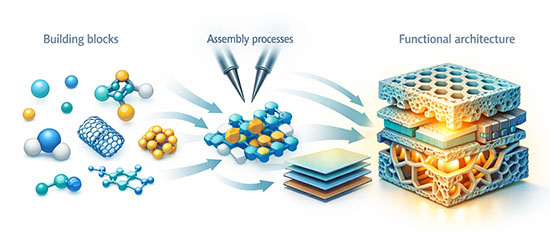
How Nanoarchitectonics Works
The central principle behind nanoarchitectonics is the orchestrated combination of multiple fabrication strategies to control structure at the nanoscale. Unlike conventional top-down approaches, which carve structures from bulk materials, and unlike pure bottom-up self-assembly, which relies on spontaneous organization, nanoarchitectonics blends both philosophies with additional tools such as atomic and molecular manipulation, template-directed synthesis, and field-induced assembly.
A key insight of nanoarchitectonics is that individual nano-units are not always the primary source of function. Instead, it is the interactions between nano-units – and the way they are arranged – that give rise to new and often unexpected properties. Small perturbations in assembly conditions, mechanical forces, or chemical environments can steer these interactions, producing emergent behaviors that would be difficult to predict from the properties of the individual components alone.
Types of Nanoarchitectonics Approaches
Nanoarchitectonics encompasses several distinct approaches, each operating at a different scale and with different types of building blocks. Think of it as having different toolkits for different jobs: one for placing individual atoms, another for guiding molecules to lock together like puzzle pieces, and yet another for layering thin coatings with nanometer precision. These approaches can be used independently or in combination to construct materials with targeted functions.
Atomistic Nanoarchitectonics
At the smallest scale, atomistic nanoarchitectonics involves the precise positioning and manipulation of individual atoms. This approach draws on techniques from scanning tunneling microscopy (STM) and on-surface synthesis to build structures atom by atom. Atomic switch devices, in which the controlled movement of metal atoms creates and breaks conductive pathways, represent a practical embodiment of this approach and have direct relevance to nanoelectronics.
Molecular and Supramolecular Nanoarchitectonics
At the molecular level, nanoarchitectonics employs organic synthesis, supramolecular assembly, and coordination chemistry to build functional architectures from designed molecular components. Molecular assembly processes such as hydrogen bonding, metal coordination, and host–guest interactions allow molecules to organize into well-defined structures including nanosheets, porous frameworks, and molecular machines. Metal-organic frameworks (MOFs) and covalent organic frameworks (COFs) are typical products of this strategy.
Inorganic Nanoarchitectonics
Inorganic nanoarchitectonics focuses on the controlled synthesis and assembly of nanoparticles, nanowires, nanofibers, and other inorganic nano-units into functional architectures. Techniques such as atomic layer deposition (ALD), chemical vapor deposition (CVD), and layer-by-layer assembly enable precise control over composition, thickness, and spatial arrangement at the nanoscale.
Bio-Related Nanoarchitectonics
Biological systems represent the ultimate examples of nanoarchitectonics in nature. Bio-related nanoarchitectonics aims to mimic or integrate biological components, using DNA nanotechnology, peptide assembly, and lipid-based structures as building blocks. Bioinspired nanomaterials constructed through these strategies can replicate cellular functions such as enzymatic catalysis, selective transport, and signal transduction.
Significance in Nanotechnology
Nanoarchitectonics addresses a fundamental gap in materials science: the disconnect between knowing what happens at the nanoscale and being able to use that knowledge to build practical functional systems. While nanotechnology provided tools to observe and characterize nanostructured materials, it did not offer a comprehensive methodology for constructing complex, multi-component architectures. Nanoarchitectonics fills this gap by providing a unifying framework that bridges basic nanoscience and real-world materials fabrication.
A defining characteristic of nanoarchitectonics is its ability to manage uncertainty. At the nanoscale, thermal fluctuations, quantum effects, and statistical distributions introduce inherent unpredictability into assembly processes. Nanoarchitectonics accommodates these uncertainties rather than fighting them, using approaches such as Langmuir-Blodgett film techniques and interfacial assembly to guide structure formation under conditions where precise atomic-level control is not always possible.
Key Properties and Functional Outcomes
Hierarchical Organization
Nanoarchitectonics excels at creating materials with hierarchical structures spanning multiple length scales. By combining self-assembly at the molecular level with template-directed fabrication at the mesoscale, researchers can produce materials such as mesoporous materials and nanoporous architectures with precisely tuned pore sizes, surface areas, and connectivity.
Emergent Functionality
One of the most compelling aspects of nanoarchitectonics is the emergence of functions that cannot be predicted from the properties of individual building blocks. When fullerenes are nanoarchitectonically assembled into microtubes or cubes with open-hole structures, they develop sensing capabilities that isolated fullerene molecules lack entirely. Similarly, assembling gold nanoparticles into ordered arrays produces collective surface plasmon resonance effects absent in isolated particles.
Interface-Driven Control
Interfaces – whether solid–liquid, air–water, or liquid–liquid – serve as critical platforms for nanoarchitectonics. Confining molecules to two-dimensional interfacial environments restricts their degrees of freedom and enables precise control over orientation, packing density, and intermolecular coupling. This approach is especially powerful for constructing soft 2D materials such as organic crystalline sheets and molecular receptor arrays. These interfacial structures can then be transferred to solid substrates or stacked into multilayered architectures through thin film deposition techniques.
Applications
Energy Conversion and Storage
Nanoarchitectonics enables the rational design of electrode materials for batteries, supercapacitors, and photovoltaic devices. By controlling pore architecture and surface chemistry at the nanoscale, researchers can maximize the accessible surface area for electrochemical reactions while maintaining efficient charge transport pathways. Nanocatalysts created through nanoarchitectonics strategies, including single-atom catalysts dispersed on engineered supports, offer improved activity and selectivity for energy conversion reactions such as water splitting and CO2 reduction.
Biomedical Applications
In nanomedicine, nanoarchitectonics provides tools for constructing targeted drug delivery vehicles, tissue engineering scaffolds, and diagnostic nanobiosensors with precisely engineered structures. For example, pore-engineered nanoarchitectonics of porous nanocarriers allows controlled drug loading and release profiles. Layer-by-layer capsules that mimic cell membranes have been developed to encapsulate and protect biological cargo, including living cells coated with artificial membranes.
Sensing and Detection
The structural precision afforded by nanoarchitectonics is particularly valuable for nanosensors. Fluorescent sensing films constructed through nanoarchitectonics can spatially separate individual fluorophore molecules, preventing aggregation-induced quenching that degrades sensor performance. Similar approaches have produced gas sensors based on MOF-coated fullerene nanotubes and electrochemical sensors with single-atom active sites, achieving selectivity and sensitivity that conventional materials cannot match.
Molecular Machines and Robotics
Molecular motors and machines represent a frontier application of nanoarchitectonics. By confining functional molecules at dynamic interfaces such as the air–water boundary, researchers can couple macroscopic mechanical forces to molecular-level structural changes. This mechano-nanoarchitectonics approach enables the operation and tuning of molecular machines through gentle lateral pressure, bridging the gap between molecular electronics and responsive mechanical systems, and opening pathways toward nanorobots with single-atom-level catalytic functionality.
Challenges and Future Perspectives
Despite significant progress, nanoarchitectonics faces several challenges that must be addressed before the concept can reach its full potential. Precise structural control across length scales – from atomic to macroscopic – remains difficult, particularly when attempting to produce materials reproducibly and at scale. The inherent statistical nature of nanoscale assembly processes means that achieving uniformity in large-area or bulk production is an ongoing engineering challenge.
Characterization also presents obstacles. While atomic force microscopy, transmission electron microscopy, and other nanoscale imaging tools can reveal the structure of nanoarchitectonics products, understanding the dynamic processes that occur during assembly requires advanced in situ and operando techniques that are still being developed.
Looking ahead, the integration of computational methods such as molecular dynamics simulations and machine learning with experimental nanoarchitectonics is expected to accelerate the discovery and optimization of new functional materials. The ultimate aspiration of nanoarchitectonics is to achieve control over material construction comparable to the sophistication of biological systems – creating artificial structures with the hierarchical complexity and adaptive functionality of living organisms. Continued advances toward this goal will be documented in the nanotechnology glossary.
Further Reading
Bulletin of the Chemical Society of Japan, Nanoarchitectonics: the method for everything in materials science