| Jun 02, 2025 |
A Milky Way and Andromeda galaxy collision may not be happening after allThe chance that our Milky Way Galaxy will collide with the Andromeda Galaxy may not be as certain as previously thought, according to researchers, who say that a new simulation has found a 50% chance that there will be no collision between the two galaxies in the next 10 billion years. |
| (Nanowerk News) The likelihood of a collision between the Milky Way and its neighbouring galaxy Andromeda may be smaller than previously thought, according to a new simulation described in Nature Astronomy ("No certainty of a Milky Way–Andromeda collision"). |
| The Milky Way is moving through the Universe and its path is influenced by the combined gravitational pulls of nearby galaxies, such as Andromeda, the Triangulum galaxy and the Large Magellanic Cloud. As such, previous research has suggested for over a decade that the Milky Way has a high likelihood of colliding with Andromeda, forming a new galaxy dubbed ‘Milkomeda’, in approximately five billion years. |
| Till Sawala and colleagues simulated the Milky Way’s movement through the Universe over the next 10 billion years using updated data from the Gaia and Hubble telescopes and revised estimates of the masses of local galaxies. They found that there is an approximately 50% chance that there will be no Milky Way–Andromeda collision in that time period. |
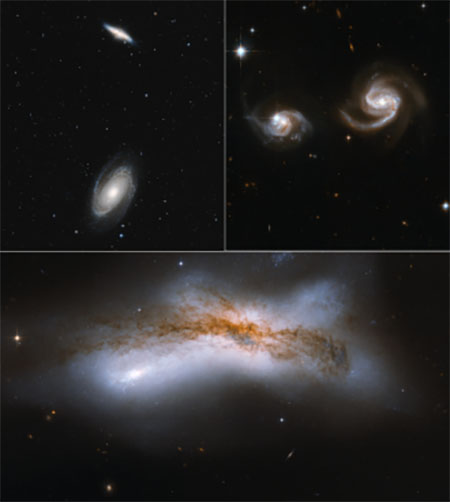 |
| Three future scenarios for Milky Way and Andromeda encounter. Top left: Galaxies bypass at 1 million light-year separation. Top right: At 500,000 light-years, dark matter provides friction that brings galaxies to a close encounter. Bottom: A 100,000 light-year separation leads to a collision. (Image: NASA, ESA) |
| The authors suggest that including the gravitational pull of the Large Magellanic Cloud — a smaller galaxy orbiting the Milky Way — in the calculations, which was not considered in previous analyses, and accounting for uncertainties, could explain the reduced probability. Sawala and colleagues also suggest that a Milky Way–Large Magellanic Cloud merger is almost certain within the next 2 billion years, before any potential collision with Andromeda. |
| The authors note that even using the most up-to-date data, there is still some uncertainty about how the Milky Way–Andromeda system will evolve, and that future data from the Gaia telescope could help produce a more accurate simulation. |
| Source: International Centre for Radio Astronomy Research (ICRAR) (Note: Content may be edited for style and length) |