

Nanotechnology News – Latest Headlines
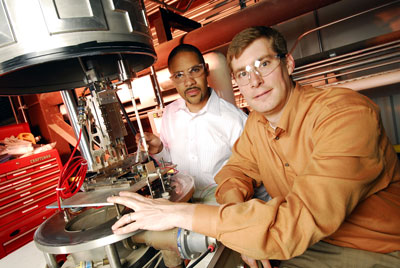
Carbon nanotube components boost satellite lifetimes through improved propulsion
Researchers at the Georgia Institute of Technology have won a $6.5 million grant to develop improved components that will boost the efficiency of electric propulsion systems used to control the positions of satellites and planetary probes.
October 22, 2009 Read more
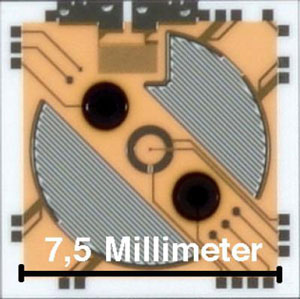
Sensor biochips could aid in cancer diagnosis and treatment
Researchers at the Heinz Nixdorf Chair for Medical Electronics at the Technische Universitaet Muenchen have developed a new test process for cancer drugs. With the help of microchips, they can establish in the laboratory whether a patient's tumor cells will react to a given drug.
October 22, 2009 Read more
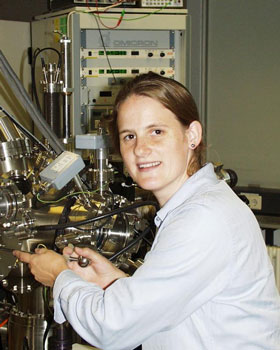
Winzige Kontakte im Visier
Dr. Regina Hoffmann vom Physikalischen Institut des KIT untersucht die Struktur und die elektronischen Eigenschaften von Nanokontakten in der Nanoelektronik und konnte fuer ihr Projekt erstmals fuer Karlsruhe einen begehrten ERC Starting Grant des European Research Council einwerben.
October 22, 2009 Read more
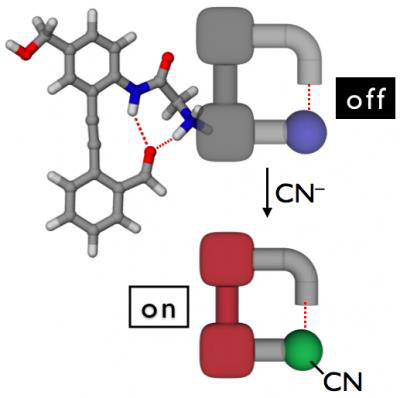
Designer molecule detects tiny amounts of cyanide, then glows
A small molecule designed to detect cyanide in water samples works quickly, is easy to use, and glows under ultraviolet or 'black' light.
October 21, 2009 Read more
Argonne dedicates new microscopy facility at Center for Nanoscale Materials
The new building will house a new scanning probe microscope that measures spin-polarized electrons on surfaces.
October 21, 2009 Read more
Winners announced in 2009 Collegiate Inventors Competition
2 grand prize winners have innovations related to cell engineering and tools for quadriplegics.
October 21, 2009 Read more
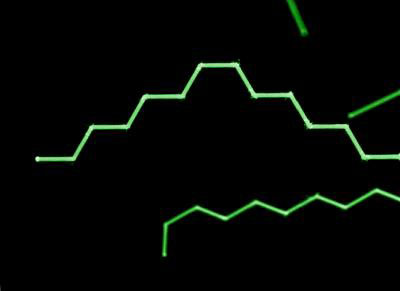
New 'stereocenters' introduce triangular joints into otherwise linear nanomaterials
Taking nanomaterials to a new level of structural complexity, scientists have determined how to introduce kinks into arrow-straight nanowires, transforming them into zigzagging two- and three-dimensional structures with correspondingly advanced functions.
October 21, 2009 Read more
Nanotechnology can help crops grow faster
With potential adverse health and environmental effects often in the news about nanotechnology, scientists in Arkansas are reporting that carbon nanotubes could have beneficial effects in agriculture.
October 21, 2009 Read more
Smart integrated biodiagnostic systems for healthcare
The EC-funded SmartHEALTH Integrated Project to present its latest results at a booth and a dedicated workshop at ComPaMed, Dusseldorf, 18th-20th Nov 2009.
October 21, 2009 Read more
Biosensor to battle cancer
A powerful new biosensor developed by European researchers will help identify cells in the immune system that actively suppress tumour growth, then put them to use. Enlisting the patient's own immune system would be like sending reinforcements for resistance fighters.
October 21, 2009 Read more
The Spin Cycle: Nanotechnology could lead to next generation of transistors
Scientists now have discovered that transistors could use less energy, generate less heat and operate at higher speeds if they exploited another property of the electron: its spin.
October 21, 2009 Read more
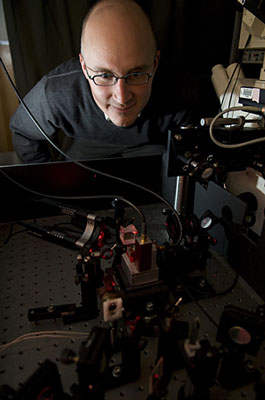
Two new grants to investigate directed self-assembly
Eric Furst, associate professor in the Department of Chemical Engineering at the University of Delaware, has received two grants totaling $727,000 for his work on directed self-assembly of soft materials.
October 21, 2009 Read more

Chemist turns light into a weapon against cancer
Chemist Michael Therien works at the interface of light and matter, as when sunlight shines on a leaf.
October 21, 2009 Read more
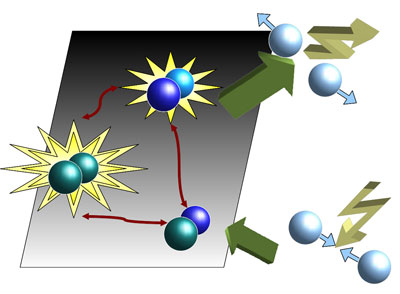
Physicists turn to radio dial for finer atomic matchmaking
Investigating mysterious data in ultracold gases of rubidium atoms, scientists at the Joint Quantum Institute of the National Institute of Standards and Technology (NIST) and the University of Maryland and their collaborators have found that properly tuned radio-frequency waves can influence how much the atoms attract or repel one another, opening up new ways to control their interactions.
October 20, 2009 Read more
Using self-assembly to make molecule-sized particles with patches of charge
Physicists, chemists and engineers at the University of Pennsylvania have demonstrated a novel method for the controlled formation of patchy particles, using charged, self-assembling molecules that may one day serve as drug-delivery vehicles to combat disease and perhaps be used in small batteries that store and release charge.
October 20, 2009 Read more
Carbon nanotubes may cheaply harvest sunlight
University of Wisconsin-Madison researchers are studying how to create inexpensive, efficient solar cells from carbon nanotubes, which are sheets of carbon rolled into seamless cylinders 1-nanometer in diameter.
October 20, 2009 Read more
 Subscribe to our Nanotechnology News feed