

Nanotechnology News – Latest Headlines
'Smart' materials get smarter with ability to better control shape and size
A dynamic way to alter the shape and size of microscopic three-dimensional structures built out of proteins has been developed by biological chemist Jason Shear and his former graduate student Bryan Kaehr at The University of Texas at Austin.
July 3, 2008 Read more
Keeping nanotechnology safe
The second generation of nanotechnology research will involve creating predictive models for the safe use of nanoparticles.
July 3, 2008 Read more
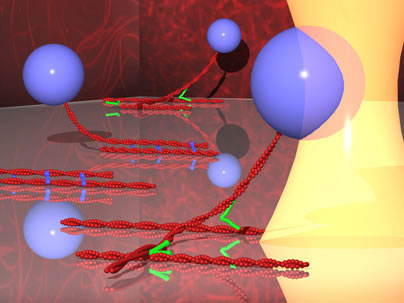
Using a light touch to measure protein bonds
MIT researchers tug at molecules with optical tweezers.
July 2, 2008 Read more
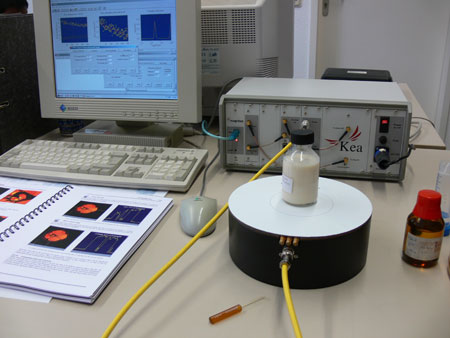
Pocket-sized magnetic resonance imaging
Research scientists have now developed small portable MRI scanners that perform their services in the field: for instance to examine ice cores.
July 2, 2008 Read more
Call: Environmental effects of nanoparticles and nanomaterials
Abstract submission and early registration deadline for this conference have been extended to Friday, July 4.
July 2, 2008 Read more
Austria launches nanoimprint lithography project NILaustria
The Austrian government will fund a series of nanoimprint lithography (NIL) research projects. The NILaustria project will focus on large-area nanostructuring, using NIL to transfer different nanostructures to large surfaces in a cost-efficient manner.
July 2, 2008 Read more
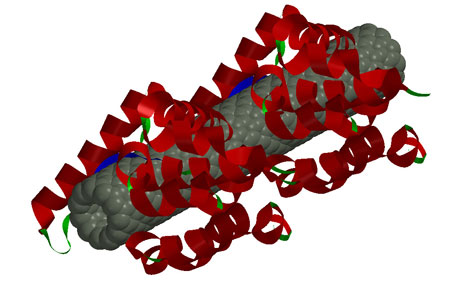
Super strong antimicrobial nanotube coatings for medicine, defense
One of the world' strongest materials meets one of Nature's most powerful germ killers in a new research project that produced incredibly tough anti-bacterial surfaces with multiple applications in home appliances, medicine, aerospace, and national defense.
July 2, 2008 Read more
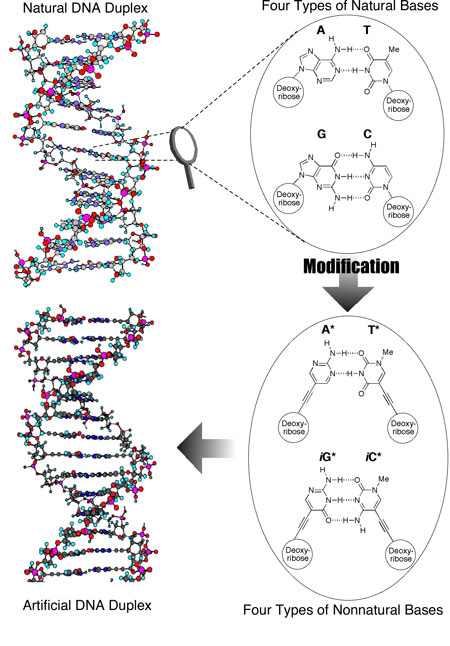
First DNA molecule made almost entirely of artificial parts
Chemists in Japan report development of the world's first DNA molecule made almost entirely of artificial parts. The finding could lead to improvements in gene therapy, futuristic nano-sized computers, and other high-tech advances, they say.
July 2, 2008 Read more
Single-electron transistor world's smallest high performance, low energy sensor
Scientists at the University of Southampton?s School of Electronics and Computer Science (ECS) are developing the world?s smallest, high-performance and low-power sensor in silicon which will have applications in biosensing and environmental monitoring.
July 2, 2008 Read more
Study shows quantum dots can penetrate skin through minor abrasions
Researchers at North Carolina State University have found that quantum dot nanoparticles can penetrate the skin if there is an abrasion, providing insight into potential workplace concerns for healthcare workers or individuals involved in the manufacturing of quantum dots or doing research on potential biomedical applications of the tiny nanoparticles.
July 2, 2008 Read more
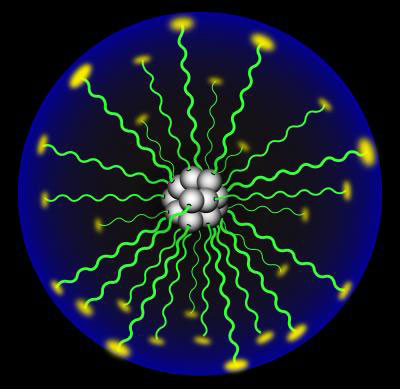
Nanotechnology transforms an old, accidentally-discovered drug derived from mold
The first oral, broad-spectrum angiogenesis inhibitor, specially formulated through nanotechnology, shows promising anticancer results in mice, report researchers from Children's Hospital Boston.
July 1, 2008 Read more
New paper offers insights into 'blinking' phenomenon
A new paper provides an overview of research into one of the few remaining unsolved problems of quantum mechanics.
July 1, 2008 Read more
UAlbany NanoCollege, Albany city school district partner to launch Nanoscale Science Summer Institute
25 middle-school students from five area school districts to participate in new initiative through NYS Education Department's Excelsior Scholars Program.
July 1, 2008 Read more
The fight for the best quantum bit (qubit)
Post Doc Henrik Ingerslev Jorgensen has come an important step closer to the quantum computer.
July 1, 2008 Read more
Gift of $100 million to transform energy and environment research at Princeton
Gerhard R. (Gerry) Andlinger, an alumnus and noted international business executive, has made a gift to Princeton University to accelerate research on effective and sustainable solutions to problems of energy and the environment.
July 1, 2008 Read more
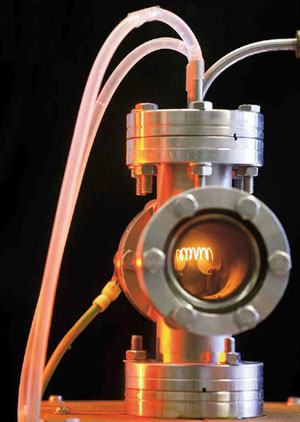
Super atoms turn the periodic table upside down
Researchers at Delft University of Technology in The Netherlands have developed a technique for generating atom clusters made from silver and other metals. Surprisingly enough, these so-called super atoms (clusters of 13 silver atoms, for example) behave in the same way as individual atoms and have opened up a whole new branch of chemistry.
July 1, 2008 Read more
 Subscribe to our Nanotechnology News feed