

Nanotechnology News – Latest Headlines
Researchers create mercury-absorbent container linings for broken compact fluorescent lamps
Sales of the curlicue, energy-sipping bulbs, which previously had languished since they were introduced in the United States in 1979, reached nearly 300 million last year. There is just one catch to this energy conservation story: Each CFL contains a small amount (3 to 5 milligrams) of mercury, a neurotoxin that can be released as vapor when a bulb is broken.
June 27, 2008 Read more
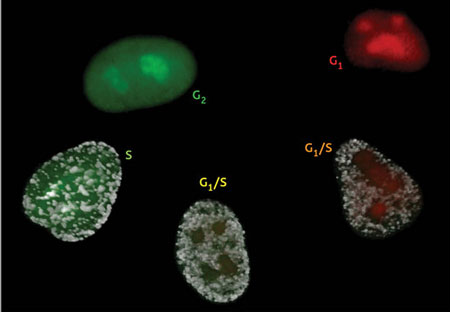
Installing 'traffic lights' inside living cells
A new technique installs fluorescent 'traffic lights' in living cells, enabling researchers to tell whether or not they are actively dividing.
June 27, 2008 Read more
In 'novel playground,' metals are formed into porous nanostructures
Cornell researchers have developed a method to self-assemble metals into complex nanostructures. Applications include making more efficient and cheaper catalysts for fuel cells and industrial processes and creating microstructured surfaces to make new types of conductors that would carry more information across microchips than conventional wires do.
June 26, 2008 Read more

Quantum computing breakthrough arises from unknown molecule
The odd behavior of a molecule in an experimental silicon computer chip has led to a discovery that opens the door to quantum computing in semiconductors.
June 26, 2008 Read more
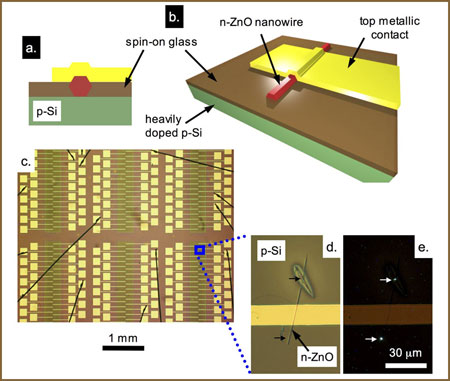
Researchers develop new technique for fabricating nanowire circuits
Scientists at Harvard's School of Engineering and Applied Sciences (SEAS), collaborating collaborating with researchers from the German universities of Jena, Gottingen, and Bremen, have developed a new technique for fabricating nanowire photonic and electronic integrated circuits that may one day be suitable for high-volume commercial production.
June 26, 2008 Read more
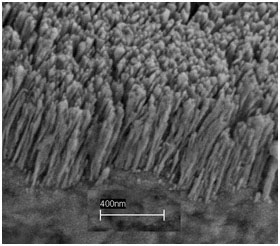
On the boil: New nano technique significantly boosts boiling efficiency
Hyper-efficient boiling could lead to smaller computer chips, lower energy costs.
June 26, 2008 Read more
MIT Energy Initiative and Bosch announce energy collaboration
As part of the MIT Energy Initiative (MITEI), MIT and Bosch, a leading global supplier of technology and services, are forming an energy research collaboration aimed at exploring new materials and concepts for efficient energy-conversion and energy-storage systems.
June 26, 2008 Read more
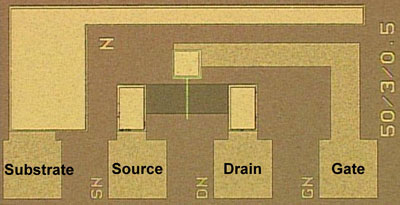
Novel ferroelectric NAND flash memory cell demonstrates 10000 times more program and erase cycles than conventional memory cells
Researchers in Japan have demonstrated that the use of ferroelectric gate field-effect transistors (FeFETs) as memory cells dramatically improves the performance of NAND flash memory.
June 26, 2008 Read more
Giant memory thanks to tiny capacitors
German-Korean research team produces a permanent memory using a new procedure and thereby sets a memory density record.
June 26, 2008 Read more
Nanotubes could help study retrovirus transmission between human cells
Recent findings by medical researchers indicate that naturally occurring nanotubes may serve as tunnels that protect retroviruses and bacteria in transit from diseased to healthy cells - a fact that may explain why vaccines fare poorly against some invaders.
June 26, 2008 Read more
Automakers turn to nanotechnology as precious metal prices soar
Reeling from a relentless rise in precious metal prices, Japanese automakers are banking on new know-how, including nanotechnology, to clean up car exhausts in place of platinum and related metals.
June 26, 2008 Read more
Nanotechnology risks: the unclear fate of nanosilver
Tiny particles of silver designed to kill germs are being put into socks to control odor. But as a recent story on ScienCentral explains, what happens to that nanosilver later is concerning some scientists.
June 25, 2008 Read more
'Electron trapping' may impact future microelectronics measurements
Using an ultra-fast method of measuring how a transistor switches from the 'off' to the 'on' state, researchers at the National Institute of Standards and Technology recently reported that they have uncovered an unusual phenomenon that may impact how manufacturers estimate the lifetime of future nanoscale electronics.
June 25, 2008 Read more
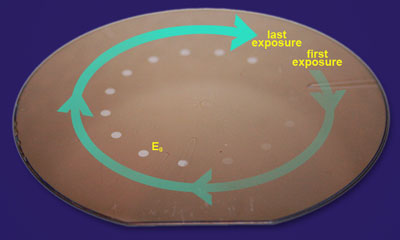
Exposing the sensitivity of extreme ultraviolet photoresists
Researchers at the National Institute of Standards and Technology (NIST) have confirmed that the photoresists used in next-generation semiconductor manufacturing processes now under development are twice as sensitive as previously believed.
June 25, 2008 Read more
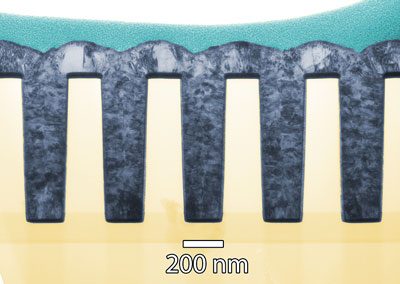
New process creates 3-D nanostructures with magnetic materials
Materials scientists at the National Institute of Standards and Technology (NIST) have developed a process to build complex, three-dimensional nanoscale structures of magnetic materials such as nickel or nickel-iron alloys using techniques compatible with standard semiconductor manufacturing.
June 25, 2008 Read more
International Symposium on Nanotechnology in Construction
The 3rd International Symposium on Nanotechnology in Construction will be held in Prague from May 31 to June 2, 2009.
June 25, 2008 Read more
 Subscribe to our Nanotechnology News feed