

Nanotechnology News – Latest Headlines
Nanorings
What appear under an atomic force microscope to be tiny rings with little bits missing are actually nanoscopic rings made of double-stranded DNA with a little gap in the form of a short single-stranded fragment. This gap is a place to attach other molecules that have the potential to transform the rings into versatile nanocomposites for various applications.
March 5, 2008 Read more
Nanoswitches toggled by light
Microscopic fissures in a tiny crystal open and closeâ??on command. Researchers successfully used ultrafast electron microscopy to observe nanoscopic structures at their 'exercises', as they report in the journal Angewandte Chemie. Such switchable nanochannels could be useful for future nanoelectronics and nanoscopic 'machines'.
March 5, 2008 Read more
Cellular construction methods emulated
Not only is our body made of individual organs, our cells themselves are made of tiny organelles, a variety of separate compartments that fulfill different tasks. Such functional, nanostructured systems would also be useful for technical applications, such as biosensors, self-repairing materials, optoelectronic components, or nanocapsules. However, it has not been possible to recreate structures with sufficient complexity in the lab. Researchers in the Netherlands are now pursuing a new angle.
March 5, 2008 Read more
Nanotechnology in health care forum: possibilities, risks, and benefits
Nanotechnology-enabled medical technologies have the potential to transform health care as we know it. But should new applications be available before we understand the possible risks?
March 5, 2008 Read more
Quatar Foundation to hold symposium on nanomedicine
Qatar Foundation will organize an international symposium on applied nanomedicine in an effort to acquaint the local community with the utility of this futuristic medical science from March 9 to 10 at the Doha Sheraton Hotel.
March 4, 2008 Read more
Nanotechnology environmental, health and safety aspects workshop for reporters
Nanotechnology is everywhere today in consumer products, emerging medicines and scientific research. Which advances will change our lives the most? What role will regulation play as the field develops? And how can journalists best convey both the promise and potential risks of this emerging technology?
March 4, 2008 Read more
Micron Foundation pledges $1.25m for University of Utah nanofabrication center
The University of Utah today announced a $1.25 million pledge from the Micron Technology Foundation to support the development of a nanofabrication teaching and research laboratory as a core facility in the new Utah Science, Technology and Research (USTAR) building now under development on the universityâ??s campus.
March 4, 2008 Read more
Igor Sokolov Promoted to Professor at Clarkson University
Clarkson University President Tony Collins has announced that Igor Sokolov has been promoted from associate professor to professor of physics in the School of Arts & Sciences.
March 4, 2008 Read more
Physicist earns patent for materials weakness detection system
The first patent awarded to Southeastern Louisiana University through one of its faculty has the potential to identify weaknesses in structures ranging from massive bridge construction to the tiniest elements of nanotechnology no larger than a speck of dust on a pinhead.
March 4, 2008 Read more
Pentagon releases new analysis of Chinaâ??s military development and strategy
The Pentagon on Monday released its latest analysis of China's military development and strategy and says that the country spent as much as $139 billion, more than three times its announced defense budget, modernizing its military forces last year and that China has gone from virtually no research or funding in nanotechnologies and processes five years ago, to being a close second to the United States in total government investment.
March 4, 2008 Read more
Biological electron transfer captured in real time
Two research teams led by Dr. Michael Verkhovsky and Prof. Marten Wikstrom of the Institute of Biotechnology of the University of Helsinki have for the first time succeeded in monitoring electron transfer by Complex I in real time. In the future, this work might, for example, have medical relevance, because most of the maternally inherited so-called mitochondrial diseases are caused by dysfunction of Complex I.
March 3, 2008 Read more
Appelbaum wins NSF Career Award for research on silicon spintronics
Ian Appelbaum, assistant professor of electrical and computer engineering at the University of Delaware, has received the prestigious Faculty Early Career Development Award from the National Science Foundation for his pioneering research in the exciting next evolution of electronics known as spintronics.
March 3, 2008 Read more
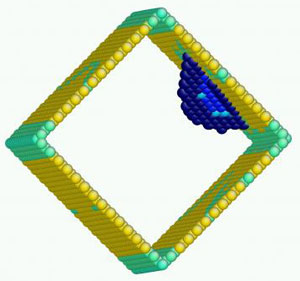
Surface dislocation nucleation: Strength is but skin deep at the nanoscale
Researchers at the University of Pennsylvania have found that, while metals tend to be stronger at nanoscale volumes, their strengths saturate at around 10-50 nanometers diameter, at which point they also become more sensitive to temperature and strain rate.
March 3, 2008 Read more
The march of the carbon nanotubes
Stanford Synchrotron Radiation Laboratory researchers have surpassed by a surprising margin the Department of Energy's goal for storing hydrogen within a unique material called carbon nanotubes.
March 3, 2008 Read more
Biomass can yield new chemicals, materials
Biomass will be increasingly important in replacing a portion of petroleum as a feedstock for fuel and chemicals, a lecturer at South Dakota State University says.
March 3, 2008 Read more
Rochester Institute of Technology to host new Pollution Prevention Institute
Governor Eliot Spitzer today announced the selection of the Rochester Institute of Technology as the host of the Pollution Prevention Institute, a cutting-edge research and development center to design and test 'green' manufacturing methods and provide technical support to businesses for pollution reduction measures that will help make them more competitive.
March 3, 2008 Read more
 Subscribe to our Nanotechnology News feed