

Nanotechnology News – Latest Headlines
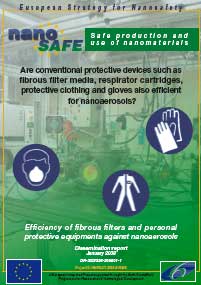
Nanosafe2 releases its first 'dissemination report'
This first report is about conventional protective devices such as fibrous filter media, respirator cartridges, protective clothing and gloves and their efficiency against nanoaerosols.
February 7, 2008 Read more
Nanosieves save energy in biofuel production
A new type of membrane, developed by scientists of the University of Twente in The Netherlands, can stand high temperatures for a long period of time. This 'molecular sieve' is capable of removing water out of e.g. solvents and biofuels. It is a very energy efficient alternative to existing techniques like distillation.
February 7, 2008 Read more
Nanotechnology creates a once-a-month HIV drug
By encapsulating HIV drug molecules into tiny polymer particles that slow-release drug when they are injected, researchers are working on the next step in simplifying HIV therapy: injectable HAART you could take once a month.
February 6, 2008 Read more
DNA nanotechnology could transform gene detection
Scientists at ASU's Biodesign Institute have developed the world's first gene detection platform made up entirely from self-assembled DNA nanostructures.
February 6, 2008 Read more
U.S. Department of Energy to open 10th Small Fuel Cells Conference
The Knowledge Foundation announced today that Dr. Terry Payne, Technology Development Manager with the U.S. Department of Energy's Hydrogen, Fuel Cell & Infrastructure Technologies Program, will be the opening speaker at the 10th Small Fuel Cells conference to be held in Atlanta, GA from April 30 - May 2, 2008.
February 6, 2008 Read more
Program for FESPA's first Digital Textile Conference
FESPA has announced the conference programme for its first-ever Digital Textile Conference (March 31 to 1 April 1, 2008). Entitled Digital Printing for Commercial Success, the conference will focus on both commercial and technical topics, examining market opportunities in the sector.
February 6, 2008 Read more
Scientists develop novel fluorescent proteins for live cell imaging, biosensor design
Scientists at Carnegie Mellon University's Molecular Biosensor and Imaging Center (MBIC) have developed new 'fluorogen activating proteins' (FAPs) that will become a key component of novel molecular biosensor technology being created at Carnegie Mellon.
February 6, 2008 Read more
Harvard claims NMR system is smallest built
Harvard University and its medical school have built the smallest complete nuclear magnetic resonance (NMR) system, claimed the team.
February 6, 2008 Read more
Optical scientists add new, practical dimension to holography
University of Arizona optical scientists have broken a technological barrier by making three-dimensional holographic displays that can be erased and rewritten in a matter of minutes.
February 6, 2008 Read more
The MONA Nanophotonics Technology Roadmap now available
During 2 years, the MONA ('Merging Optics and Nanotechnologies') consortium has been working through workshops, symposia and expert interviews at establishing a roadmap for photonics and nanotechnologies in Europe. Almost 300 people from industry and academia have been involved in the construction of this roadmap that gives insight into the future of materials, equipment, processes and applications. It also highlights the European position and outlook with respect to nanophotonics, and offers recommendations.
February 6, 2008 Read more
Pitt receives $1m grant to research ultrafast time-resolved microscopy of electronic nanomaterial
Researchers will develop revolutionary method to probe molecular structures.
February 6, 2008 Read more
Shear ingenuity: Tweaking the conductivity of nanotube composites
New measurements by scientists at the National Institute of Standards and Technology (NIST) have uncovered an intriguing wrinkle. For a given CNT concentration, the electrical properties of the composite can be tuned from being a conductor to a non-conductor simply by changing processing conditions - basically how fast the polymer flows.
February 6, 2008 Read more
IMEC realized full CMOS multiple antenna receiver for 60 GHz
At today's IEEE International Solid State Circuit Conference, IMEC introduced its prototype of a 60GHz multiple antenna receiver, and invites industry to join its 60GHz research program. The 60GHz band offers massive available bandwidth that enables very high bit rates of several Gbits-per-second at distances up to 10 meters (about 33 feet).
February 6, 2008 Read more
Nanotechnology: Towards reducing animal testing
This Conference, the first of its kind in Europe, will examine how nanotechnology could contribute to alternatives to animal testing.
February 6, 2008 Read more
Holst Centre reports breakthrough in organic RFID
The plastic RFID tag builds on IMEC's plastic rectifier technology combined with Polymer Visionâ??s organic electronics technology and approaches item-level tagging requirements.
February 6, 2008 Read more
EUV research helps solve 193 resist problems
Leading-edge research into the requirements for extreme ultraviolet (EUV) photoresist is helping to solve some of the problems encountered by 193 nm litho technology as it ventures into increasingly smaller CDs.
February 6, 2008 Read more
 Subscribe to our Nanotechnology News feed