

Nanotechnology News – Latest Headlines
Nanotechnology to be explored at Jan. 19 CU-Boulder physics program
The University of Colorado at Boulder physics department will continue its Saturday Physics Series on Jan. 19 with an examination of some of the tools used in the nanotechnology field and where breakthroughs in the field may lead.
January 11, 2008 Read more
Chairman Wynn examines dangers of nanotechnology
On Wednesday, Congressman Albert R. Wynn (D-MD), Chairman of the Subcommittee on the Environment and Hazardous Materials, convened a forum on nanotechnology and heard from some of the leading environmental, government and industry experts in the field.
January 11, 2008 Read more
Scientists invent nanotechnology device for disease biomarker discovery
Scientists at George Mason University's Center for Applied Proteomics and Molecular Medicine have invented an innovative nanotechnology tool that may lead to a dramatic improvement in treatment results for patients diagnosed with cancer or other diseases.
January 11, 2008 Read more
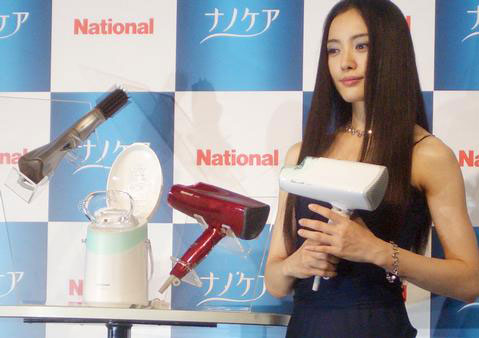
Molecular beauty
The New Straits Times in Malaysia carries a funny editorial that makes for a perfect Slow News Friday article. Nanotechnology is now being used for facial and hair care. But Shannon Teoh will have none of it. Because, he rails, beauty is being sacrificed for health in the process.
January 11, 2008 Read more
Europe launches new Joint Technology Initiatives
Joint Technology Initiatives (public-private partnerships, involving industry, the research community and public authorities) are proposed as a means to implement the Strategic Research Agendas of a limited number of European Technology Platforms.
January 11, 2008 Read more
Phonon resonant cavities as promising building blocks of hand-made nanocrystalline matter
Researchers from the Institute for Nuclear Research and the Baikov Institute of Metallurgy and Material Science, both in Moscow, Russia, are proposing that that nanocomposites of phonon resonant cavities (NPRC) will possess an interesting electrodynamic properties.
January 11, 2008 Read more
Cell printout
The design of the human body is an excellent example of bioengineering, and this means engineers and chemists are able to apply their technical knowledge to the body. Suwan Jayasinghe, at University College London, is collaborating with other experts to apply the principles of ink-jet technology to create a viable method of 'printing' living cells.
January 11, 2008 Read more
MIT gas sensor is tiny, quick
Energy-efficient device could quickly detect hazardous chemicals.
January 11, 2008 Read more
Nanoparticles to clean up mercury emissions
Washington University in St. Louis is partnering with Chrysler LLC and a major Midwest utility company in a project to determine if paint solid residues from automobile manufacturing can reduce emissions of mercury from electric power plants.
January 11, 2008 Read more
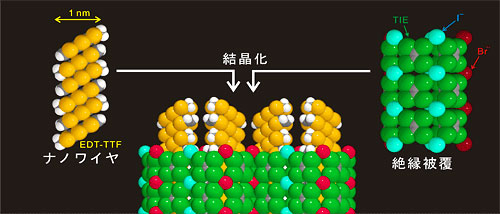
Insulated nanowires bring molecular machines one step closer
In a development that brings superdense memory devices and molecule-sized machines a step closer to reality, scientists at Japan's Institute of Physical and Chemical Research (RIKEN) have succeeded in creating 1-nanometer-thick electric wires with a layer of insulation.
January 11, 2008 Read more
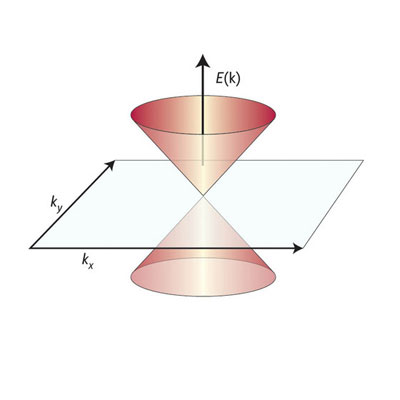
Graphene - the indecisive insulator
Researchers are applying relativistic quantum theory to explain how graphene could switch from a metal to an insulator.
January 11, 2008 Read more
Robin Garrell wins international award for pioneering nanotechnology research
UCLA professor and CNSI Member, Dr. Robin Garrell, has been selected by an independent panel of scientists to receive an international award and special recognition for her pioneering research work in nanotechnology.
January 10, 2008 Read more
Sixteen finalists chosen in Piedmont Triad Entrepreneurial Network's GAP competition
Technology that improves on the output of Eli Whitney's cotton gin, and a system that better preserves organs during transplants, are among the winning ideas of the finalists that Piedmont Triad Entrepreneurial has named in its 2007-2008 Growth Accelerator Program competition.
January 10, 2008 Read more
Researchers discover road to sustainable electronic devices
A recent discovery by a multinational team including a University of Minnesota scientist, professor Michael Sadowsky in the department of soil, water and climate, could lead to more environmentally friendly manufacturing of electronic devices.
January 10, 2008 Read more
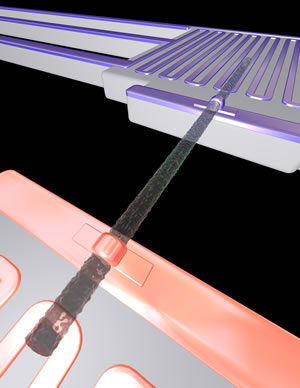
Feeling the heat: Berkeley researchers make thermoelectric breakthrough in silicon nanowires
Energy now lost as heat during the production of electricity could be harnessed through the use of silicon nanowires synthesized via a technique developed by researchers with the Berkeley Lab and the University of California at Berkeley. The far-ranging potential applications of this technology include DOE's hydrogen fuel cell-powered 'Freedom CAR,' and personal power-jackets that could use heat from the human body to recharge cell-phones and other electronic devices.
January 10, 2008 Read more
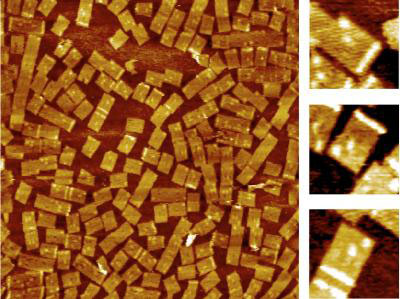
Nanotechnology innovation may revolutionize gene detection in a single cell
Scientists at Arizona State University's Biodesign Institute have developed the worldâ??s first gene detection platform made up entirely from self-assembled DNA nanostructures. The results could have broad implications for gene chip technology and may also revolutionize the way in which gene expression is analyzed in a single cell.
January 10, 2008 Read more
 Subscribe to our Nanotechnology News feed