

Nanotechnology News – Latest Headlines
Measurement innovations add up to big savings for semiconductors
A new report from the National Institute of Standards and Technology (NIST) shows that investment in measurement science has and will continue to have a dramatic effect on innovation, productivity, growth and competitiveness in and among high technology sectors.
January 9, 2008 Read more
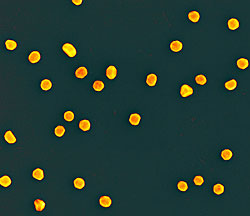
NIST reference materials are 'gold standard' for bio-nanotechnology research
The National Institute of Standards and Technology (NIST) has issued its first reference standards for nanoscale particles targeted for the biomedical research community - literally 'gold standards' for labs studying the biological effects of nanoparticles.
January 9, 2008 Read more
Future rests with biomedical scientists
With barriers between disciplines vanishing, there is need for biomedical scientists to familiarise themselves with subjects such as electronics, computers, and nanotechnology to take research forward.
January 9, 2008 Read more
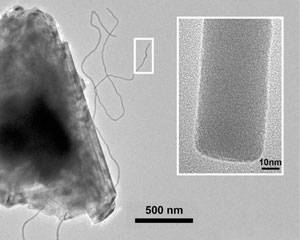
Make nanoparticles while the sun shines
Concentrated sunlight is all you need to make useful nanomaterials, according to Israeli researchers.
January 9, 2008 Read more
Future soldier will generate power
The American soldier of the future will be garbed in an array of lightweight nanoscale materials that will provide ballistic protection, produce power through solar energy and integrate electronics that can monitor health and provide assistance when needed.
January 9, 2008 Read more
LSE governor discusses shaping company and skills
Globalization, rapid technological change and communications interconnectivity are changing the world's business environment at an unprecedented pace, all in the face of huge political, social and environmental uncertainty.
January 9, 2008 Read more
An 'attractive' man-machine interface
Researchers use magnetic fields, rather than drugs, to control cellular signaling.
January 8, 2008 Read more
Molecules that matter
A university gallery in upper New York state has merged art and science in a display of 10 giant molecules that each represent a key piece of American life and society over the past century.
January 8, 2008 Read more
NCBIO-led group receives $100,000 grant for emerging technology effort
The North Carolina Biotechnology Center has awarded a $100,000 grant to a consortium coordinated by NCBIO for Phase I planning for a Center of Innovation in Advanced Medical Technologies
January 8, 2008 Read more
Nanotechnology and food safety
The topic this year at the KALS (Karlsruher Lebensmittelsymposium) will be Nanotechnology (Nano4Food).
January 8, 2008 Read more
New technology aims to cool hot chips
Heat bedevils semiconductor engineers, who have in recent years seen their quest to build ever-faster chips frustrated by the ravages of excess heat. At the same time, they are under pressure to better control heat amid rising electricity costs for cooling electronics, demand for longer battery life in mobile devices and an ascendant green movement. Now a small company called Nextreme Inc. says it has found a way to make chips 'cool' again.
January 8, 2008 Read more
New membranes improve carbon dioxide capture
An EU-funded research is using a process known as facilitated transport in an effort to develop effective, inexpensive and eco-friendly membranes to remove carbon dioxide from other gases.
January 8, 2008 Read more
New nanostructured thin film shows promise for efficient solar energy conversion
In the race to make solar cells cheaper and more efficient, many researchers and start-up companies are betting on new designs that exploit nanostructures. Using nanotechnology, researchers can experiment with and control how a material generates, captures, transports, and stores free electrons - properties that are important for the conversion of sunlight into electricity.
January 8, 2008 Read more
Albert Franks Memorial Lecture: Micro and Nano Technologies for Food - a healthy and safe option?
Announcing the Albert Franks Memorial Lecture 2008 on Thursday, January 17, 2008, in London: 'Micro and Nano Technologies for Food - a healthy and safe option?'
January 8, 2008 Read more
Greener Nano 2008 Conference: Nanoscience for a sustainable future
ONAMI and SNNI (Safer Nanomaterials and Nanomanufacting Initiative) present the Greener Nano 2008 Conference: Nanoscience for a Sustainable Future, 10-11 March 2008 at the Hewlett-Packard Company Corvallis, OR site.
January 8, 2008 Read more
Pushing the limits of chip miniaturization
Over the last four decades, computer chips have found their way into virtually every electronic device in the world. During that time they have become smaller, cheaper and more powerful, but, for a team of European researchers, there is still plenty of scope to push back the limits of miniaturization.
January 8, 2008 Read more
 Subscribe to our Nanotechnology News feed