| Posted: Jan 27, 2016 |
Fun with Lego (molecules)(Nanowerk News) A great childhood pleasure is playing with Legos® and marveling at the variety of structures you can create from a small number of basic elements. Such control and variety of superstructures is a goal of polymer chemists, but it is hard to regulate their specific size and how the pieces fit together. |
| This week in ACS Central Science ("Toward Controlled Hierarchical Heterogeneities in Giant Molecules with Precisely Arranged Nano Building Blocks"), researchers report a simple system to make different nano-architectures with precision. |
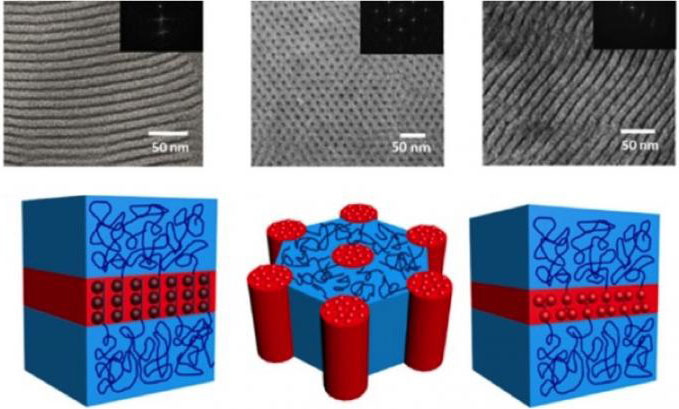 |
| Depending on the relative amounts of different building-block molecules, it is possible to create different sandwich and wheel topologies (shown above in micrographs and below as models). (© American Chemical Society) (click on image to enlarge) |
| Using a variety of highly efficient chemical transformations and other techniques to ensure high yields and purity, Stephen Z. D. Cheng, Yiwen Li, Wen-Bin Zhang and coworkers designed systems to create giant molecules with 'orthogonal' ends, meaning that they only fit together with a specific partner just like Legos®. |
| Depending on the relative amounts of different building-block molecules, these molecules come together in different superstructures -- ranging from cubes to wheels and sandwiches. |
| Eventually, they could be employed in device-creation, where it is crucial to have precise control over the positions of the components. |
| Source: American Chemical Society |