| Posted: Oct 17, 2017 |
Scientists create most powerful micro-scale bio-solar cell yet(Nanowerk News) Researchers at Binghamton University, State University of New York have created a micro-scale biological solar cell that generates a higher power density for longer than any existing cell of its kind (Lab on a Chip, "Self-sustainable, high-power-density bio-solar cells for lab-on-a-chip applications"). |
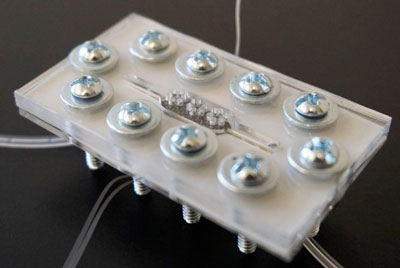 |
| Assembled micro-biological solar cell device. (Image: Seokheun Choi) |
| A microfluidic lab-on-a-chip system that generates its own power is essential for stand-alone, independent, self-sustainable point-of-care diagnostic devices to work in limited-resource and remote regions, said Binghamton University Electrical and Computer Science Assistant Professor Seokheun Choi. Miniaturized biological solar cells (or micro-BSCs) can be the most suitable power source for those applications because the technique resembles the earth’s natural ecosystem. |
| “Micro-BSCs can continuously generate electricity from microbial photosynthetic and respiratory activities over day-night cycles, offering a clean and renewable power source with self-sustaining potential,” said Choi. “However, the promise of this technology has not been translated into practical applications because of its relatively low power and current short lifetimes.” |
| Choi and PhD candidate Lin Liu created a microscale microfluidic biological solar cell that can attain high electrical power and long-term operational capability, which will provide a practical and sustainable power supply for lab-on-a-chip applications. The bio-solar cell generated the highest power density for the longest time among any existing micro-scale bio-solar cells. |
| “The device will release biological photo-energy conversion technology from its restriction to conceptual research and advance its translational potential toward practical and sustainable power applications for point-of-care diagnostics to work independently and self-sustainably in limited-resource and remote regions,” added Choi. |
| Source: Binghamton University |