| Jul 24, 2025 |
Physicists simplify complex quantum systems using duality and effective theoryScientists developed a method combining effective theory and duality transformations to simplify and solve complex quantum systems with strong interactions.(Nanowerk News) This problem has long preoccupied quantum physics: how can systems consisting of many atoms, between which strong attractive forces act, be described mathematically? Already for about ten particles, such systems are at the limits of current numerical methods. |
| It becomes particularly complicated when the atoms are exposed to an external force. However, this is the case in many experiments with cold atoms due to the way in which motion is often restricted to one dimension, for example. Such systems of strongly interacting particles in one dimension were proposed in the 1960s and have since served as a reference problem in theoretical physics. So far, they have only been solved in a few special cases. |
| In new work (Physical Review Letters, "Effective Theory for Strongly Attractive One-Dimensional Fermions"), the researchers attempted to simplify a system using a so-called effective theory – that is, by considering only the ‘important’ physical aspects. Since atoms form pairs (diatoms) due to their strong attraction, the scientists attempted to find an ‘effective’ description based on atoms and diatoms instead of the many atoms. This reduces the number of particles to be described and thus simplifies the description. |
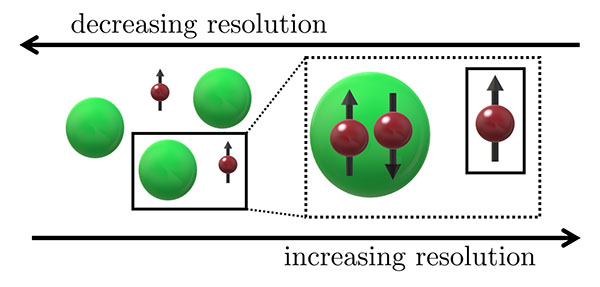 |
| Illustration of the effective theory at lower resolution which replaces composite particles by simpler structureless particles. The two theories give the same results at low energies. (Image: TU Darmstadt) |
| The approach is now additionally based on the fact that atoms and diatoms belong to two classes of particles, known as fermions and bosons. In a so-called duality transformation, the roles of fermions and bosons were swapped: here, the forces between atoms and diatoms are now weak, which means that the problem can now be solved more easily using special solution methods for weak interactions. |
 |
| Illustration of the duality transformation which exchanges fermions (red) and bosons (green). Both representations are mathematically equivalent but the dual effective theory is easier to solve. (Image: TU Darmstadt) |
Combination of both methods |
| With their approach, the research team combined both methods: effective theories to isolate the physically relevant aspects and duality transformations to convert the complex problem into a simpler form that is easier to solve. With this fundamental research, the scientists solved a notoriously difficult problem in theoretical physics. The results allow predictions to be made for experiments with cold atoms and strong attractive forces in one dimension. Potentially, more complicated, higher-dimensional systems could also be treated in a similar way. |
| Source: Technische Universität Darmstadt (Note: Content may be edited for style and length) |