| Mar 03, 2026 |
Antiferromagnets show electrically switchable liquid crystal phase
Scientists have taken the first step toward developing antiferromagnetic technology. They detected a liquid-crystal phase that may change the game for spintronic devices.
(Nanowerk News) The best candidate for next-generation magnetic devices -- technology that can power, store, sense or transport information -- may be, counterintuitively, antiferromagnets.
|
|
Today, most widely used magnetic materials are ferromagnets, which exhibit permanent magnetization and therefore strongly attract each other. Their opposite, called antiferromagnetic materials, exhibit no net magnetization at all. Despite a net zero magnetic field, they offer appealing properties that would solve the challenges of current magnetic technologies, like stray magnetic field generation or slow operation.
|
|
Now, a team led by researchers at Tohoku University have taken the first step toward developing antiferromagnetic technology. The researchers found, for the first time, that under a current, antiferromagnets can exhibit a phase of matter known as "liquid-crystal," or nematic, that can be electrically detected.
|
|
They published their work in (Nature Communications, "Transport evidence of current-induced nematic Dirac valleys in a parity-time-symmetric antiferromagnet").
|
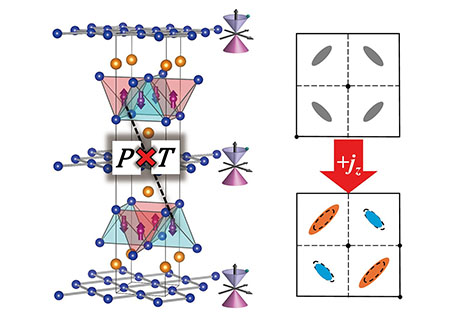 |
| Crystal and electronic structures for PT-symmetric antiferromagnet SrMnBi2 with Dirac electrons. (Image: Hideaki Sakai)
|
|
"The antiferromagnets we work with possess a fundamentally different symmetry from conventional ferromagnets, meaning that they are not simply an alternative material platform, but a new class of magnets expected to host entirely new electronic functionalities," said corresponding author Hideaki Sakai.
|
|
To achieve functionalities comparable to those of ferromagnets, antiferromagnets must break time-reversal (T) symmetry and inversion, or parity (P), symmetry. This newly emerging class of materials, known as PT-symmetric antiferromagnets, breaks both T and P symmetries while preserving their combined PT symmetry.
|
|
T symmetry refers to the idea that a system should appear the same whether it is moving forward or backward. When T symmetry breaks, it creates electronic bands with energy levels split and dependent on the spin -- a physical property -- of particles in the system. This makes the system look different when it moves forward versus backward. P symmetry refers to the physical description of a system -- a mirror image of the system should behave the same as the original. P symmetry breaking results in mirror images behaving differently. This new class of materials breaks T and P symmetries in such a way that they balance out, maintaining an unbroken combined PT symmetry.
|
|
"Recent studies in the field reveals special crystal structures that allow T symmetry breaking and novel functionalities," Sakai said. "In contrast, much less is known about antiferromagnets that also break P symmetry. These systems exhibit electronic bands that lead to physical properties fundamentally different from those of conventional ferromagnets or T-broken antiferromagnets."
|
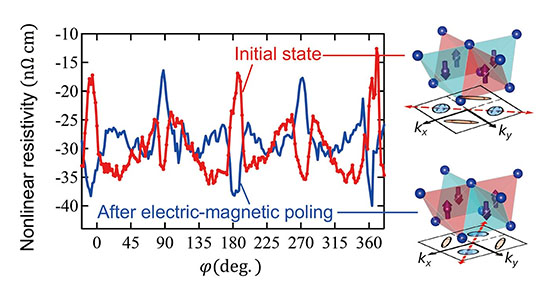 |
| Electrically switchable diode-like (nonlinear) resistance manifesting in anisotropic magneto-resistance effects. (Image: Hideaki Sakai)
|
|
The team investigated strontium manganese bismuthide (SrMnBi2), a crystalline material consisting of alternating PT-symmetric antiferromagnetic layers and highly conductive Dirac electron layers -- a type of material that enables electrons to move in a speedy, linear fashion.
|
|
The researchers measured the electron transport under an applied current and a magnetic field, observing a current-induced electronic deformation. The deformation manifested as a diode-like nonlinear resistance signal, or an electrical asymmetrical movement from a component, like a diode, which allows current to flow in one direction.
|
|
"Importantly, the diode polarity depends on the magnetic-field direction, providing clear evidence of electronic nematicity induced by electric current in a PT-symmetric antiferromagnet," Sakai said.
|
|
They also found that the diode direction could be switched by controlling the electric current and magnetic field. This contrasts with conventional diode capabilities, offering what Sakai called a new operating principle for electronic devices.
|
|
This research demonstrates, for the first time, that antiferromagnets can exhibit a current-induced electronic 'liquid-crystal' state that is directly detectable as an electrical resistance change, promising qualitatively new device functions rather than incremental improvements of existing spintronic technologies.
|