| Jun 15, 2026 |
Water-floating technique prints nano-circuits onto delicate surfaces
Water-floating transfer printing places ultra-thin metal nano-circuits on leaves, fruit, fibers and curved surfaces without heat, pressure or adhesives.
(Nanowerk News) A South Korean research team has developed a nano-transfer printing method that moves ultra-thin metal circuits floating on water directly onto delicate and curved surfaces. Led by KAIST, the technique places working sensors on living plant leaves, fruit and flexible fibers without heat, pressure or adhesives. The researchers expect it to support smart agriculture, wearable healthcare and bioelectronics (Nature Communications, "Versatile water-floated nanostructures for three-dimensional nanotransfer printing").
|
Key Findings
- The method floats a 20-nanometer metal film on water, then scoops it onto a target object, where it bonds on its own as the water dries.
- Researchers placed chemical sensors on leaves and fruit and detected the pesticide thiram on their surfaces.
- A palladium mesh transferred onto stretchable polyurethane fibers produced a wearable hydrogen gas sensor.
|
|
The technology, called Water-Floating Nano-Transfer Printing (WF-nTP), came from a team led by Distinguished Professor Inkyu Park of the KAIST Department of Mechanical Engineering, with Dr. Jun-Ho Jeong of the Korea Institute of Machinery and Materials and Professor Junseong Ahn of Korea University. It transfers precise metal thin films, floated on water, onto a range of three-dimensional surfaces.
|
|
Nano-transfer printing already features in the production of electronic devices and sensors, but the standard process relies on high heat, strong pressure, adhesives or toxic chemical solvents. Those demands make it hard to print on heat- and pressure-sensitive materials, such as biological tissue, or on complex curved shapes. Removing that barrier was the goal.
|
|
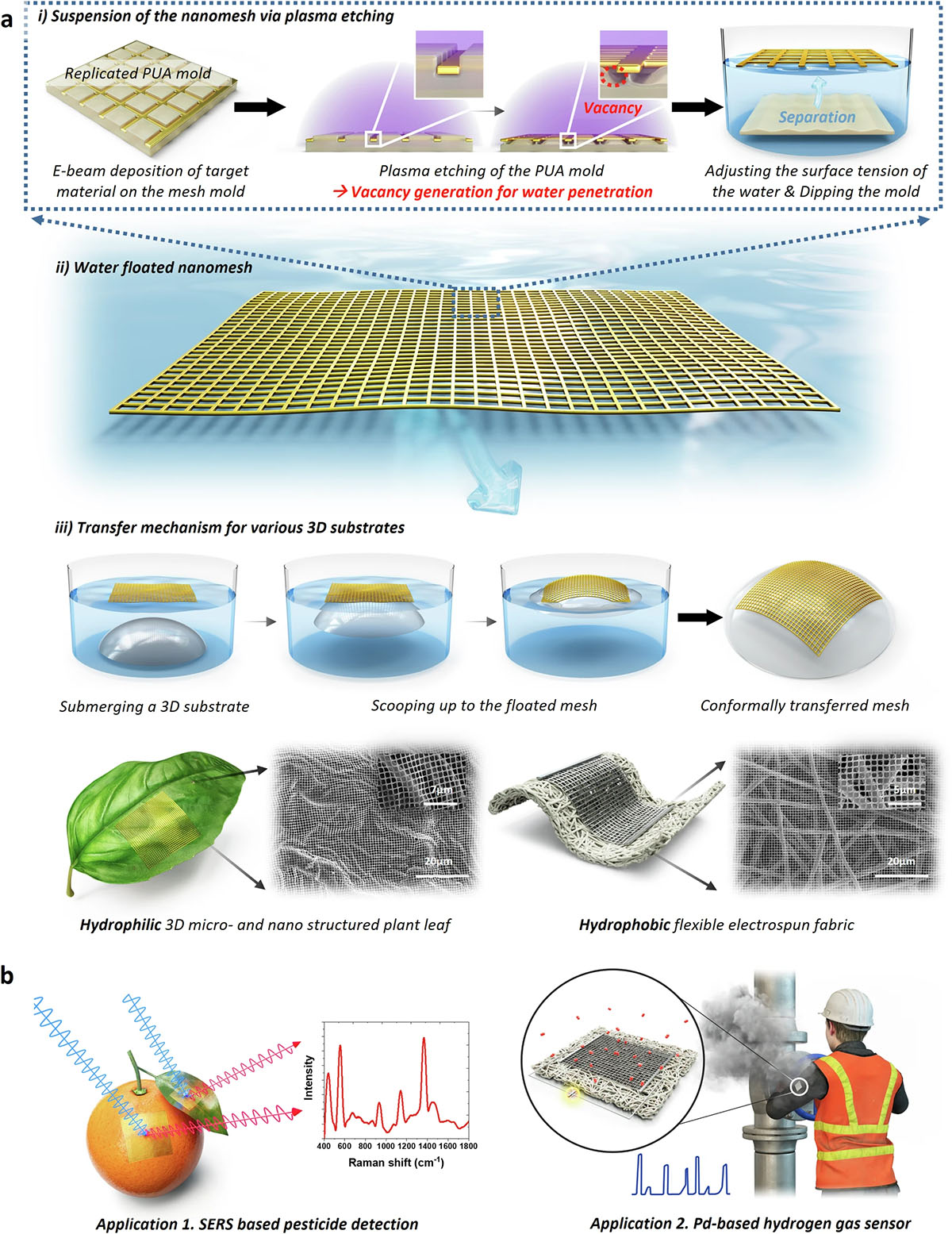
The solution was to float the metal circuits on water. The researchers first deposit an ultra-thin layer of metal, such as gold, platinum, palladium or nickel, onto a polymer mold. They then use plasma, an ionized gas, to selectively etch away part of the mold.
|
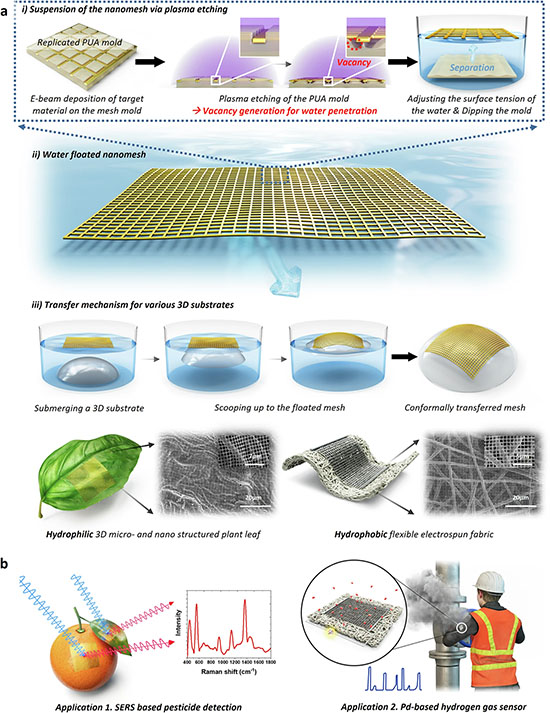 |
| Overview of the water-floated nano mesh and versatile transfer technique. (Image: Reproduced from DOI:10.1038/s41467-026-70902-5, CC BY) (click on image to enlarge)
|
|
Placed in water, the structure lets liquid seep through microscopic gaps, lifting the 20-nanometer-thick metal film to the surface with its original shape intact. Transfer happens through a scooping motion: the target object is submerged beneath the film and slowly raised. As the water evaporates, capillary force pulls the circuit tight against the surface.
|
|
Once the water dries, intermolecular forces hold the circuit in place with no adhesive. The method also reached water-repellent surfaces such as lotus leaves. A small amount of ethanol lowered the water's surface tension, the property that makes a liquid surface contract, clearing an obstacle that limited earlier approaches.
|
|
Because the process keeps the fine nano-patterns intact across varied surfaces, it fits many uses. The group built Surface-Enhanced Raman Scattering (SERS) sensors, which detect trace amounts of chemicals, and attached them to plant leaves and fruit. The sensors then identified thiram, a pesticide ingredient, on those surfaces.
|
|
For a second demonstration, the team transferred a palladium mesh onto highly flexible thermoplastic polyurethane (TPU) fibers, producing a wearable hydrogen gas sensor. The result showed that the printing method can place functioning sensors on soft, bendable materials, not only on rigid or flat ones.
|
|
Distinguished Professor Inkyu Park stated: "This technology is highly significant as it shatters the substrate limitations of conventional nano-transfer printing, allowing nano-patterns to be transferred onto sensitive surfaces like living plant leaves or human skin without heat or adhesives. We expect it to evolve into a core platform technology for wearable sensors and bioelectronics, finding applications in smart agriculture for pesticide detection without damaging crops, wearable health monitoring devices, bioelectronic devices, and electronic skins for next-generation robots."
|
|
Replacing heat, pressure and adhesives with water and natural surface forces lets metal circuits reach substrates that earlier printing could not handle, including living plants and stretchable fabric. Whether the same approach extends to human skin and robot surfaces, as the team anticipates, will depend on further testing.
|