| Jun 15, 2026 |
Spintronic system protects cryptographic keys
Physical state changes make unauthorized key extraction impossible to hide.
(Nanowerk News) As billions of connected devices continue to exchange encrypted data across networks, protecting cryptographic keys remains one of the most persistent challenges in hardware security. Conventional approaches often rely on storing keys in nonvolatile memory while monitoring physical tampering through external sensors or dedicated protection circuits. However, sophisticated attackers can sometimes bypass or manipulate such defenses.
|
|
Researchers at Huazhong University of Science and Technology and Hubei University have now demonstrated a spintronic hardware security architecture that approaches the problem from a different angle: Instead of merely detecting attacks, the device physically changes itself whenever a key-access operation occurs. They introduce a spin-orbit torque-based key generation system capable of generating cryptographic keys, concealing them when idle, and detecting unauthorized access attempts through irreversible physical state transitions.
|
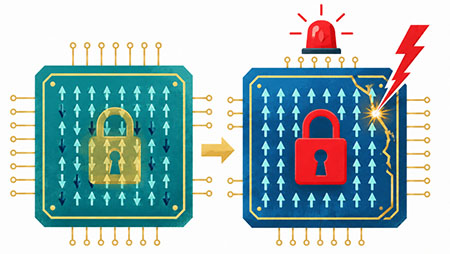 |
| Key protection via magnetization state transitions. (Image: Long You, Huazhong University of Science and Technology)
|
One Device, Two Sources of Entropy
|
|
At the heart of the system are Ta/CoFeB/MgO/Ta spintronic Hall devices. The researchers exploit two distinct physical phenomena within the same structure. First, stochastic magnetization switching driven by spin-orbit torque serves as a dynamic entropy source, enabling true random number generation. Second, fabrication-induced variations in the critical switching current provide a static entropy source that functions as a physically unclonable function, producing unique device fingerprints.
|
|
By integrating both mechanisms into the spintronic device architecture, the platform can generate either random numbers or device-specific cryptographic keys on demand. Such dual-function entropy generation is particularly attractive for edge computing and IoT systems, where silicon area, power consumption, and design complexity are tightly constrained.
|
|
Perhaps the most distinctive feature of the design is its approach to key protection. Traditional secure memories store key information continuously, making them vulnerable to invasive attacks such as micro-probing or reverse engineering. In contrast, the spin-orbit torque device remains in a random magnetic state during idle periods. In this state, no meaningful key information is physically stored.
|
|
When legitimate key extraction is requested, a specific excitation signal drives the device into a deterministic magnetic state, allowing key reconstruction. Importantly, the transition is irreversible because the original random magnetic configuration cannot be restored once disturbed. This means that any unauthorized attempt to probe or extract the key inevitably alters the device's physical state and destroys the original entropy configuration.
|
Physical Tamper Evidence
|
|
The researchers further implemented a monitoring circuit that compares stored random-state information with the current device state. Any discrepancy indicates that the device has undergone an unauthorized transition, triggering an alarm and allowing the compromised key to be revoked.
|
|
Unlike conventional tamper-detection schemes that depend on external environmental monitoring, the new approach embeds the detection mechanism directly into the physical behavior of the security primitive itself. The concept effectively transforms key access into a physically observable event rather than a purely digital operation.
|
|
The work highlights a broader trend in hardware security: moving protection mechanisms closer to the underlying physics of the device.
|
|
As IoT nodes, smart sensors, and portable authentication tokens increasingly operate unattended for long periods, they become attractive targets for invasive attacks. A security architecture that combines key generation, key concealment, and attack detection in spintronic devices could reduce hardware overhead while providing stronger protection against physical extraction attempts.
|
|
Although additional engineering will be required before commercial deployment, the study demonstrates how spintronic devices may evolve beyond memory and logic applications to become foundational components of future hardware security systems.
|
|
The researchers detailed their findings in Science Advances ("A spin-orbit torque–based key generation system with key concealment and attack detection through irreversible physical changes").
|