| Feb 24, 2014 |
New biological scaffold home, sweet home, for stem cells |
| (Nanowerk News) Our cells don’t live in a vacuum. They are surrounded by a complex, nurturing matrix that is essential for many biological functions, including growth and healing. |
| In all multicellular organisms, including people, cells make their own extracellular matrix. But in the lab, scientists attempting to grow tissue must provide a scaffold for cells to latch onto as they grow and proliferate. This engineered tissue has potential to repair or replace virtually any part of our bodies. |
| Typically, researchers construct scaffolds from synthetic materials or natural animal or human substances. All have their strengths and weaknesses, but no scaffolds grown in a Petri dish have been able to mimic the highly organized structure of the matrix made by living things, at least until now. |
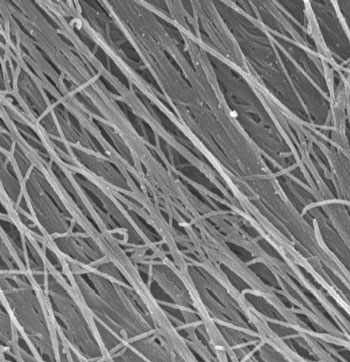 |
| Highly aligned nanofibers created by fibroblasts form a biological scaffold which could prove an ideal foundation for engineered tissues. Stem cells placed on the scaffold thrived, and it had the added advantage of provoking a very low immune response. |
| Feng Zhao of Michigan Technological University has persuaded fibroblasts, cells that makes the extracellular matrix, to make just such a well-organized scaffold ("Highly Aligned Nanofibrous Scaffold Derived from Decellularized Human Fibroblasts"). Its fibers are a mere 80 nanometers across, similar to fibers in a natural matrix. And, since her scaffold is made by cells, it is composed of the same intricate mix of all-natural proteins and sugars found in the body. Plus, its nanofibers are as highly aligned as freshly combed hair. |
| The trick was to orient the cells on a nano-grate that guided their growth—and the creation of the scaffold. |
| “The cells did the work,” Zhao said. “The material they made is quite uniform, and of course it is completely biological.” |
| Stem cells placed on her scaffold thrived, and it had the added advantage of provoking a very low immune response. |
| “We think this has great potential,” she said. “I think we could use this to engineer softer tissues, like skin, blood vessels and muscle.” |
| Source: By Marcia Goodrich, Michigan Technological University |