| May 12, 2014 |
Three-dimensional polymeric microtiles for fluidic self-assembly |
| (Nanowerk News) Self-assembly (SA) is a bio-inspired key coordination mechanism for swarms of intelligent agents as well as a pervasive bottom-up methodology for the fabrication of heterogeneous micro- and nanosystems. |
| Analytical studies of SA at small scales are therefore highly relevant for many technological applications. |
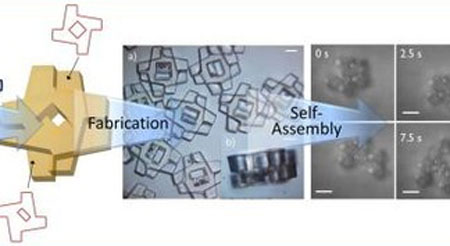 |
| In this paper ("Three-dimensional polymeric microtiles for optically-tracked fluidic self-assembly"), researchers present an innovative design and fabrication process for three-dimensional polymeric microtiles conceived as passive vehicles to investigate the dynamics of fluidic SA at sub-millimeter scale. |
| The microtiles are fabricated out of the superposition of two structural SU-8 layers featuring chiral copies of the same centro-symmetric pattern. They can coordinate laterally in water independently of their vertical orientation to form close-packed square lattice clusters. |
| The microtiles embed a central marker enabling the real-time optical tracking and automated closed-loop control of their fluidic SA. |
| The fabrication process makes use of a thick sacrificial copper layer and allows the wafer-level batch production of tens of thousands of microtiles, in line with the massively parallel nature of SA. |
| Source: Ecole Polytechnique Fédérale de Lausanne |