

Biotechnology News – Latest Headlines
 Subscribe to our Biotechnology News feed
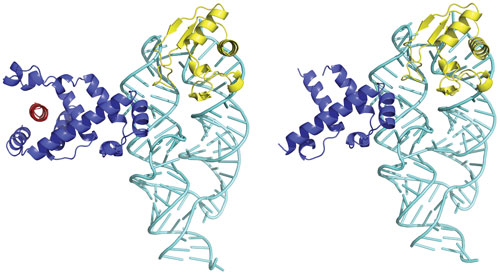
Structural data reveals new mechanism behind protein transport
In order for newly-produced secretory or membrane proteins to find their final destination, the proteins have signal-sequences connected to themselves as a form of address tag. Furthermore, they use a particle guiding them to the cell membrane. In a new study, researchers show how this particle recognizes these address tags and thus makes it possible for the proteins to be directed to the cell membrane.
June 16, 2015 Read more
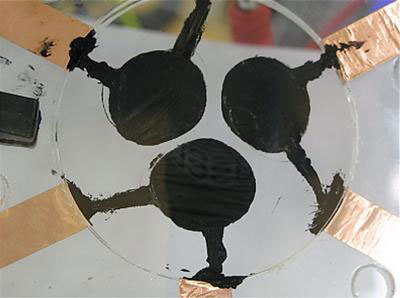
Squid inspires camouflaging smart materials
Researchers have shown it is possible to create artificial skin that can be transformed at the flick of a switch to mimic one of nature's masters of camouflage, the squid.
June 15, 2015 Read more
Scientists map surface of immune cells
The immune system must constantly adapt to its environment in order to protect a body effectively. The so-called T cells are an important example in this regard. Researchers recently examined the surface of precursors of these T cells and identified previously unknown proteins there. According to the scientists, the results could supply approaches to new therapies in the area of asthma and allergies.
June 12, 2015 Read more
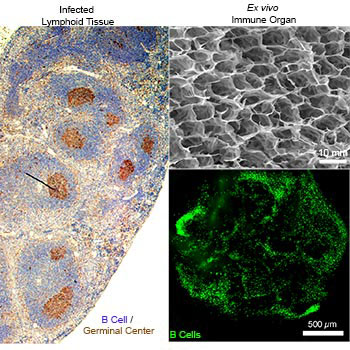
Engineers' synthetic immune organ produces antibodies
Engineers have created a functional, synthetic immune organ that produces antibodies and can be controlled in the lab, completely separate from a living organism. The engineered organ has implications for everything from rapid production of immune therapies to new frontiers in cancer or infectious disease research.
June 10, 2015 Read more
Mimicking the body on a chip for new drug testing
Scientists have developed a microfluidic chip that simultaneously analyses the reactions of several human organ tissues when they come into contact with candidates for new drugs. The ground-breaking device could save millions of euros in drug development costs.
June 10, 2015 Read more
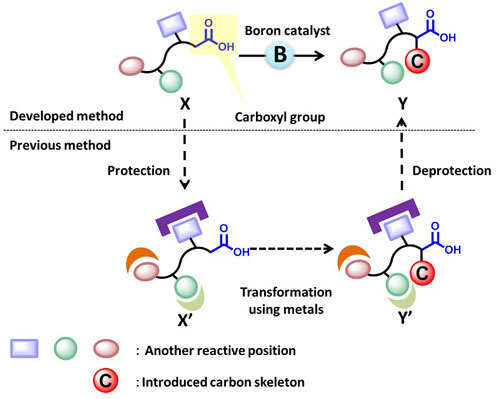
New carboxylic acid selective carbon-carbon bond forming reactions
Researchers successfully developed a novel method enabling selective transformation of carboxyl groups, a common structure in many drugs and natural products.Synthesis of amino acids and drug candidates from acetic acid.
June 8, 2015 Read more
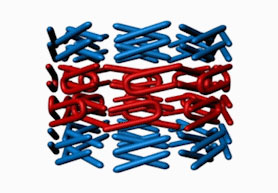
Research reveals key interaction that opens the channel into the cell's nucleus
Scientists have uncovered crucial steps in the dynamic dance that dilates and constricts the nuclear pore complex - the latest advance in their ongoing efforts to tease apart the mechanism by which its central channel admits specific molecules. Their work, based on quantitative biophysical data, has revealed that the nuclear pore complex is much more than the inert structure it was once thought to be.
June 8, 2015 Read more
World's first digitally-encoded synthetic polymers
Researchers have for the first time succeeded in recording a binary code on a synthetic polymer. Inspired by the capacity of DNA to retain an enormous amount of genetic information, scientist synthesized and read a multi-bit message on an artificial polymer.
June 4, 2015 Read more
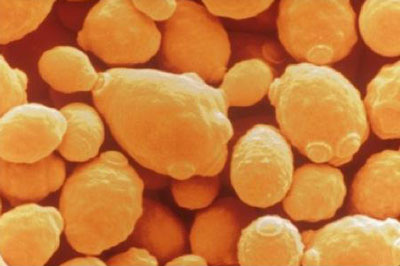
Researchers develop revolutionary microbe for biofuel production
Biofuel pioneers have developed a revolutionary strain of yeast that could help significantly accelerate the development of biofuels from nonfood plant matter.
June 3, 2015 Read more
In search of memory storage
The hippocampus plays a crucial role in memory formation. However, it is not yet fully understood in what way that brain structure's individual regions are involved in the formation of memories. Neuroscientists now have recreated this process with the aid of computer simulations.
June 3, 2015 Read more
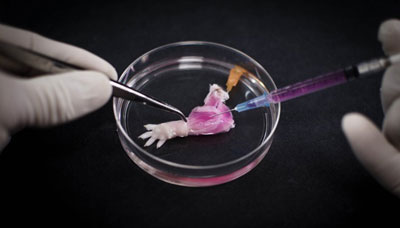
Team develops transplantable bioengineered forelimb in an animal model (w/video)
Experimental technique used to create whole organs appears feasible for creation of complex tissues.
June 3, 2015 Read more
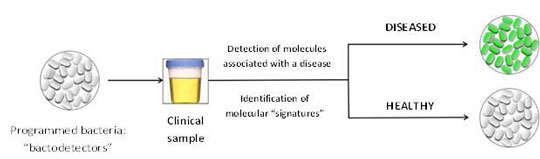
Intelligent bacteria for detecting disease
Another step forward has just been taken in the area of synthetic biology. Researchers have transformed bacteria into 'secret agents' that can give warning of a disease based solely on the presence of characteristic molecules in the urine or blood. To perform this feat, the researchers inserted the equivalent of a computer programme into the DNA of the bacterial cells.
June 2, 2015 Read more
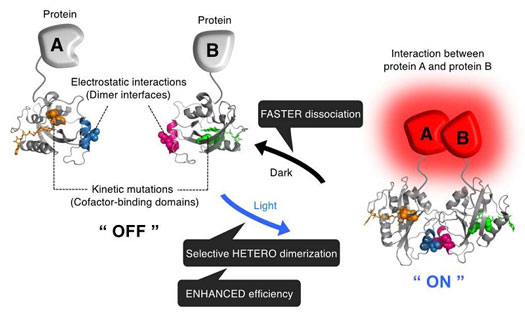
Powerful tool to control living cells at will by light
Researchers have developed small photoswitching proteins that enable the highly accurate control of the activity of various intracellular molecules at will by irradiation with light.
June 2, 2015 Read more
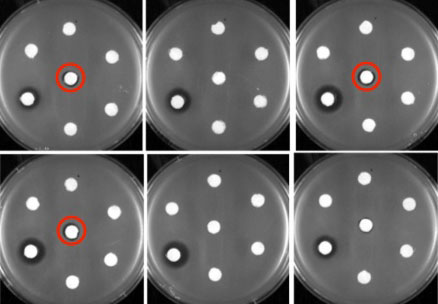
Engineers turn E. coli into tiny factories for producing new forms of popular antibiotic
Like a dairy farmer tending to a herd of cows to produce milk, researchers are tending to colonies of the bacteria Escherichia coli to produce new forms of antibiotics - including three that show promise in fighting drug-resistant bacteria.
May 29, 2015 Read more
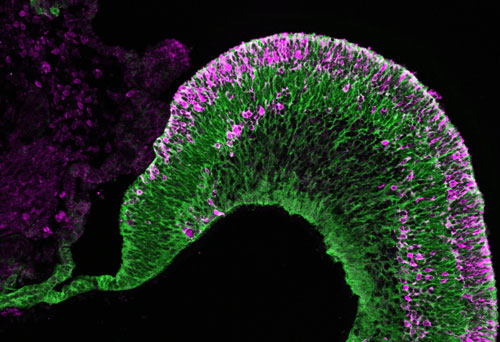
Growing eyes from stem cells
Embryonic stem cells give rise to three-dimensional, multilayered retinal tissue in a dish.
May 29, 2015 Read more
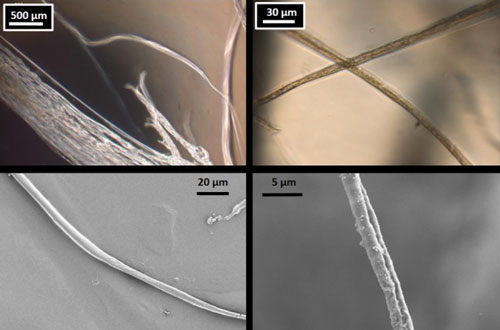
Spinning a new version of silk
Simulations and experiments aim to improve on spiders in creating strong, resilient fibers.
May 28, 2015 Read more
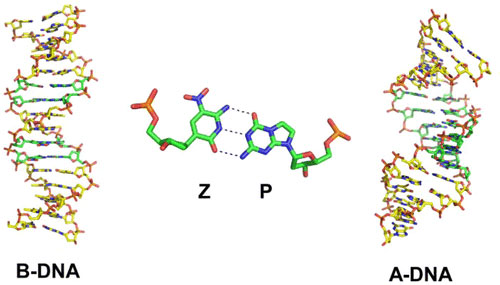
Expanding the code of life with new 'letters'
The DNA encoding all life on Earth is made of four building blocks called nucleotides, commonly known as 'letters', that line up in pairs and twist into a double helix. Now, two groups of scientists are reporting for the first time that two new nucleotides can do the same thing - raising the possibility that entirely new proteins could be created for medical uses.
May 27, 2015 Read more
Researchers find 'decoder ring' powers in micro RNA
MicroRNA can serve as a 'decoder ring' for understanding complex biological processes, a team of New York University chemists has found. Their study points to a new method for decrypting the biological functions of enzymes and identifying those that drive diseases.
May 26, 2015 Read more