

Nanotechnology News – Latest Headlines
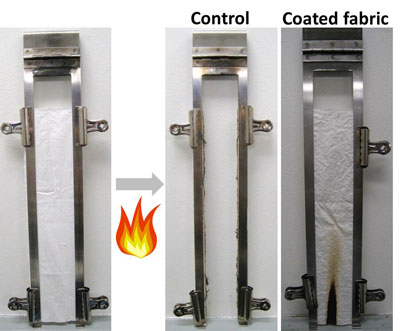
A nano, environmentally friendly, and low toxicity flame retardant protects fabric
The technology in 'fire paint' used to protect steel beams in buildings and other structures has found a new life as a first-of-its-kind flame retardant for children's cotton sleepwear, terrycloth bathrobes and other apparel.
August 31, 2011 Read more
Tiny oxygen generators boost effectiveness of anticancer treatment
Researchers have created and tested miniature devices that are implanted in tumors to generate oxygen, boosting the killing power of radiation and chemotherapy.
August 31, 2011 Read more
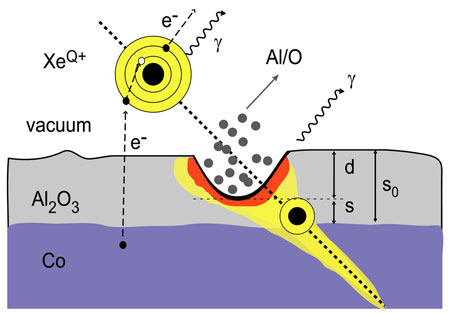
Ion armageddon: Measuring the impact energy of highly charged ions
Much like a meteor impacting a planet, highly charged ions hit really hard and can do a lot of damage, albeit on a much smaller scale. And much like geologists determine the size and speed of the meteor by looking at the hole it left, physicists can learn a lot about a highly charged ion's energy by looking at the divots it makes in thin films.
August 31, 2011 Read more
Inexpensive technique for making high quality nanowire solar cells
Solar or photovoltaic cells represent one of the best possible technologies for providing an absolutely clean and virtually inexhaustible source of energy to power our civilization. However, for this dream to be realized, solar cells need to be made from inexpensive elements using low-cost, less energy-intensive processing chemistry, and they need to efficiently and cost-competitively convert sunlight into electricity. A team of researchers with the Lawrence Berkeley National Laboratory has now demonstrated two out of three of these requirements with a promising start on the third.
August 31, 2011 Read more
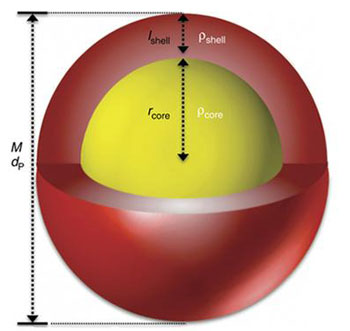
Innovative method allows nanoparticle measurements in a single procedure
Precise measurement of the molecular weight, size and density of a nanoparticle in a single procedure is now possible, thanks to an ultracentrifugation method, dusted off by scientists at EPFL.
August 31, 2011 Read more
New chemical reagent turns biological tissue transparent
Researchers at RIKEN have developed a ground-breaking new aqueous reagent which literally turns biological tissue transparent. Experiments using fluorescence microscopy on samples treated with the reagent have produced vivid 3D images of neurons and blood vessels deep inside the mouse brain.
August 31, 2011 Read more
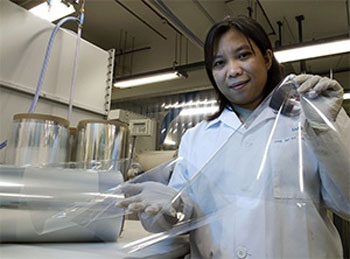
An impermeable wrap for future electronics
A nanoparticle-infused film brings innovative lighting and display technologies closer to reality.
August 31, 2011 Read more
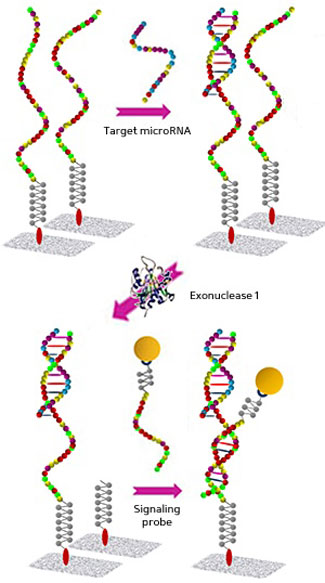
New, highly sensitive microarray can detect 300 copies of microRNA in a one-microliter sample
The rapid detection of microRNAs using small-volume samples could therefore help save millions of lives. Such a technique could also pave the way for widespread analysis of the spatial and temporal patterns of gene activity involving microRNAs, which are believed to play a critical role in the development and operation of organisms.
August 31, 2011 Read more
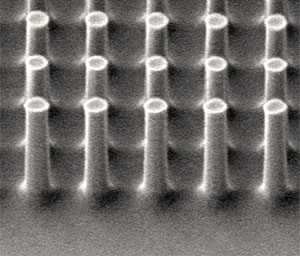
Better solar cells around the corner
Design optimization could help maximize the power conversion efficiency of thin-film silicon solar cells.
August 31, 2011 Read more
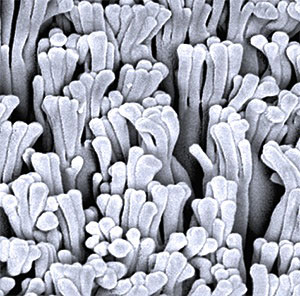
Sticky nanomaterials - copying geckos' toes
Simple templating technology allows researchers to stamp out materials that mimic the adhesive properties of gecko toes
August 31, 2011 Read more
Ultrasensitive particles offer new way to find cancer
Tiny particles that measure microRNA levels in tissue samples could help diagnose and monitor many diseases.
August 31, 2011 Read more
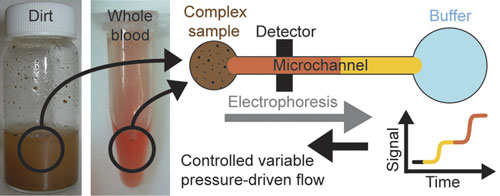
Researchers expand capabilities of miniature analyzer for complex samples
Researchers at NIST significantly extended the reach of their novel microfluidic system for analyzing the chemical components of complex samples. The new work shows how the system, meant to analyze real-world, crude mixtures such as dirt or whole blood, can work for negatively charged components as well as it has in the past for positively charged ones.
August 31, 2011 Read more
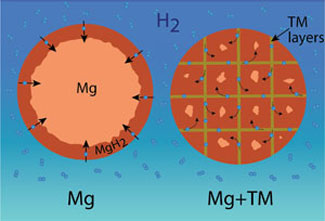
Iron 'veins' are secret of promising new hydrogen storage material
With a nod to biology, scientists at the National Institute of Standards and Technology (NIST) have a new approach to the problem of safely storing hydrogen in future fuel-cell-powered cars. Their idea: molecular scale 'veins' of iron permeating grains of magnesium like a network of capillaries.
August 31, 2011 Read more
GLOBALFOUNDRIES announces winners of inaugural "Leading in Innovation" awards
At today's second annual Global Technology Conference (GTC 2011), GLOBALFOUNDRIES announced the winners of its new "Leading in Innovation" awards. Presented to customers who have demonstrated innovative solutions on products ranging from 0.35um non-volatile memories to leading-edge 28nm smartphone processors, the awards showcase the company's collaborative approach to enabling chip designers to deliver a superior end-user experience.
August 30, 2011 Read more
DURIP grant funds the study of nanoscale wetting dynamics of superhydrophobic surfaces
To support Office of Naval Research (ONR) development of hydrodynamically efficient and environmentally non-toxic anti-corrosion materials, Dr. Chang-Hwan Choi, Assistant Professor of Mechanical Engineering at Stevens Institute of Technology, researches nanotechnology with multifunctional superhydrophobic properties that repel water and prevent corrosion in robust and durable ways. Dr. Choi's work has recently been awarded a Defense University Research Instrumentation Program (DURIP) grant that backs this work.
August 30, 2011 Read more
Novel alloy could produce hydrogen fuel from sunlight
Using advanced theoretical computations, a team of Kentucky scientists has derived a means to "tweak" an inexpensive semiconductor to function as photoelectrochemical catalyst.
August 30, 2011 Read more
 Subscribe to our Nanotechnology News feed