

Nanotechnology News – Latest Headlines
ERC Advanced Grant for nanolaboratory at TU Delft
Professor Henny Zandbergen has been awarded an ERC Advanced Grant of 2.5 million euros for his research into improved microscopic technologies. The technologies enable Professor Zandbergen to visualise extremely small structures, such as semiconductor nanowires, all the way down to atomic level.
November 5, 2010 Read more
Sizing up nanotechnology: The economic impact of nanoelectronics
On December 3, 2010, the Federal Reserve Bank of Dallas, in cooperation with the Semiconductor Industry Association, is hosting a 1-day event 'Sizing Up Nanotechnology: The Economic Impact of Nanoelectronics'.
November 5, 2010 Read more
Breakthrough in precision gene surgery through photonic manipulation of light-activated nano-scissors
A cross-disciplinary Small Medicine and Advanced Research Translation (SMART) team led by Prof. Dar-Bin Shieh of Institute of Oral Medicine in Medical College at National Cheng Kung University (NCKU), Tainan, Taiwan, has announced a breakthrough in the precision in-cell gene scission at pre-designed sequence sites using Artificial Targeting Light Activated Nano Scissors (ATLANS) and a custom build photonic device.
November 5, 2010 Read more
Carnegie Mellon's Bone Tissue Engineering Center receives Defense Department research grant
CMU's Jeffrey O. Hollinger, director of the center, and Professor Krzysztof Matyjaszewski have received a three-year, $2.9 million U.S. Department of Defense research grant to develop a therapy that would aid amputees, specifically wounded soldiers.
November 4, 2010 Read more
Charles Babbage grant establishes nanoelectronics and computing research laboratory
San Francisco State University (SF State) is the latest university to receive the Charles Babbage Grant from Synopsys. Through the grant, the School of Engineering received licenses of Synopsys' comprehensive electronic design automation (EDA) software and intellectual property, along with curriculum support and professor training. The grant also enabled the creation of a new Nanoelectronics and Computing Research Laboratory (NeCRL) by providing a new server and compute hardware for students.
November 4, 2010 Read more
Texas Center for Cancer Nanomedicine targets two tough cancers
A $16-million, five-year grant by the National Cancer Institute's nanomedicine initiative blends the expertise of five research institutions to focus an array of innovative nanotechnologies on improving the outcome of patients with ovarian or pancreatic cancers.
November 4, 2010 Read more
Colonic navigation with nanoparticles
Nanoparticles could help smuggle drugs into the gut, according to a study published this month.
November 4, 2010 Read more
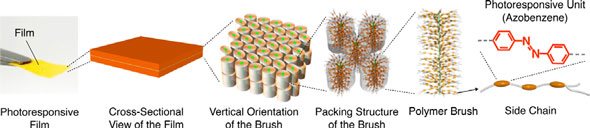
New photosensitive film converts light into kinetic energy, bends when irradiated
Researchers at RIKEN have successfully developed a revolutionary new polymer film that changes shape upon irradiation with UV and visible light. The film is the largest-ever example of a material whose molecular elements are ordered in three dimensions on a macroscopic length scale, marking a breakthrough in techniques for molecular design and processing.
November 4, 2010 Read more
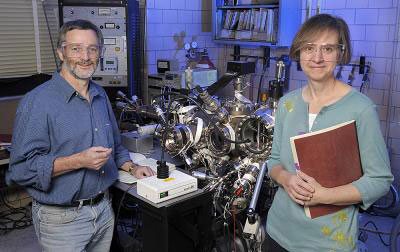
Scientists advance the understanding of the big getting bigger
A better understanding of the coarsening process can help researchers develop small structures - including nanoscale technologies, catalysts or drug suspensions - that resist coarsening and are therefore more durable.
November 4, 2010 Read more
The more we talk, the less we might agree: Study shows discussion can hurt consensus-building on science/technology
When it comes to public issues pertaining to science and technology, 'talking it out' doesn't seem to work. A new study from North Carolina State University shows that the more people discuss the risks and benefits associated with scientific endeavors, the more entrenched they become in their viewpoint - and the less likely they are to see the merit of other viewpoints.
November 4, 2010 Read more
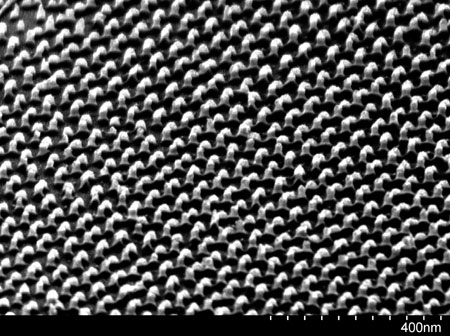
Plastic heated in microwave could re-invent the manufacture of computer chips
Plastic, heated in a simple microwave oven, is the technique researchers at the University of Alberta and the National Institute for Nanotechnology believe could help to re-invent the manufacture of computer chips.
November 4, 2010 Read more
Aston University is strengthening its world leading photonics research with nanotechnology
Aston University is strengthening its world leading photonics research with two new international partnerships set to advance laser telecommunications and nanotechnologies.
November 4, 2010 Read more

Easy fabrication of non-reflecting and self-cleaning silicon and plastic surfaces
The Microfabrication group of Aalto University which specializes in microfabrication and microfludics has developed a new and rapid method for fabrication of non-reflecting and self-cleaning surfaces. Surface properties are based on the nanostructured surface.
November 4, 2010 Read more
Versatile algorithms for nanoscale designs
The ambitious objective of the EU-funded ICESTARS research project has been to overcome the barriers in both existing and future radio frequency design flows by developing and deploying integrated simulation algorithms and prototype tools.
November 4, 2010 Read more
Australia and China agree joint nanotechnology laboratory
The Australia-China Joint Laboratory on Nanoscience will be established under the current memorandum of understanding between the Australian Technology Network of Universities (ATN) and the International Strategic Technology Alliance of Chinese universities.
November 4, 2010 Read more
Expanding the toolbox for superconducting film investigations
Using a combination of unique tools to build and analyze films just nanometers thick, a group of researchers found subtle structural changes that are known to alter superconducting properties. Their findings stress the importance of studying both the superficial and deep features of superconducting materials, which transport electricity with zero resistance and are envisioned for use in applications like ultrafast, power-saving electronics or more efficient electricity lines.
November 4, 2010 Read more
 Subscribe to our Nanotechnology News feed