

Nanotechnology News – Latest Headlines
Nanoparticles for therapy and regeneration of osteoarthritis
Researchers aim at inducing the self healing capacity of damaged cartilage and bone by coordinated cooperation/interaction of gene vectors, mesenchymal stem cells, polymers and magnetic nanoparticles.
September 29, 2010 Read more
Carbon nanoobjects will facilitate the construction of futuristic power sources
The Layer-by-Layer method (LbL) is applied in particular to create three-dimensional structures made of polymers only or alternating layers of polymers and nanoparticles on the surface of electrodes.
September 29, 2010 Read more
Development of high performance electron source for world's highest resolution in electron microscope
Researchers in Japan have succeeded in establishing a surface cleaning and crystal control technologyfor lanthanum hexaboride (LaB6), nanowires and are able to set a goal of practical applications of LaB6 nanowires, which is expected to significantly improve the performance of electron microscopes.
September 29, 2010 Read more
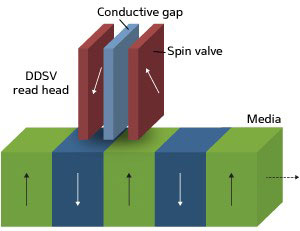
Applied physics: A head-to-head comparison
Hard disk drives could cram ten terabits of data per square inch of area using a new read head design.
September 29, 2010 Read more

Crystal engineering: Composition of functions
Compositional tuning proves to be an effective approach for the fabrication of semiconductor nanocrystals with novel optical functions.
September 29, 2010 Read more
New technique allows 3-D visualization of quantum property
Scientists at the U.S. Department of Energy's (DOE) Argonne National Laboratory have developed a new technique that maps the magnetic vector potential - one of the most important electromagnetic quantities and a foundation of quantum mechanics - in three dimensions.
September 29, 2010 Read more
NIST to award up to $15 million to University of Maryland to support nanotechnology research
The National Institute of Standards and Technology (NIST) Center for Nanoscale Science and Technology (CNST) will award a five-year cooperative agreement totaling $15 million to the University of Maryland (UMD), College Park, Md., to develop and implement a Postdoctoral Researcher and Visiting Fellow Measurement Science and Engineering Program.
September 29, 2010 Read more
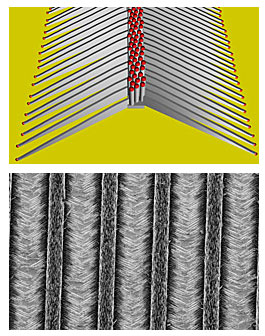
Growing nanowires horizontally yields new benefit: Nano-LEDs
While refining their novel method for making nanoscale wires, chemists at the National Institute of Standards and Technology (NIST) discovered an unexpected bonus - a new way to create nanowires that produce light similar to that from light-emitting diodes (LEDs).
September 29, 2010 Read more
Nanotechnology brings personalized therapy one step closer to reality
A novel technology can make nanoscale protein measurements, which scientists can use in clinical trials to learn how drugs work.
September 29, 2010 Read more
Tiny generators turn waste heat into power
Using tiny structures called ferroelectric nanowires, a team of researchers can rapidly generate an electrical current in response to any change in the ambient temperature, harvesting otherwise wasted energy from thermal fluctuations.
September 28, 2010 Read more
Finding a buckyball in photovoltaic cells
New research describes a technique that analyzes the reflection of neutrons to locate the buckyballs within the composite material in plastic solar cell film.
September 28, 2010 Read more
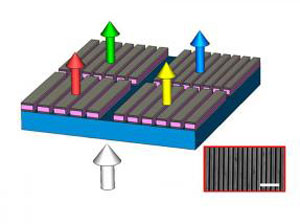
Nanostructuring technology creates energy efficient and ultra-small displays
University of Michigan scientists using AFOSR-funding have created the smallest pixels available that will enable LED, projected and wearable displays to be more energy efficient with more light manipulation possible and all on a display that may eventually be as small as a postage stamp.
September 28, 2010 Read more

Sneaking spies into a cell's nucleus
Duke University bioengineers have not only figured out a way to sneak molecular spies through the walls of individual cells, they can now slip them into the command center - or nucleus - of those cells, where they can report back important information or drop off payloads.
September 28, 2010 Read more
NanoCode project published synthesis report on responsible development of nanotechnology
The NanoCode Project has recently published a Synthesis Report that provides a broad overview of current codes of conduct, voluntary measures and practices aimed toward promoting responsible development of nanoscience and nanotechnologies, and which compares these with the provisions of the Code of Conduct for nanotechnology research as proposed by the European Commission. The report includes information drawn from individual country reports prepared by each of the NanoCode partners that covered the situation in their own country.
September 28, 2010 Read more
Europa forscht an Halbleiterscheiben mit 450 mm Durchmesser
27 europaeische Unternehmen und institutionelle Forschungseinrichtungen aus den Branchen Halbleiterindustrie, Geraete- und Materialhersteller haben sich zum Verbundprojekt EEMI450 (European Equipment and Materials Initiative for 450 mm) zusammengeschlossen, mit dem Ziel, 450 mm-Technologie und Know-how fuer den Standort Europa zu sichern.
September 28, 2010 Read more
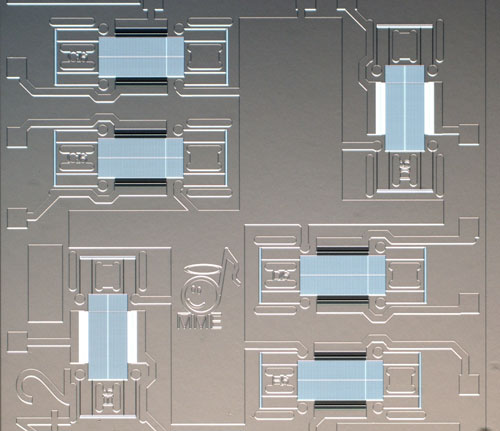
Making music on a microscopic scale
Strings a fraction of the thickness of a human hair, with microscopic weights to pluck them: researchers and students from the MESA+ Institute for Nanotechnology of the University of Twente in The Netherlands have succeeded in constructing the first musical instrument with dimensions measured in mere micrometres - a 'micronium' - that produces audible tones.
September 28, 2010 Read more
 Subscribe to our Nanotechnology News feed