

Nanotechnology News – Latest Headlines
Solar cells thinner than wavelengths of light hold huge power potential
Ultra-thin solar cells can absorb sunlight more efficiently than the thicker, more expensive-to-make silicon cells used today, because light behaves differently at scales around a nanometer (a billionth of a meter), say Stanford engineers. They calculate that by properly configuring the thicknesses of several thin layers of films, an organic polymer thin film could absorb as much as 10 times more energy from sunlight than was thought possible.
September 27, 2010 Read more
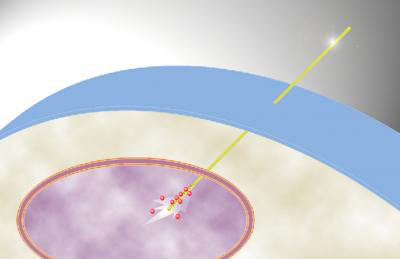
Nanoneedle delivers quantum dots to cell nucleus
Getting an inside look at the center of a cell can be as easy as a needle prick, thanks to University of Illinois researchers who have developed a tiny needle to deliver a shot right to a cell's nucleus.
September 27, 2010 Read more
NCI awards $13.6 million to UNC's Carolina Center of Cancer Nanotechnology Excellence
Grant will support the continued work of the center launched in 2005 as part of NC's Alliance for Nanotechnology in Cancer.
September 27, 2010 Read more
Europe's central meeting of experts for nanomedicine
The 5th General Assembly and Annual Forum of the European Technology Platform on Nanomedicine will take place at Centro Congressi Fondazione Cariplo in Milan, Italy on 14 and 15 October 2010.
September 27, 2010 Read more
Single electron reader opens path for quantum computing
A team led by engineers and physicists at the University of New South Wales (UNSW) in Sydney, Australia, have developed one of the key building blocks needed to make a quantum computer using silicon: a 'single electron reader'.
September 27, 2010 Read more
Rethinking renewables: A new approach to energy storage for wind and solar
Rensselaer Polytechnic Institute researchers win $2 million NSF grant to develop capacitive energy storage system for renewable power source.
September 27, 2010 Read more
Nanobiotechnology experts join forces to improve Tubercolosis testing
Two UK companies have been awarded joint funding for a research project that could see significant advances in the quest to aid detection and eradication of Tuberculosis (TB), across the world.
September 27, 2010 Read more
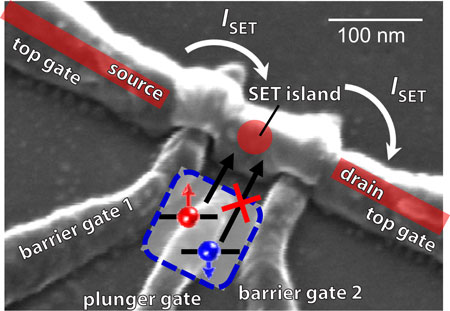
Detector for the single-electron magnet discovered - pathway to the silicon-based quantum computer
Researchers from University of New South Wales (Australia), University of Melbourne (Australia), and Aalto University (Finland) have succeeded in demonstrating a high-fidelity detection scheme for the magnetic state of a single electron, that is, the spin.
September 27, 2010 Read more
Centre for Food Safety conducts risk study on nanotechnology in food
The study aimed to review the basic principles, application and the potential health implications associated with the use of nanotechnology in the food sector, particularly on food and food contact materials incorporated with nanomaterials.
September 27, 2010 Read more
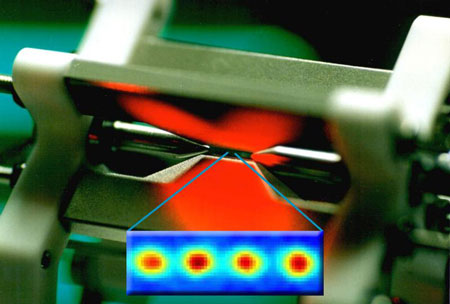
Quantum physics: Flavors of entanglement
The entanglement of quantum objects can take surprising forms. Quantum physicists at the University of Innsbruck have investigated several flavors of entanglement in four trapped ions.
September 27, 2010 Read more
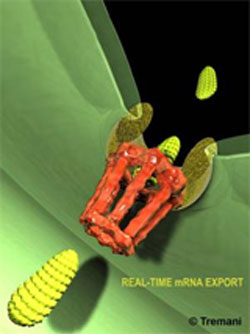
Study shows how molecules escape from the nucleus of living cells
By constructing a microscope apparatus that achieves resolution never before possible in living cells, researchers at Albert Einstein College of Medicine of Yeshiva University have illuminated the molecular interactions that occur during one of the most important 'trips' in all of biology: the journey of individual messenger Ribonucleic acid (RNA) molecules from the nucleus into the cytoplasm (the area between the nucleus and cell membrane) so that proteins can be made.
September 27, 2010 Read more
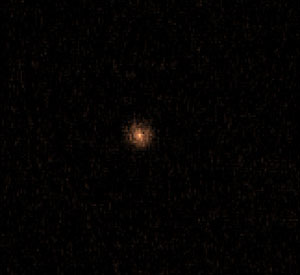
Physicists repeatedly capture and photograph fast-moving atom
In a major physics breakthrough with international significance, University of Otago scientists have developed a technique to consistently isolate and capture a fast-moving neutral atom - and have also seen and photographed this atom for the first time.
September 27, 2010 Read more
Nanotechnology conference: Fundamentals and applications
The International Academy of Science, Engineering and Technology (International ASET) and the University of Ottawa are pleased to organize the 2nd International Conference on Nanotechnology: Fundamentals and Applications. The conference will take place in Ottawa, Canada, 27-29 July 2011.
September 27, 2010 Read more
Quantum information systems: Researchers convert signals to telecom wavelengths, increase memory times
Using optically dense, ultra-cold clouds of rubidium atoms, researchers have made advances in three key elements needed for quantum information systems - including a technique for converting photons carrying quantum data to wavelengths that can be transmitted long distances on optical fiber telecom networks.
September 26, 2010 Read more
National Cancer Institute launches next phase of Alliance for Nanotechnology in Cancer program
The National Cancer Institute (NCI) has awarded five-year, multi-institution grants in continued support of its Alliance for Nanotechnology in Cancer program. The Alliance is engaged in efforts to leverage the specific advantages of nanotechnology to improve the way we diagnose, treat, and prevent cancer. Given the progress to date, the NCI approved a second phase of the program with an investment of approximately $30 million per year for the next five years.
September 24, 2010 Read more
IBM breakthrough captures high speed measurements of individual atoms
Today, IBM researchers published a breakthrough technique that measures how long a single atom can hold information, and giving scientists the ability to record, study and 'visualize' extremely fast phenomena inside these atoms.
September 24, 2010 Read more
 Subscribe to our Nanotechnology News feed