

Nanotechnology News – Latest Headlines
Hydrogen-powered, solar-inspired nanotechnology battery
Eduard Karpov, University of Illinois at Chicago assistant professor of civil and materials engineering, just received a three-year, $217,000 grant from the National Science Foundation to develop a new battery he is calling a catalothermionic generator.
September 23, 2010 Read more
Nanotechnology for a just world peace
During the Week of Peace, six opinion leaders make statements on nanotechnology, peace and development cooperation in the framework of the Dutch public dialogue on nanotechnology. Their filmportraits of five minutes each have just been published in Dutch and English.
September 23, 2010 Read more
Sicherheit und Nanomaterialien - Kickoff-Meeting
Wie sicher sind Nanomaterialien? Das soll jetzt das neue wissenschaftliche Projekt NanoGEM 'Nanostrukturierte Materialien-Gesundheit, Exposition und Materialeigenschaften' klaeren helfen.
September 23, 2010 Read more

Electricity collected from the air could become the newest alternative energy source
Imagine devices that capture electricity from the air - much like solar cells capture sunlight - and using them to light a house or recharge an electric car. Imagine using similar panels on the rooftops of buildings to prevent lightning before it forms. Strange as it may sound, scientists already are in the early stages of developing such devices.
September 22, 2010 Read more
AFM studies reveal path to protein crystallization in cell-like environments
Scientists at the Molecular Foundry, a nanoscience user facility at Berkeley Lab, have used atomic force microscopy to image in real time how S-layer proteins form crystals in a cell-like environment. This direct observation of protein assembly could provide researchers with insight into how microorganisms stave off antibiotics or lock carbon dioxide into minerals.
September 22, 2010 Read more
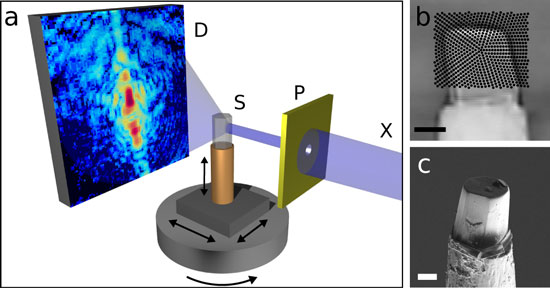
New computer-tomography method visualizes nanostructure of bones
A novel nano-tomography method developed by a team of researchers from the Technische Universitaet Muenchen, the Paul Scherrer Institute and the ETH-Zurich opens the door to computed tomography examinations of minute structures at nanometer resolutions.
September 22, 2010 Read more
Nanomanufacturing center to cooperate with federal health agency on nanotechnology safety
According to the agreement, CHN at Northeastern University with its core partner institutions will collaborate with the National Institute for Occupational Safety and Health (NIOSH) to advance workplace health and safety standards and practices, and act as a global resource for research, education and information dissemination in nanotechnology safety and health.
September 22, 2010 Read more
Harnessing the potential of the oddly-shaped molecule
A team of physicists and chemists have demonstrated for the first time the way in which an irregularly shaped molecule is adsorbed on a surface.
September 22, 2010 Read more
Research gives insight into using graphene in electronics
New findings from the laboratory of University of Illinois researcher Joe Lyding are providing valuable insight into graphene, a single two-dimensional layer of graphite with numerous electronic and mechanical properties that make it attractive for use in electronics.
September 22, 2010 Read more
Gemeinsame deutsch-japanische Exzellenz-Forschung auf dem Gebiet Halbleitertechnologie und Halbleitermaterialien
Das Leibniz-Institut fuer Innovative Mikroelektronik und das Research Institute of Electrical Communication an der Tohoku University in Japan verlaengern ihre Zusammenarbeit um weiter fuenf Jahre.
September 22, 2010 Read more
Nanotechnology research cooperation between NSF's E3S Center and German Leibnitz Institute
Special focus is devoted to novel basic materials science approaches to build up low power Silicon microelectronics, for example by merging photonics and electronics on the mature Si technology platform.
September 22, 2010 Read more
Engineers find a way to convert carbon-dioxide emissions to useful building materials
MIT engineers want to capture carbon dioxide and not put it underground, but turn it into something that will be stable for hundreds of thousands of years.
September 22, 2010 Read more
Rice University's award-winning NanoJapan program wins $4M grant
Undergraduate program combines study-abroad, research experiences.
September 21, 2010 Read more
Fiber optic interface to link robotic limbs, human brain
Lightning-fast connections between robotic limbs and the human brain may be within reach for injured soldiers and other amputees with the establishment of a multimillion-dollar research center led by Southern Methodist University (SMU) engineers.
September 21, 2010 Read more
Research project launched on the digital printing of single biological cells
The central theme of the project is the printing of such cells confined in micro-droplets of only one tenth of a millimetre in diameter. The mid-term objective of the seven research institutions and companies working together is to establish a platform for the manipulation, culture, and analysis of individual living biological cells without loss of viability.
September 21, 2010 Read more
EU-Forschungsprojekt zum digitalen Drucken einzelner biologischer Zellen gestartet
Das Institut fuer Mikrosystemtechnik (IMTEK) der Uni Freiburg ist Technologiepartner und Projektkoordinator des am 1. September 2010 gestarteten EU-Forschungsprojektes PASCA. Hinter der Abkuerzung verbirgt sich die Entwicklung einer innovativen Plattform fuer die Manipulation und Analyse einzelner lebender Zellen (Platform for Advanced Single Cell-Manipulation and Analysis).
September 21, 2010 Read more
 Subscribe to our Nanotechnology News feed